Archive for the 'monetary history' Category


What Are They Thinking?

The common European currency seems well on its way toward annihilation, and the demise is more likely to happen with a bang than a whimper. One might have thought that the looming catastrophe would elicit a sense of urgency in the statements and actions of European officials. “Depend upon it, sir,” Samuel Johnson once told Boswell, “when a man knows he is to be hanged in a fortnight, it concentrates his mind wonderfully.” So far, however, there is little evidence that minds are being concentrated, least of all the minds of those who really count, Chancellor Merkel and the European Central Bank (ECB).

As I pointed out in a previous post in August, the main cause of the debt crisis is that incomes are not growing fast enough to generate enough free cash flow to pay off the fixed nominal obligations incurred by the insolvent, nearly insolvent, or potentially insolvent Eurozone countries. Even worse, stagnating incomes impose added borrowing requirements on governments to cover expanding fiscal deficits. When a private borrower, having borrowed in expectation of increased future income, becomes insolvent, regaining solvency just by reducing expenditures is rarely possible. So if the borrower’s income doesn’t increase, the options are usually default and bankruptcy or a negotiated write down of the borrower’s indebtedness to creditors. A community or a country is even less likely than an individual to regain solvency through austerity, because the reduced spending of one person diminishes the incomes earned by others (the paradox of thrift), meaning that austerity may impair the income-earning, and, hence, the debt-repaying, capacity of the community as a whole.

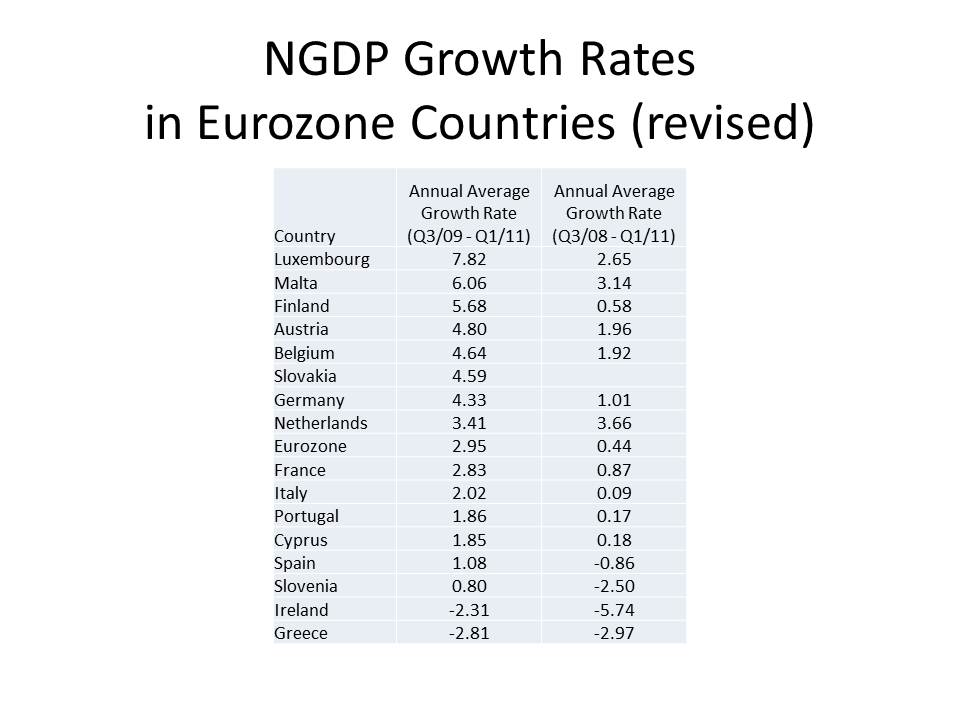
I reproduce below a new version of the table that I included in my August post. It shows that from the third quarter of 2009 to the first quarter of 2011, NGDP for the Eurozone as a whole increased at the anemic rate of 2.95%. Eight countries (Luxembourg, Malta, Austria, Finland, Belgium, Slovakia, Germany, and the Netherlands) grew faster than the Eurozone as a whole, and eight countries (France, Italy, Portugal, Cyprus, Spain, Slovenia, Greece, and Ireland) grew less rapidly than the Eurozone as a whole. Guess which of the two groups the countries with debt problems are in. I have now added NGDP growth rates for the first, second and (where available) third quarters.
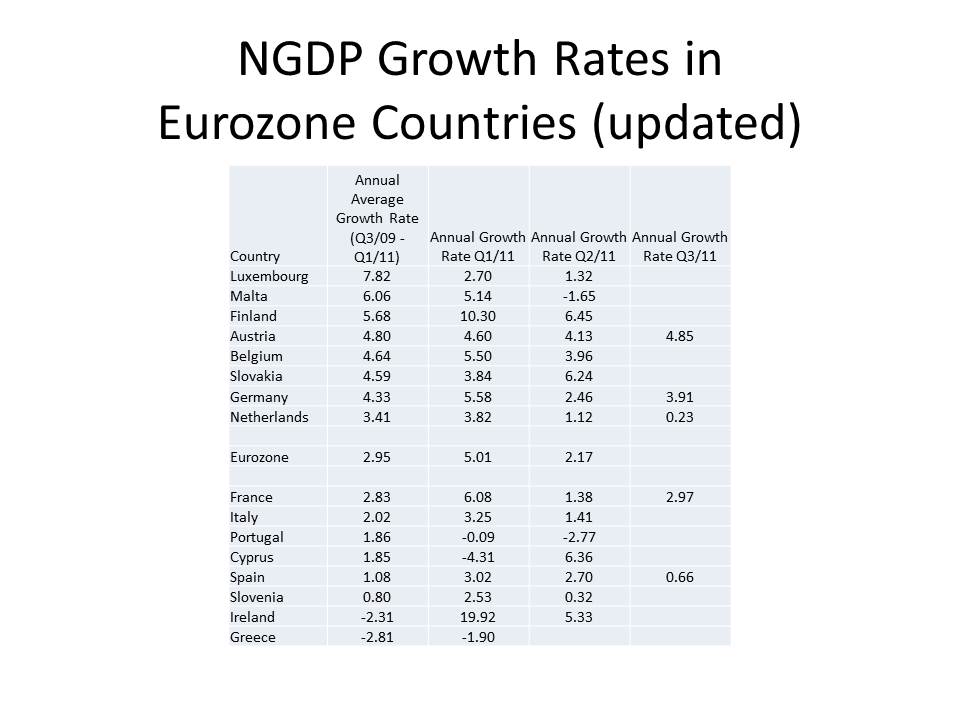
Comparing NGDP growth rates in Q1 with growth rates in Q2 and Q3 is instructive inasmuch as the ECB raised its benchmark interest rates by 25 basis points at the start of Q2 (April 13). In Q1, Eurozone NGDP rose by 5.01%, but in Q2, Eurozone NGDP growth fell to just 2.17%, with Q2 NDGP growth less than Q1 growth in every Eurozone country except Slovakia and Cyprus (Greece not yet reporting NGDP for Q2). On July 13, the ECB raised its benchmark interest rates by another 25 basis points. For the five countries (Austria, France, Germany, Netherlands, and Spain) already reporting NGDP growth for Q3, four had slower NGDP growth in Q3 than in Q1, with three reporting slower NGDP growth in Q3 than the average between Q3 2009 and Q1 2011. Rebecca Wilder has an important recent post with graph showing that the spreads between bonds issued by Belgium, Italy and Spain and bonds issued by Germany began increasing almost immediately after the ECB announced the increase in its benchmark interest rates on April 13, with the spreads continuing to increase in Q3. The connection between monetary policy, NGDP growth and the debt crisis could not be any more plain.

Nevertheless, there are those (and not just the Wall Street Journal) that seem to find merit in the unyielding stance of the Mrs. Merkel and the ECB. In his column last week in the Financial Times, John Kay, usually an insightful and sensible commentator, compares bailing out the insolvent Eurozone countries with a martingale strategy in which a bettor increases his bet each time he loses, in the expectation that he will eventually win enough to pay off his losses. Such a strategy only works if one has deep enough pockets to sustain the losses while waiting for a lucky strike. The problem in John Kay’s view is that the other side (the rest of the world) has deeper and can raise the ante to an intolerable level. Here is how Kay sums up the current situation:

Now the players look to the only remaining credible supporter. Surely the European Central Bank can enable them to see the night through. The ECB really does have infinite resources: if it runs out of money, it can print more.

Up to a point. Money created by a central bank is not free – if it were, we could all be as rich as Croesus. The resources of a monetary agency come either directly from taxpayers or indirectly from everyone through general inflation. To fund the bet the ECB would have to stand ready to buy, not just every Eurozone government bond issued so far, but any that might be issued. And more. . . .

Of course, say the advocates of this course, if only the banker would promise to underwrite our losses he would not actually have to pay. If you will only lend me a bit more money, says the gambler, you will get it all back, and more. That is the seductive song of the martingale.

The difference, of course, is that gambling is a zero-sum game. When the ECB is asked to print more money, the point is not to lend money with which insolvent governments can place a bet in the hope of winning enough to repay what they owe; the point is to create an economic environment conducive to growth. The inflation that John Kay finds so scary is actually the last best hope for all those creditors holding the sovereign debt of five or more Eurozone countries, debt increasingly unlikely, thanks to Mrs. Merkel and the ECB, ever to be repaid.

Before leaving the subject of inflation, I will make one further comment on German inflation-phobia. It is certainly true that the German hyperinflation of 1923-24 was a traumatic event in German history, undoubtedly leaving a deep imprint on the German national memory. Although a deep aversion to inflation has been a constant feature of German economic policy since World War II, it is also true that inflation in Germany for the past three years has been at or near its lowest level since the end of World War II. Nor is there much doubt that German inflation hawkishness has increased since the creation of the ECB, Germans becoming more sensitive about the danger of inflation created by a non-German institution than they were about inflation produced by the good old German Bundesbank. Conversely, the ECB has been all too eager to show that it can be even more hawkish on inflation than even a German central bank.

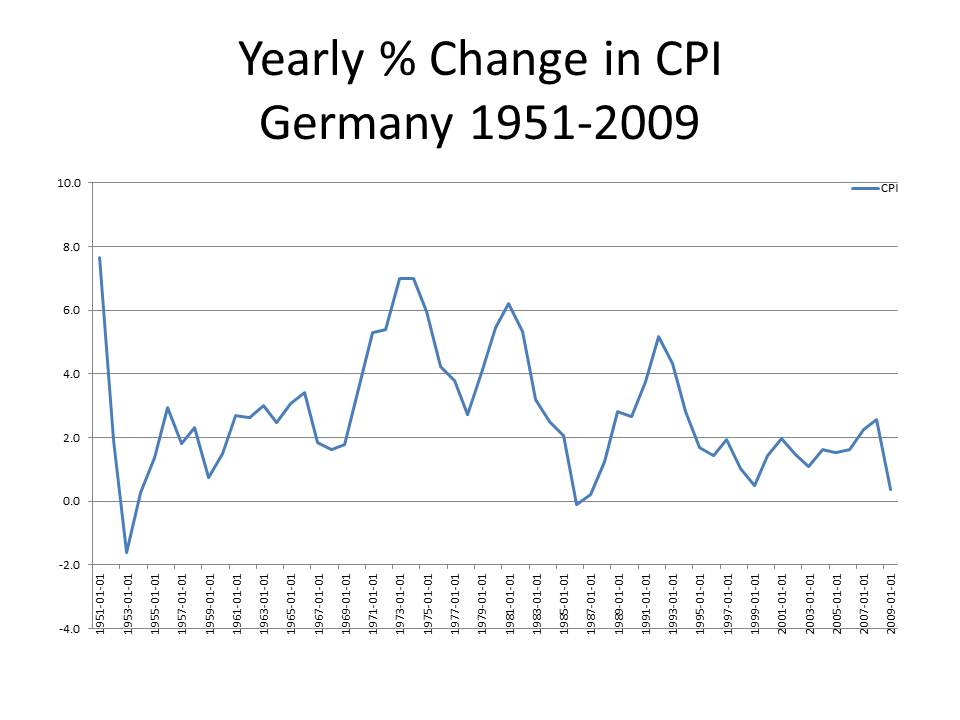
But have a look at German inflation in historical context. Here are two charts presenting German CPI. The first shows the annual change in the CPI in Germany from 1951 to 2009.
The second shows the year-on-year change in the CPI by month from January 1961 to October 2011.
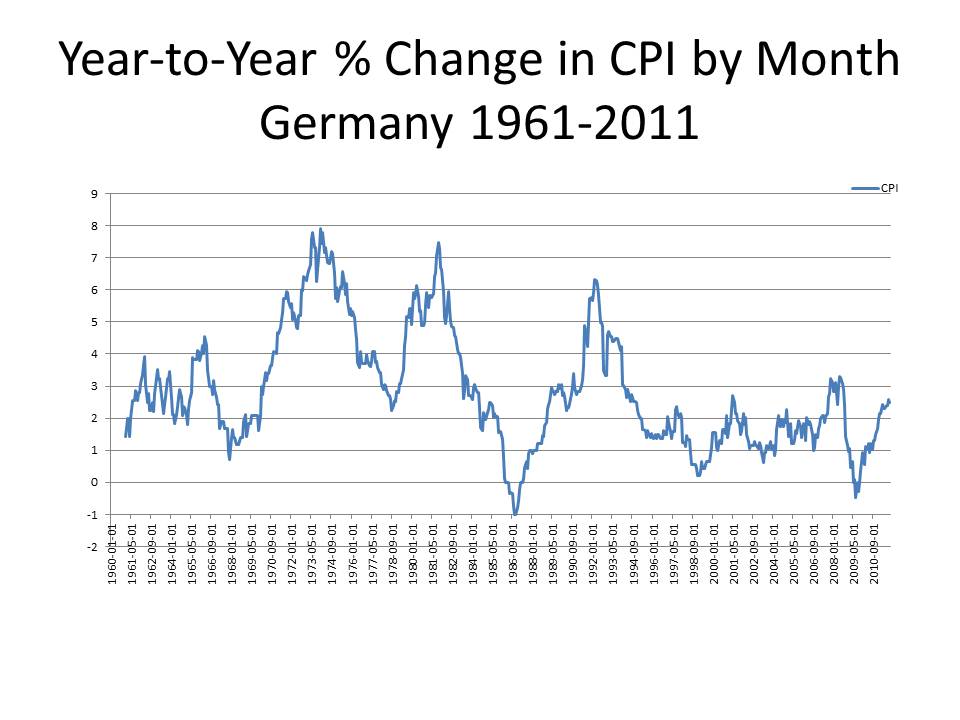
The charts are instructive in showing that even in the heyday of the German Wirtschaftswunder from 1950 to 1966 under conservative governments headed by Konrad Adenauer and then by Ludwig Erhard (friend and disciple of Hayek, member of the Mont Pelerin Society, and the acknowledged architect of the Wirtschaftswunder) the rate of inflation was often above 3%. For long stretches of time since 1950, Germany has had inflation above 3%, sometimes over 5%, nevertheless managing to avoid the political and economic disasters that, we are now told, supposedly follow inexorably whenever inflation exceeds 2%.

A similar story is told by the third chart showing the German GDP price deflator measured quarterly since 1971. The price deflator is now running at the lowest rates in 40 years.
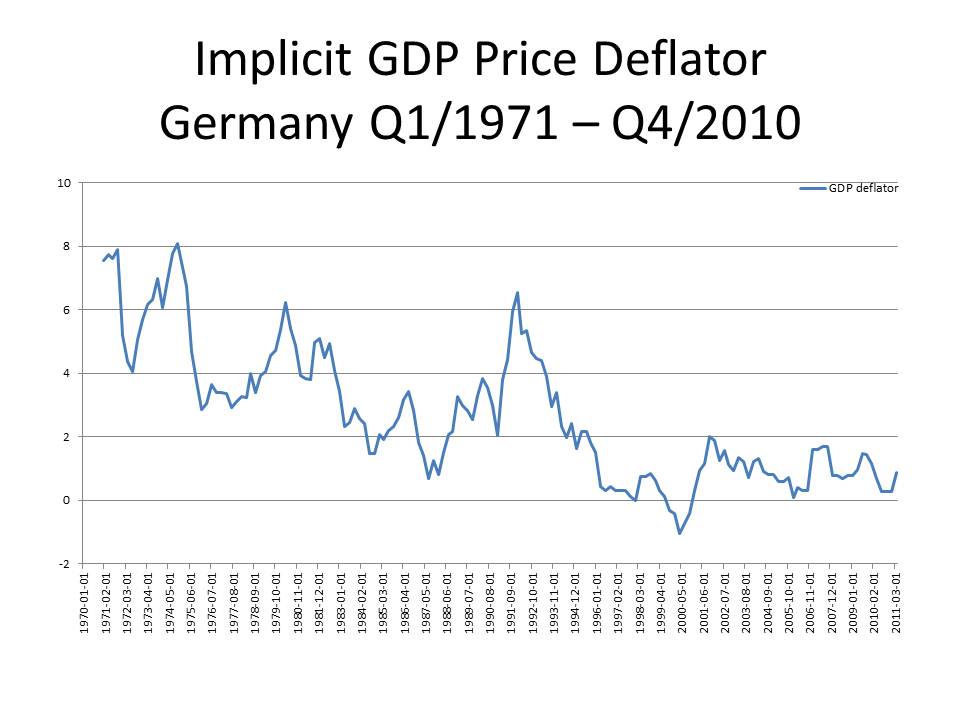
Is the risk to the German economy from a rate of inflation closer to the mean rate of the last 40 years, say 3-4%, really so intolerable? What are they thinking?
Rules v. Discretion

I gave a talk this afternoon at a panel on the Heritage of Monetary Economics and Macroeconomics at the meetings of the Southern Economic Association in Washington. The panel was brought together to commemorate a confluence of significant anniversaries this year: the 300th anniversary of David Hume’s birth, the 200th anniversary of the publication of the Bullion Report to the British Parliament, the 100th anniversary of the publication of Irving Fisher’s Purchasing Power of Money, the 75th anniversary of the publication of Keynes’s General Theory, and the 50th anniversary of the publication of John Muth’s paper on rational expectations. I spoke about the Bullion Report and the contributions of classical monetary theory. At some point, I may post the entire paper on SSRN, but I thought that the section of my paper on rules versus discretion in monetary policy might be of interest to readers of the blog, so here is an abridged version of that section of my paper.

The Bullion Report, whose 200th anniversary we are observing, is an appropriate point from which to start a discussion of the classical contribution to the perpetual debate over rules versus discretion in the conduct of monetary policy. The Bullion Report contained an extended discussion of several important theoretical issues, but its official purpose was to recommend an early resumption of convertibility (suspended since 1797) of Bank of England banknotes, to make them redeemable again at a fixed parity in terms of gold. In other words, the Bullion Report called for a rapid return to the gold standard, then regarded as a safe and workable rule for the conduct of monetary policy.

Despite the rejection by Parliament of the Report’s recommendation to quickly restore the gold standard, the general argument of the Bullion Report for the gold standard undoubtedly influenced the ultimate decision to restore the gold standard after the Napoleonic Wars. But full restoration of gold standard in 1821 did not produce the promised monetary stability, with ongoing disturbances punctuated by financial crises every 10 years or so, in 1825, 1836, 1847, 1857 and 1866. The result of the early disturbances was the adoption of new rules motivated by the idea that monetary disturbances were symptomatic of the failure of a mixed (gold and paper) currency to fluctuate exactly as a purely metallic currency would have.

These new rules seem to me to have been altogether misguided and pernicious, but their adoption reflected a fear that the simple rule embodying the gold standard, the requirement that banknotes be convertible into gold, would not ensure monetary stability unless supplemented by further rules limiting the creation of banknotes by the banks. The rules had to be tightened and spelled out in increasing detail to effectively limit the discretion of the bankers and prevent them from engaging in the destabilizing behavior that they would otherwise engage in.

Thus, over the course of the nineteenth century, there evolved a conception of the rules of the game governing the behavior of the monetary authorities under gold standard. However, the historical record is far from clear on the extent to which the rules of the game were actually observed. The record of equivocal adherence by the monetary authorities under the gold standard to the rules of the game can be interpreted to mean either that the rules of the game were unworkable or irrelevant — in which case following the rules would have been destabilizing — or that it was the failure to follow the rules of the game that caused the instabilities observed even in the heyday of the international gold standard (1880-1914).

The outbreak of World War I led quickly to the effective suspension of the international gold. The prestige of the gold standard was such that hardly anyone questioned the objective of restoring it after the war.  However, there was an increasing understanding that the assumption that the gold standard was the simplest and most effective arrangement by which to achieve price-level stability was unlikely to be valid in the post-war environment. Ralph Hawtrey and Gustav Cassel were especially emphatic after the war about the deflationary dangers associated with restoring the international gold standard unless measures were taken to reduce the monetary demand for gold as countries went back on the gold standard. As a result, the 1920s literature on monetary policy contain frequent derogatory references by supporters of the orthodox gold standard to supporters of managed money, i.e., to advocates of using monetary policy to stabilize prices rather than accept whatever price level was generated by allowing the gold standard to operate according to the rules of the game.

Advocates of price-level stabilization, especially Hawtrey and Cassel, attributed the Great Depression to a failure to manage the gold standard in a way that prevented a sharp increase in the worldwide monetary demand for gold after France, followed by a number of other countries, rejoined the gold standard in 1928 and began redeeming foreign exchange holdings for gold. It was at just this point that the Federal Reserve, having followed a somewhat accommodative policy since 1925, shifted to a tighter policy in late 1928 out of concern with stock-market speculation supposedly fueling a bubble in stock prices. Supporters of the traditional gold standard blamed the crisis on the “inflationary” policies of the Federal Reserve which prevented the “natural” deflation that would otherwise have started in 1927.

Supporters of the traditional gold standard thought that they were upholding the classical tradition of a monetary policy governed by rules not discretion. But Hawtrey and Cassel were not advocates of unlimited policy discretion; they believed that the gold standard ought to be managed by the leading central banks with an understanding of how their policies jointly would determine the international price level and that they should therefore do what was necessary to avoid the deflation to which the world economy was dangerously susceptible because of the rapidly increasing monetary demand for gold.

The Keynesian Revolution after the Great Depression provided a rationale for not allowing policy rules (e.g., keeping the government’s budget balanced, or keeping an exchange rate or an internal price level constant) to preclude taking fiscal or monetary actions designed to increase employment. Achieving full employment by controlling aggregate spending by manipulating fiscal and monetary instruments became the explicit goal of economic policy for the first time. The gold standard having been effectively discredited, opponents of discretionary policies had to search for an alternative rule in terms of which they could take a principled stand against discretionary Keynesian policies. A natural rule to specify would have been to stabilize a price index, as Irving Fisher had proposed after World War I, with his plan for a compensated dollar based on adjusting the price of gold at which the dollar would be made convertible as necessary to keep the price level constant. But Fisher’s plan was too complicated for laymen to understand, and Milton Friedman, the dominant anti-Keynesian of the 1950s and 1960s, preferred to formulate a monetary rule in terms of the quantity of money, perhaps reflecting the Currency School bias for quantitative rules he inherited from his teacher at Chicago Lloyd Mints. A quantitative rule, Friedman argued, imposes a tighter, more direct, constraint on the actions of the central bank than a price-level rule.

The attempt by the Federal Reserve under Paul Volcker to implement a strict Monetarist control over the growth of the money aggregates proved unsuccessful even though the Fed succeeded in its ultimate goal of reducing inflation. Friedman himself, observing the rapid growth of the monetary aggregates, after inflation had been brought down, predicted that inflation would soon rise again to near double-digit rates. That error marked the end of Monetarism as a serious guide to conducting monetary policy.

However, traditional Keynesian prescriptions were, by then, no longer fashionable either, and we entered a two-decade period in which monetary policy aimed at a gradually declining inflation target, falling from 3.5% in the late 1980s to about 2% at present. The instrument used to achieve the inflation target was the traditional pre-Keynesian instrument of the bank rate. John Taylor suggested a rule for setting the bank rate based on the target inflation rate and the gap between actual and potential output that seemed consistent with the recent behavior of the Fed and other central banks. Everything seemed to be going well, and central banks basked in a glow of general approval and gratitude for achieving what was called the Great Moderation. But, perhaps because the Fed didn’t follow the Taylor rule for a few years after the dot-com bubble and the 9/11 attack, there was a housing bubble and then a recession and then a financial crisis, and we now find ourselves mired in the worst recession – actually a Little Depression — since the Great Depression.

The classical monetary theorists, with very few exceptions, believed in some sort of monetary rule, for the most part, either a simple gold standard governed only by the obligation to maintain convertibility or a gold standard hedged in by a variety of rules specifying the appropriate adjustments. Only a few classical economists had other ideas about a monetary regime, and of these they were also rule-based systems such as bimetallism or some form of a tabular standard. The idea of a purely discretionary regime unconstrained by any rule was generally beyond their comprehension.

The problem, for which we as yet have no solution, is that it is dangerous to formulate a rule governing monetary policy if one doesn’t have a fully adequate model of the economy and of the monetary system for which the rule is supposed to determine policy. Ever since the nineteenth century, monetary reformers have been proposing rules to govern policy whose effects they have grossly misunderstood. The Currency School erroneously believed that monetary and financial crises were caused by the failure of a mixed currency to fluctuate in exactly the same way as a purely metallic currency would have. The attempt to impose such a rule simply aggravated the crises to which any gold standard was naturally subject as a result of more or less random fluctuations in the value of gold. The Great Depression was caused by a misguided attempt to recreate the prewar gold standard without taking into account the effect that restoring the gold standard would have on the value of gold. A Monetarist rule to control the rate of growth of the money supply was nearly impossible to implement, because Monetarists stubbornly believed that the demand for money was extremely stable and almost unaffected by the rate of interest so that a steady rate of growth in the money supply was a necessary and sufficient condition for achieving the maximum degree of macroeconomic stability monetary policy was capable of.

After those failures, it was thought that a policy of inflation targeting would achieve macroeconomic stability. But there are two problems with inflation targeting. First, it calls for a perverse response to supply shocks, adding stimulus when a positive productivity shock speeds economic growth and reduces inflation, and reducing aggregate demand when a negative supply shock reduces economic growth and increases inflation. Thus, in one of the greatest monetary policy mistakes since the Great Depression, the FOMC stubbornly tightened policy for most of 2008, because negative supply shocks were driving up commodities prices, causing fears that inflation expectations would become unanchored. The result was an accelerating downturn in the summer of 2008, producing deflationary expectations that precipitated a financial panic and a crash in asset prices.

Second, even without a specific supply shock, if profit expectations worsen sufficiently, causing equilibrium real short-term interest rates to go negative, the only way to avoid a financial crisis is for the rate of inflation to increase sufficiently to allow the real short term interest rate to drop to the equilibrium level. If inflation doesn’t increase sufficiently to allow the real interest rate to drop to its equilibrium level, the expected rate of return on holding cash will exceed the expected return from holding capital causing a crash in asset prices, just what happened in October 2008.

Some of us are hoping that targeting nominal GDP may be an improvement over the rules that have been followed to date.  But the historical record, at any rate, does not offer much comfort to anyone who believes that adopting a following a simple rule is the answer to our monetary ills.

Nicholas Crafts on the Lessons of the 1930s

In Wednesday’s Financial Times, Nicholas Crafts, Professor of Economics at Warwick University, writes a superb op-ed “Fiscal stimulus is not our only option” explaining how an easy money policy worked for England in the 1930s, generating a 20% increase in real GDP between 1933 and 1937 despite fiscal retrenchment.  The op-ed summarizes a report (Delivering growth while reducing deficits:  Lessons from the 1930s) just published by the Centre Forum, a liberal think tank based in London.

Here is the opening paragraph:

The lessons of the 1930s are not well understood but are important. Britain enjoyed a strong recovery from the depression, with growth exceeding 3 per cent in each year between 1933 and 1937, despite a double-dip recession in 1932 and continuing turmoil in the international economy. Until 1936, growth owed nothing to rearmament. Indeed, as now, in the early 1930s the government was engaged in fiscal consolidation at a time of very precarious public finances, while from mid-1932 short-term interest rates were close to zero and could not be cut to deliver monetary stimulus. The parallels with today are clear, but today’s policymakers are unaware of the successful economic policy that revived growth. How did they pull this off 80 years ago – and could we do the same?

Crafts answers his question — correctly! — in the affirmative.

The Economic Consequences of Mrs. Merkel

Winston Churchill, in 1925 Chancellor of the Exchequer in the Conservative government headed by Stanley Baldwin, was pressed by the Governor of the Bank of England, Montagu Norman, to restore the British pound to its pre-war parity of $4.86, thereby re-establishing the gold standard in Britain, paving the way for a general restoration of the international gold standard, one of the first casualties of war in August 1914. Having accumulated an enormous stockpile of gold in exchange for supplies it provided to the belligerents, US restored convertibility into gold soon after the end of hostilities, but sterling had depreciated against the dollar by about 25 percent after the war, so Britain could not achieve its goal of restoring the convertibility into gold at the prewar parity without a tight monetary policy aimed at raising the external value of the pound from about $4 to $4.86.

In 1925, sterling had risen to within about 10% of the old parity, making restoration of the pre-war dollar parity seem attainable, thus increasing the pressure from the London and the international financial communities to take the final steps toward the magic $4.86 level. Churchill understood that such a momentous step was both politically and economically dangerous and sought advice from a wide range of opinion, pro and con, both inside and outside government. The most persuasive advice he received was undoubtedly from J. M. Keynes, who, having served as a Treasury economist during World War I and then serving on the British delegation to the Versailles Peace Conference, became world famous after resigning from the Treasury to write The Economic Consequences of the Peace, his devastating critique of the Treaty of Versailles, protesting the overly harsh and economically untenable reparations obligations imposed on Germany. Keynes advised Churchill that the supposedly minimal 10% appreciation of sterling against the dollar would impose an intolerable burden on British workers, who had suffered from exceptionally high unemployment since the 1920-21 postwar deflation.

Despite Keynes’s powerful arguments, Churchill in the end followed the advice of the Bank of England and other members of the British financial establishment. Perhaps one argument that helped persuade him to follow the orthodox advice was that of another Treasury economist, the great Ralph Hawtrey, who submitted a paper analyzing the effects of restoring the prewar dollar parity. Hawtrey argued that Britain and the world would benefit from the restoration of an international gold standard, provided that the restoration was managed in a way that avoided the deflationary tendencies associated a remonetization of gold. Hawtrey suggested that there was reason to think that the institution that mattered most, the U.S. Federal Reserve, with its huge stockpile of gold, would follow a mildly inflationary policy allowing Britain to maintain the prewar parity without additional deflationary pressure. However, Hawtrey warned that if the US did not follow an accommodative policy, it would be a mistake and futile for Britain to defend the parity by deflating.

Keynes, who never suffered from a lack of self-confidence, undoubtedly thought that he had gotten the better of his opponents in presenting the case against restoring the prewar dollar parity to Churchill. When the decision went against him, he vented his outrage at the decision, and perhaps his own personal frustration, by writing a short pamphlet, The Economic Consequences of Mr. Churchill, a withering rhetorical assault on Churchill and the decision to restore the pre-war dollar parity. However, the consequences of the decision to restore the prewar parity were, at least initially, less devastating than Keynes predicted. Contrary to Keynes’s prediction, unemployment in Britain actually declined slightly in 1926 and 1927, falling below 10% for the first time in the 1920s. Hawtrey’s conjecture that the Federal Reserve, then led by the head of the New York Federal Reserve Bank, Benjamin Strong, would follow a mildly accommodative policy, alleviating the deflationary pressure on Britain, turned out to be correct. However, ill health forced Strong to resign in 1928 only months before his untimely death. His accommodative policy was reversed just as the Bank of France started accumulating gold, unleashing deflationary forces that had been contained since the deflation of 1920-21.

Fast forward some four score years to today’s tragic re-enactment of the deflationary dynamics that nearly destroyed European civilization in the 1930s. But what a role reversal! In 1930 it was Germany that was desperately seeking to avoid defaulting on its obligations by engaging in round after round of futile austerity measures and deflationary wage cuts, causing the collapse of one major European financial institution after another in the annus horribilis of 1931, finally (at least a year after too late) forcing Britain off the gold standard in September 1931. Eighty years ago it was France, accumulating huge quantities of gold, in Midas-like self-satisfaction despite the economic wreckage it was inflicting on the rest of Europe and ultimately itself, whose monetary policy was decisive for the international value of gold and the downward course of the international economy. Now, it is Germany, the economic powerhouse of Europe dominating the European Central Bank, which effectively controls the value of the euro. And just as deflation under the gold standard made it impossible for Germany (and its state and local governments) not to default on its obligations in 1931, the policy of the European Central Bank, self-righteously dictated by Germany, has made default by Greece and now Italy and at least three other members of the Eurozone inevitable.

The only way to have saved the gold standard in 1930 would have been for France and the US to have radically changed their monetary policy to encourage an outflow of gold, driving down the international value of gold and reversing the deflation. Such a policy reversal, though advocated by Hawtrey and the great Swedish economist Gustav Cassel, was beyond the limited imagination of the world’s central bankers and monetary authorities at the time. But once started, the deflationary downward spiral did not stop until France, finally having had enough, abandoned gold in 1935. If the European central bank does not soon – and I mean really soon – grasp that there is no exit from the debt crisis without a reversal of monetary policy sufficient to enable nominal incomes in all the economies in the Eurozone to grow more rapidly than does their indebtedness, the downward spiral will overtake even the stronger European economies. (I pointed out three months ago that the European crisis is a NGDP crisis not a debt crisis.) As the weakest countries choose to ditch the euro and revert back to their own national currencies, the euro is likely to start to appreciate as it comes to resemble ever more closely the old deutschmark. At some point the deflationary pressures of a rising euro will cause even the Germans, like the French in 1935, to relent. But one shudders at the economic damage that will be inflicted until the Germans come to their senses. Only then will we be able to assess the full economic consequences of Mrs. Merkel.

Europe Is Having an NGDP Crisis not a Debt Crisis

Aside from rampant pessimism about the US economy, the mini-panic now swamping international stock markets is also being attributed to worries about the eurozone and the increasing likelihood that at least five members of eurozone will default on their debt unless rescued by the other countries.  The problems of three countries, Greece, Ireland, and Portugal, have been well known for at least a year and a half.  But the problems of Spain and Italy, which had been thought to be manageable and unlikely to cause a crisis, have suddenly become critical as well.  Because of their size and the size of their debt burdens, it is unclear whether any rescue package would be feasible if the debt of all five countries had to be rescued by the eurozone governments.

It has been fashionable to blame the crisis on the fecklessness of the politicians in these countries, the greediness of their public employee unions and the overly generous pensions that they have extracted from taxpayers, overly generous welfare benefits, and an unwillingness to work hard and save like the good old solid Northern Europeans.  There probably is some truth in that assessment, though there is probably some exaggeration as well.

However, assigning blame in this way is really a distraction from the true cause of the crisis, which is a stagnation of income growth, making it impossible to pay off debts that were undertaken when it was expected that incomes would be rising.  Since the debts are fixed in nominal terms, the condition for being able to pay off the debts is that nominal income (NGDP) rise fast enough to provide enough free cash flows to service the debts.  That hasn’t happened in the five countries now unable to borrow at manageable rates.

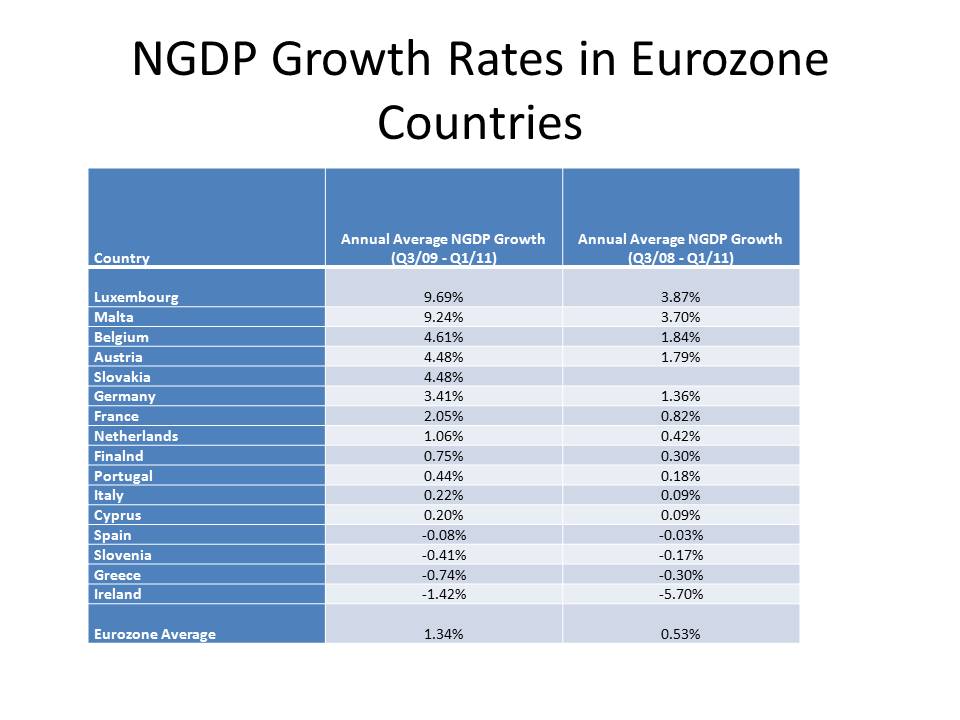
Using official data of the European Commission, I calculated the average annual rate of growth in NGDP for each of the 15 countries in the eurozone since the third quarter of 2008 when the eurozone went into recession and for each of the 16 countries in the eurozone since the third quarter of 2009 when the recovery started (Slovakia having joined in eurozone in the second quarter of 2009) through the first quarter of 2011.

Here are the two lists arranged in order from the fastest to the slowest growth rates of NGDP

The five countries primarily implicated in the debt crisis are at the bottom of NGDP growth rates.  The only other countries in that range are Cyprus and Slovenia.  Cyprus bonds also seem to be problematic, but Slovenia bonds are still rated AA by S&P.

The European debt crisis can thus primarily be laid at the doorstep of Chancellor Merkel and Jean-Claude Trichet, President of the European Central Bank who, in their inflation fighting zeal, have spurned calls for monetary easing to speed the recovery.  We are now all reaping what they have sown.

Chancellor Merkel is following in the worst tradition of one of her predecessors, the unfortunate Chancellor Heinrich Bruning, who in his obsession with proving that Germany was unable to pay off its World War I obligations to the Allies, drove Germany mercilessly into a deflationary spiral in the early 1930s paving the way for Hitler’s ascent to power.  This time, Germany has largely been spared the pain caused by the tight monetary policy for which Chancellor Merkel has expended so much effort.  The pain has mostly been borne by others.  But Germany ultimately cannot escape the costs of its unyielding attachment to tight monetary policy.  Mr. Trichet, too, can look for inspiration to the tragically misguided Emile Moreau, governor the of the Bank of France who presided over the disastrous accumulation of gold by France in the late 1920s and early 1930s that was perhaps the most important factor in triggering the international deflation that led to the Great Depression.

UPDATE (11/25/2011):  In working on a new post about the euro crisis, I discovered that I seriously misstated the growth rates from Q3/09 to Q1/11 for the eurozone countries reported in the above table.  Although I got the numbers wrong, the general relationship among the growth rates in the various countries was not wildly off, so the mistake does not affect the central message of the post, but in my haste, I negligent in checking the numbers.  There were also a few mistakes in the column reporting reporting growth rates from Q3/08 to Q1/11,but only a few of those number were mistaken, not the whole column, as was unfortunately the case for Q3/09 to Q1/11.  Here is a revised table, which aside from correcting my own mistkaes is also based on revised data from the EU.


About Me

David Glasner
Washington, DC

I am an economist in the Washington DC area. My research and writing has been mostly on monetary economics and policy and the history of economics. In my book Free Banking and Monetary Reform, I argued for a non-Monetarist non-Keynesian approach to monetary policy, based on a theory of a competitive supply of money. Over the years, I have become increasingly impressed by the similarities between my approach and that of R. G. Hawtrey and hope to bring Hawtrey’s unduly neglected contributions to the attention of a wider audience.

My new book Studies in the History of Monetary Theory: Controversies and Clarifications has been published by Palgrave Macmillan

Follow me on Twitter @david_glasner

Archives

Enter your email address to follow this blog and receive notifications of new posts by email.

Join 665 other subscribers
Follow Uneasy Money on WordPress.com