Archive for the 'Keynes' Category


The Road to Serfdom: Good Hayek or Bad Hayek?

A new book by Angus Burgin about the role of F. A. Hayek and Milton Friedman and the Mont Pelerin Society (an organization of free-market economists plus some scholars in other disciplines founded by Hayek and later headed by Friedman) in resuscitating free-market capitalism as a political ideal after its nineteenth-century version had been discredited by the twin catastrophes of the Great War and the Great Depression was the subject of an interesting and in many ways insightful review by Robert Solow in the latest New Republic. Despite some unfortunate memory lapses and apologetics concerning his own errors and those of his good friend and colleague Paul Samuelson in their assessments of the of efficiency of central planning, thereby minimizing the analytical contributions of Hayek and Friedman, Solow does a good job of highlighting the complexity and nuances of Hayek’s thought — a complexity often ignored not only by Hayek’s critics but by many of his most vocal admirers — and of contrasting Hayek’s complexity and nuance with Friedman’s rhetorically and strategically compelling, but intellectually dubious, penchant for simplification.

First, let’s get the apologetics out of the way. Tyler Cowen pounced on this comment by Solow:

The MPS [Mont Pelerin Society] was no more influential inside the economics profession. There were no publications to be discussed. The American membership was apparently limited to economists of the Chicago School and its scattered university outposts, plus a few transplanted Europeans. “Some of my best friends” belonged. There was, of course, continuing research and debate among economists on the good and bad properties of competitive and noncompetitive markets, and the capacities and limitations of corrective regulation. But these would have gone on in the same way had the MPS not existed. It has to be remembered that academic economists were never optimistic about central planning. Even discussion about the economics of some conceivable socialism usually took the form of devising institutions and rules of behavior that would make a socialist economy function like a competitive market economy (perhaps more like one than any real-world market economy does). Maybe the main function of the MPS was to maintain the morale of the free-market fellowship.

And one of Tyler’s commenters unearthed this gem from Samuelson’s legendary textbook:

The Soviet economy is proof that, contrary to what many skeptics had earlier believed, a socialist command economy can function and even thrive.

Tyler also dug up this nugget from the classic paper by Sameulson and Solow on the Phillips Curve (but see this paper by James Forder for some revisionist history about the Samuelson-Solow paper):

We have not here entered upon the important question of what feasible institutional reforms might be introduced to lessen the degree of disharmony between full employment and price stability. These could of course involve such wide-ranging issues as direct price and wage controls, antiunion and antitrust legislation, and a host of other measures hopefully designed to move the American Phillips’ curves downward and to the left.

But actually, Solow was undoubtedly right that the main function of the MPS was morale-building! Plus networking. Nothing to be sneered at, and nothing to apologize for. The real heavy lifting was done in the 51 weeks of the year when the MPS was not in session.

Anyway, enough score settling, because Solow does show a qualified, but respectful, appreciation for Hayek’s virtues as an economist, scholar, and social philosopher, suggesting that there was a Good Hayek, who struggled to reformulate a version of liberalism that transcended the inadequacies (practical and theoretical) that doomed the laissez-faire liberalism of the nineteenth century, and a Bad Hayek, who engaged in a black versus white polemical struggle with “socialists of all parties.” The trope strikes me as a bit unfair, but Hayek could sometimes be injudicious in his policy pronouncements, or in his off-the-cuff observations and remarks. Despite his natural reserve, Hayek sometimes indulged in polemical exaggeration. The appetite for rhetorical overkill was especially hard for Hayek to resist when the topic of discussion was J. M. Keynes, the object of both Hayek’s admiration and his disdain. Hayek seemingly could not help but caricature Keynes in a way calculated to make him seem both ridiculous and irresistible.  Have a look.

So I would not dispute that Hayek occasionally committed rhetorical excesses when wearing his policy-advocate hat. And there were some other egregious lapses on Hayek’s part like his unqualified support for General Pinochet, reflecting perhaps a Quixotic hope that somewhere there was a benevolent despot waiting to be persuaded to implement Hayek’s ideas for a new liberal political constitution in which the principle of the separation of powers would be extended to separate the law-making powers of the legislative body from the governing powers of the representative assembly.

But Solow exaggerates by characterizing the Road to Serfdom as an example of the Bad Hayek, despite acknowledging that the Road to Serfdom was very far from advocating a return to nineteenth-century laissez-faire. What Solow finds troubling is thesis that

the standard regulatory interventions in the economy have any inherent tendency to snowball into “serfdom.” The correlations often run the other way. Sixty-five years later, Hayek’s implicit prediction is a failure, rather like Marx’s forecast of the coming “immiserization of the working class.”

This is a common interpretation of Hayek’s thesis in the Road to Serfdom.   And it is true that Hayek did intimate that piecemeal social engineering (to borrow a phrase coined by Hayek’s friend Karl Popper) created tendencies, which, if not held in check by strict adherence to liberal principles, could lead to comprehensive central planning. But that argument is a different one from the main argument of the Road to Serfdom that comprehensive central planning could be carried out effectively only by a government exercising unlimited power over individuals. And there is no empirical evidence that refutes Hayek’s main thesis.

A few years ago, in perhaps his last published article, Paul Samuelson wrote a brief historical assessment of Hayek, including personal recollections of their mostly friendly interactions and of one not so pleasant exchange they had in Hayek’s old age, when Hayek wrote to Samuelson demanding that Samuelson retract the statement in his textbook (essentially the same as the one made by Solow) that the empirical evidence, showing little or no correlation between economic and political freedom, refutes the thesis of the Road to Serfdom that intervention leads to totalitarianism. Hayek complained that this charge misrepresented what he had argued in the Road to Serfdom. Observing that Hayek, with whom he had long been acquainted, never previously complained about the passage, Samuelson explained that he tried to placate Hayek with an empty promise to revise the passage, attributing Hayek’s belated objection to the irritability of old age and a bad heart. Whether Samuelson’s evasive response to Hayek was an appropriate one is left as an exercise for the reader.

Defenders of Hayek expressed varying degrees of outrage at the condescending tone taken by Samuelson in his assessment of Hayek. I think that they were overreacting. Samuelson, an academic enfant terrible if there ever was one, may have treated his elders and peers with condescension, but, speaking from experience, I can testify that he treated his inferiors with the utmost courtesy. Samuelson was not dismissing Hayek, he was just being who he was.

The question remains: what was Hayek trying to say in the Road to Serfdom, and in subsequent works? Well, believe it or not, he was trying to say many things, but the main thesis of the Road to Serfdom was clearly what he always said it was: comprehensive central planning is, and always will be, incompatible with individual and political liberty. Samuelson and Solow were not testing Hayek’s main thesis. None of the examples of interventionist governments that they cite, mostly European social democracies, adopted comprehensive central planning, so Hayek’s thesis was not refuted by those counterexamples. Samuelson once acknowledged “considerable validity . . . for the nonnovel part [my emphasis] of Hayek’s warning” in the Road to Serfdom: “controlled socialist societies are rarely efficient and virtually never freely democratic.” Presumably Samuelson assumed that Hayek must have been saying something more than what had previously been said by other liberal economists. After all, if Hayek were saying no more than that liberty and democracy are incompatible with comprehensive central planning, what claim to originality could Hayek have been making? None.

Yep, that’s exactly right; Hayek was not making any claim to originality in the Road to Serfdom. But sometimes old truths have to be restated in a new and more persuasive form than that in which they were originally stated. That was especially the case in the early 1940s when collectivism and planning were widely viewed as the wave of the future, and even so thoroughly conservative and so eminent an economic theorist as Joseph Schumpeter could argue without embarrassment that there was no practical or theoretical reason why socialist central planning could not be implemented. And besides, the argument that every intervention leads to another one until the market system becomes paralyzed was not invented by Hayek either, having been made by Ludwig von Mises some twenty years earlier, and quite possibly by other writers before that.  So even the argument that Samuelson tried to pin on Hayek was not really novel either.

To be sure, Hayek’s warning that central planning would inevitably lead to totalitarianism was not the only warning he made in the Road to Serfdom, but conceptually distinct arguments should not be conflated. Hayek clearly wanted to make the argument that an unprincipled policy of economic interventions was dangerous, because interventions introduce distortions that beget further interventions, producing a cumulative process of ever-more intrusive interventions, thereby smothering market forces and eventually sapping the productive capacity of the free enterprise system. That is an argument about how it is possible to stumble into central planning without really intending to do so.  Hayek clearly believed in that argument, often invoking it in tandem with, or as a supplement to, his main argument about the incompatibility of central planning with liberty and democracy. Despite the undeniable tendency for interventions to create pressure (for both political and economic reasons) to adopt additional interventions, Hayek clearly overestimated the power of that tendency, failing to understand, or at least to take sufficient account of, the countervailing political forces resisting further interventions. So although Hayek was right that no intellectual principle enables one to say “so much intervention and not a drop more,” there could still be a kind of (messy) democratic political equilibrium that effectively limits the extent to which new interventions can be piled on top of old ones. That surely was a significant gap in Hayek’s too narrow, and overly critical, view of how the democratic political process operates.

That said, I think that Solow came close to getting it right in this paragraph:

THE GOOD HAYEK was not happy with the reception of The Road to Serfdom. He had not meant to provide a manifesto for the far right. Careless readers ignored his rejection of unqualified laissez-faire, and the fact that he reserved a useful, limited economic role for government. He had not actually claimed that the descent into serfdom was inevitable. There is no reason to doubt Hayek’s sincerity in this (although the Bad Hayek occasionally made other appearances). Perhaps he would be appalled at the thought of a Congress full of Tea Party Hayekians. But it was his book, after all. The fact that natural allies such as Knight and moderates such as Viner thought that he had overreached suggests that the Bad Hayek really was there in the text.

But not exactly right. Hayek was not totally good. Who is? Hayek made mistakes. Let he who is without sin cast the first stone. Frank Knight didn’t like the Road to Serfdom. But as Solow, himself, observed earlier in his review, Knight was a curmudgeon, and had previously crossed swords with Hayek over arcane issues of capital theory.  So any inference from Knight’s reaction to the Road to Serfdom must be taken with a large grain of salt. And one might also want to consider what Schumpeter said about Hayek in his review of the Road to Serfdom, criticizing Hayek for “politeness to a fault,” because Hayek would “hardly ever attribute to opponents anything beyond intellectual error.”  Was the Bad Hayek really there in the text? Was it really “not a good book?” The verdict has to be: unproven.

PS  In his review, Solow expressed a wish for a full list of the original attendees at the founding meeting of the Mont Pelerin Society.  Hayek included the list as a footnote to his “Opening Address to a  Conference at Mont Pelerin” published in his Studies in Philosophy, Politics and Economics.  There is a slightly different list of original members in Wikipedia.

Maurice Allais, Paris

Carlo Antoni, Rome

Hans Barth, Zurich

Karl Brandt, Stanford, Calif.

John Davenport, New York

Stanley R. Dennison, Cambridge

Walter Eucken, Freiburg i. B.

Erich Eyck, Oxford

Milton Friedman, Chicago

H. D. Gideonse, Brooklyn

F. D. Graham, Princeton

F. A. Harper, Irvington-on-Hudson, NY

Henry Hazlitt, New York

T. J. B. Hoff, Oslo

Albert Hunold, Zurich

Bertrand de Jouvenal, Chexbres, Vaud

Carl Iversen, Copenhagen

John Jewkes, Manchester

F. H. Knight, Chicgao

Fritz Machlup, Buffalo

L. B. Miller, Detroit

Ludwig von Mises, New York

Felix Morely, Washington, DC

Michael Polanyi, Manchester

Karl R. Popper, London

William E. Rappard, Geneva

L. E. Read, Irvington-on-Hudson, NY

Lionel Robbins, London

Wilhelm Roepke, Geneva

George J. Stigler, Providence, RI

Herbert Tingsten, Stockholm

Fracois Trevoux, Lyon

V. O. Watts, Irvington-on-Hudson, NY

C. V. Wedgewood, London

In addition, Hayek included the names of others invited but unable to attend who joined MPS as original members

Constatino Bresciani-Turroni, Rome

William H. Chamberlin, New York

Rene Courtin, Paris

Max Eastman, New York

Luigi Einaudi, Rome

Howard Ellis, Berkeley, Calif.

A. G. B. Fisher, London

Eli Heckscher, Stockholm

Hans Kohn, Northampton, Mass

Walter Lippmann, New York

Friedrich Lutz, Princeton

Salvador de Madriaga, Oxford

Charles Morgan, London

W. A. Orten, Northampton, Mass.

Arnold Plant, London

Charles Rist, Paris

Michael Roberts, London

Jacques Rueff, Paris

Alexander Rustow, Istanbul

F. Schnabel, Heidelberg

W. J. H. Sprott, Nottingham

Roger Truptil, Paris

D. Villey, Poitiers

E. L. Woodward, Oxford

H. M. Wriston, Providence, RI

G. M. Young, London
On the Manipulation of Currencies

Mitt Romney is promising to declare China a currency manipulator on “day one” of his new administration. Why? Ostensibly, because Mr. Romney, like so many others, believes that the Chinese are somehow interfering with the foreign-exchange markets and holding the exchange rate of their currency (confusingly called both the yuan and the remnibi) below its “true” value. But the other day, Mary Anastasia O’Grady, a member of the editorial board of the avidly pro-Romeny Wall Street Journal, wrote an op-ed piece (“Ben Bernanke: Currency Manipulator” ) charging that Bernanke is no less a currency manipulator than those nasty Chinese Communists. Why? Well, that was not exactly clear, but it seemed to have something to do with the fact that Mr. Bernanke, seeking to increase the pace of our current anemic recovery, is conducting a policy of monetary expansion to speed the recovery.

So, is what Mr. Bernanke is doing (or supposed to be doing) really the same as what the Chinese are doing (or supposed to be doing)?

Well, obviously it is not. What the Chinese are accused of doing is manipulating the yuan’s exchange rate by, somehow, intervening in the foreign-exchange market to prevent the yuan from rising to its “equilibrium” value against the dollar. The allegation against Mr. Bernanke is that he is causing the exchange rate of the dollar to fall against other currencies by increasing the quantity of dollars in circulation. But given the number of dollars in circulation, the foreign-exchange market is establishing a price that reflects the “equilibrium” value of dollars against any other currency. Mr. Bernanke is not setting the value of the dollar in foreign-exchange markets, as the Chinese are accused of doing to the dollar/yuan exchange rate. Even if he wanted to control the exchange value of the dollar, it is not directly within Mr. Bernanke’s power to control the value that participants in the foreign-exchange markets attach to the dollar relative to other currencies.

But perhaps this is too narrow a view of what Mr. Bernanke is up to. If the Chinese government wants the yuan to have a certain exchange value against the dollar and other currencies, all it has to do is to create (or withdraw) enough yuan to ensure that the value of yuan on the foreign-exchange markets falls (or rises) to its target. In the limit, the Chinese government could peg its exchange rate against the dollar (or against any other currency or any basket of currencies) by offering to buy and sell dollars (or any other currency or any basket of currencies) in unlimited quantities at the pegged rate with the yuan. Does that qualify as currency manipulation? For a very long time, pegged or fixed exchange rates in which countries maintained fixed exchange rates against all other currencies was the rule, not the exception, except that the pegged rate was most often a fixed price for gold or silver rather than a fixed price for a particular currency. No one ever said that simply maintaining a fixed exchange rate between one currency and another or between one currency and a real commodity is a form of currency manipulation. And for some 40 years, since the demise of the Bretton Woods system, the Wall Street Journal editorial page has been tirelessly advocating restoration of a system of fixed exchange rates, or, ideally, restoration of a gold standard. And now the Journal is talking about currency manipulation?

So it’s all very confusing. To get a better handle on the question of currency manipulation, I suggest going back to a classic statement of the basic issue by none other than John Maynard Keynes in a book, A Tract on Monetary Reform, that he published in 1923, when the world was trying to figure out how to reconstruct an international system of monetary arrangements to replace the prewar international gold standard, which had been one of the first casualties of the outbreak of World War I.

Since . . . the rate of exchange of a country’s currency with the currency of the rest of the world (assuming for the sake of simplicity that there is only one external currency) depends on the relation between the internal price level and the external price level [i.e., the price level of the rest of the world], it follows that the exchange cannot be stable unless both internal and external price levels remain stable. If, therefore, the external price level lies outside our control, we must submit either to our own internal price level or to our exchange rate being pulled about by external influences. If the external price level is unstable, we cannot keep both our own price level and our exchanges stable. And we are compelled to choose.

I like to call this proposition – that a country can control either its internal price level or the exchange rate of its currency, but cannot control both — Keynes’s Law, though Keynes did not discover it and was not the first to articulate it (but no one else did so as succinctly and powerfully as he). So, according to Keynes, whether a country pegs its exchange rate or controls its internal price level would not matter if the price level in the rest of the world were stable, because in that case for any internal price level there would be a corresponding exchange rate and for every exchange rate there would be a corresponding internal price level. For a country to reduce its own exchange rate to promote exports would not work, because the low exchange rate would cause its internal prices to rise correspondingly, thereby eliminating any competitive advantage for its products in international trade. This principle, closely related to the idea of purchasing power parity (a concept developed by Gustav Cassel), implies that currency manipulation is not really possible, except for transitory periods, because prices adjust to nullify any temporary competitive advantage associated with a weak, or undervalued, currency. An alternative way of stating the principle is that a country can control its nominal exchange rate, but cannot control its real exchange rate, i.e, the exchange rate adjusted for price-level differences. If exchange rates and price levels tend to adjust to maintain purchasing power parity across currency areas, currency manipulation is an exercise in futility.

That, at any rate, is what the theory says. But for any proposition derived from economic theory, it is usually possible to come up with exceptions by altering the assumptions. Now for Keynes’s Law, there are two mechanisms causing prices to rise faster in a country with an undervalued currency than they do elsewhere. First, price arbitrage between internationally traded products tends to equalize prices in all locations after adjusting for exchange rate differentials. If it is cheaper for Americans to buy wheat in Winnipeg than in Wichita at the current exchange rate between the US and Canadian dollars, Americans will buy wheat in Winnipeg rather than Wichita forcing the Wichita price down until buying wheat in Wichita is again economical. But the arbitrage mechanism works rapidly only for internationally traded commodities like wheat. Many commodities, especially factors of production, like land and labor, are not tradable, so that price differentials induced by an undervalued exchange rate cannot be eliminated by direct arbitrage. But there is another mechanism operating to force prices in the country with an undervalued exchange rate to rise faster than elsewhere, which is that the competitive advantage from an undervalued currency induces an inflow of cash from other countries importing those cheap products, the foreign cash influx, having been exchanged for domestic cash, becoming an additional cause of rising domestic prices. The influx of cash won’t stop until purchasing power parity is achieved, and the competitive advantage eliminated.

What could prevent this automatic adjustment process from eliminating the competitive advantage created by an undervalued currency? In principle, it would be possible to interrupt the process of international arbitrage tending to equalize the prices of internationally traded products by imposing tariffs or quotas on imports or by imposing exchange controls on the movement of capital across borders. All of those restrictions or taxes on international transactions prevent the price equalization implied by Keynes’s Law and purchasing power parity from actually occurring. But after the steady trend of liberalization since World War II, these restrictions, though plenty remain, are less important than they used to be, and a web of international agreements, codified by the International Trade Organization, makes resorting to them a lot trickier than it used to be.

That leaves another, less focused, method by which governments can offer protection from international competition to certain industries or groups. The method is precisely for the government and the monetary authority to do what Keynes’s Law says can’t be done:  to choose an exchange rate that undervalues the currency, thereby giving an extra advantage or profit cushion to all producers of tradable products (i.e., export industries and import-competing industries), perhaps spreading the benefits of protection more widely than governments, if their choices were not restricted by international agreements, would wish. However, to prevent the resulting inflow of foreign cash from driving up domestic prices and eliminating any competitive advantage, the monetary authority must sterilize the induced cash inflows by selling assets to mop up the domestic currency just issued in exchange for the foreign cash directed toward domestic exporters. (The classic analysis of such a policy was presented by Max Corden in his paper “Exchange Rate Protection,” reprinted in his Production, Growth, and Trade: Essays in International Economics.) But to borrow a concept from Austrian Business Cycle Theory, this may not be a sustainable long-run policy for a central bank, because maintaining the undervalued exchange rate would require the central bank to keep accumulating foreign-exchange reserves indefinitely, while selling off domestic assets to prevent the domestic money supply from increasing. The central bank might even run out of domestic assets with which to mop up the currency created to absorb the inflow of foreign cash. But in a rapidly expanding economy (like China’s), the demand for currency may be growing so rapidly that the domestic currency created in exchange for the inflow of foreign currency can be absorbed by the public without creating any significant upward pressure on prices necessitating a sell-off of domestic assets to prevent an outbreak of domestic inflation.

It is thus the growth in, and the changing composition of, the balance sheet of China’s central bank rather than the value of the dollar/yuan exchange rate that tells us whether the Chinese are engaging in currency manipulation. To get some perspective on how the balance sheet of Chinese central banks has been changing, consider that Chinese nominal GDP in 2009 was about 2.5 times as large as it was in 2003 while Chinese holdings of foreign exchange reserves in 2009 were more than 5 times greater than those holdings were in 2003. This means that the rate of growth (about 25% a year) in foreign-exchange reserves held by the Chinese central bank between 2003 and 2009 was more than twice as great as the rate of growth in Chinese nominal GDP over the same period. Over that period, the share of the total assets of the Chinese central bank represented by foreign exchange has grown from 48% in December 2003 to almost 80% in December 2010. Those changes are certainly consistent with the practice of currency manipulation.  However, except for 2009, there was no year since 2000 in which the holdings of domestic assets by the Chinese central bank actually fell, suggesting that there has been very little actual sterilization undertaken by the Chinese central bank.  If there has indeed been no (or almost no) actual sterilization by the Chinese central bank, then, despite my long-standing suspicions about what the Chinese have been doing, I cannot conclude that the Chinese have been engaging in currency manipulation. But perhaps one needs to look more closely at the details of how the balance sheet of the Chinese central bank has been changing over time.  I would welcome the thoughts of others on how to interpret evidence of how the balance sheet of the Chinese central bank has been changing.

At any rate, to come back to Mary Anastasia O’Grady’s assertion that Ben Bernanke is guilty of currency manipulation, her accusation, based on the fact that Bernanke is expanding the US money supply, is clearly incompatible with Max Corden’s exchange-rate-protection model. In Corden’s model, undervaluation is achieved by combining a tight monetary policy that sterilizes (by open-market sales!) the inflows induced by an undervalued exchange rate. But, according to Mrs. O’Grady, Bernanke is guilty of currency manipulation, because he is conducting open-market purchases, not open-market sales! So Mrs. O’Grady has got it exactly backwards.  But, then, what would you expect from a member of the Wall Street Journal editorial board?

PS  I have been falling way behind in responding to recent comments.  I hope to catch up over the weekend as well as write up something on medium of account vs. medium of exchange.

PPS  Thanks to my commenters for providing me with a lot of insight into how the Chinese operate their monetary and banking systems.  My frequent commenter J.P. Koning has an excellent post and a terrific visual chart on his blog Moneyness showing the behavior over time of the asset and liability sides of the Chinese central bank.  Scott Sumner has also added an excellent discussion of his own about what Chinese monetary policy is all about.  I am trying to assimilate the various responses and hope to have a further post on the subject in the next day or two.

George Selgin Asks a Question

I first met George Selgin almost 30 years ago at NYU where I was a visiting assistant professor in 1981, and he was a graduate student. I used to attend the weekly Austrian colloquium headed by Israel Kirzner, which included Mario Rizzo, Gerry O’Driscoll, and Larry White, and a group of very smart graduate students like George, Roger Koppl, Sandy Ikeda, Allanah Orrison, and others that I am not recalling. Ludwig Lachmann was also visiting NYU for part of the year, and meeting him was a wonderful experience, as he was very encouraging about an early draft of my paper “A Reinterpretation of Classical Monetary Theory,” which I was then struggling to get into publishable form. A few years later, while I was writing my book Free Banking and Monetary Reform, I found out (I can’t remember how, but perhaps through Anna Schwartz who was on George’s doctoral committee) that he was also writing a book on free banking based on his doctoral dissertation. His book, The Theory of Free Banking, came out before mine, and he kindly shared his manuscript with me as I was writing my book. Although we agreed on many things, our conceptions of free banking and our interpretations of monetary history and policy were often not in sync.

Despite these differences, I watched with admiration as George developed into a prolific economist with a long and impressive list of publications and accomplishments to his credit. I also admire his willingness to challenge his own beliefs and to revise his views about economic theory and policy when that seems to be called for, for example, recently observing in a post on the Free Banking blog that he no longer describes himself as an Austrian economist, and admires that Austrian bete noire, Milton Friedman, though he has hardly renounced his Hayekian leanings.

In one of his periodic postings (“A Question to Market Monetarists“) on the Free Banking blog, George recently discussed NGDP targeting, and raised a question to supporters of nominal GDP targeting, a challenging question to be sure, but a question not posed in a polemical spirit, but out of genuine curiosity. George begins by noting that his previous work in arguing for the price level to vary inversely with factor productivity bears a family resemblance to proposals for NGDP targeting, the difference being whether, in a benchmark case with no change in factor productivity and no change in factor supplies, the price level would be constant or would rise at some specified rate, presumably to overcome nominal rigidities. In NGDP targeting with an upward price trend (Scott Sumner’s proposal) or in NGDP targeting with a stationary price trend (George’s proposal), any productivity increase would correspond to price increases below the underlying price trend and productivity declines would correspond to price increases above underlying the price trend.

However, despite that resemblance, George is reluctant to endorse the Market Monetarist proposal for rapid monetary expansion to promote recovery. George gives three reasons for his skepticism about increasing the rate of monetary expansion to promote recovery, but my concern in this post is with his third, which is the most interesting from his point of view and the one that prompts the question that he poses. George suggests that given the 4.5-5.0% rate of growth in NGDP in the US since the economy hit bottom in the second quarter of 2009, it is not clear why, according to the Market Monetarists, the economy should not, by now, have returned to roughly its long-run real growth trend. (I note here a slight quibble with George’s 4.5-5.0% estimate of recent NGDP growth.  In my calculations, NGDP has grown at just 4.00% since the second quarter of 2009, and at 3.82% since the second quarter of 2010.)

Here’s how George characterizes the problem.

My third reason stems from pondering the sort of nominal rigidities that would have to be at play to keep an economy in a state of persistent monetary shortage, with consequent unemployment, for several years following a temporary collapse of the level of NGDP, and despite the return of the NGDP growth rate to something like its long-run trend.

Apart from some die-hard New Classical economists, and the odd Rothbardian, everyone appreciates the difficulty of achieving such downward absolute cuts in nominal wage rates as may be called for to restore employment following an absolute decline in NGDP. Most of us (myself included) will also readily agree that, if equilibrium money wage rates have been increasing at an annual rate of, say, 4 percent (as was approximately true of U.S. average earnings around 2006), then an unexpected decline in that growth rate to another still positive rate can also lead to unemployment. But you don’t have to be a die-hard New Classicist or Rothbardian to also suppose that, so long as equilibrium money wage rates are rising, as they presumably are whenever there is a robust rate of NGDP growth, wage demands should eventually “catch down” to reality, with employees reducing their wage demands, and employers offering smaller raises, until full employment is reestablished. The difficulty of achieving a reduction in the rate of wage increases ought, in short, to be considerably less than that of achieving absolute cuts.

U.S. NGDP was restored to its pre-crisis level over two years ago. Since then both its actual and its forecast growth rate have been hovering relatively steadily around 5 percent, or about two percentage points below the pre-crisis rate.The growth rate of U.S. average hourly (money) earnings has, on the other hand, declined persistently and substantially from its boom-era peak of around 4 percent, to a rate of just 1.5 percent.** At some point, surely, these adjustments should have sufficed to eliminate unemployment in so far as such unemployment might be attributed to a mere lack of spending. How can this be?

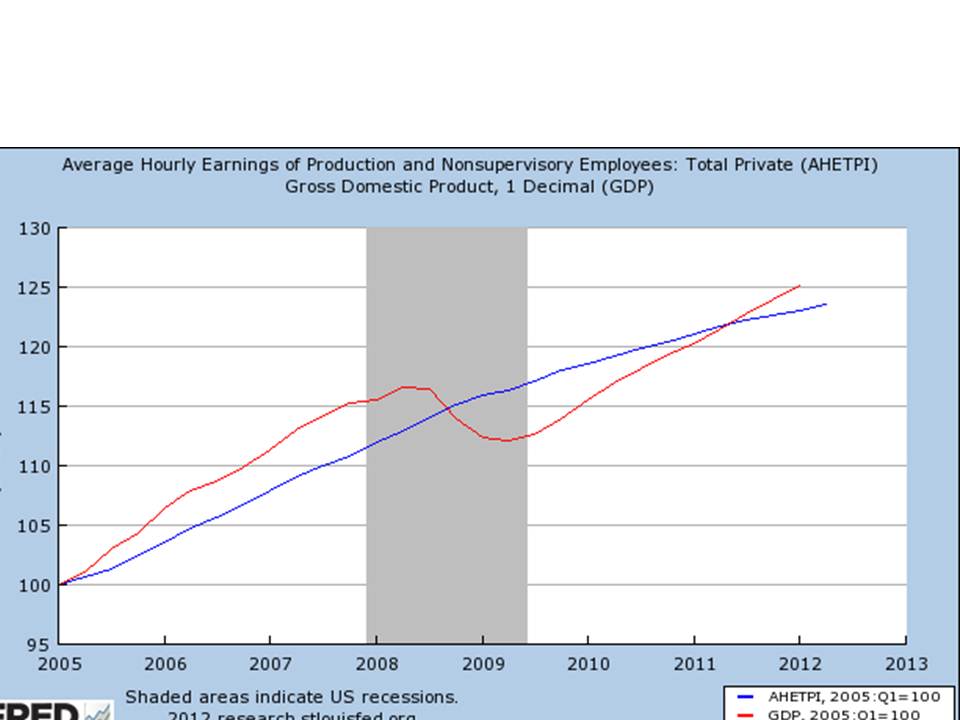
There have been a number of responses to George. Among them, Scott Sumner, Bill Woolsey and Lars Christensen. George, himself, offered a response to his own question, in terms of this graph plotting the time path of GDP versus the time path of nominal wages before and since the 2007-09 downturn.

Here’s George’s take on the graph:

Here one can clearly see how, while NGDP plummeted, hourly wages kept right on increasing, albeit at an ever declining rate. Allowing for compounding, this difference sufficed to create a gap between wage and NGDP levels far exceeding its pre-bust counterpart, and large enough to have been only slightly reduced by subsequent, reasonably robust NGDP growth, notwithstanding the slowed growth of wages.

The puzzle is, of course, why wages have kept on rising at all, despite high unemployment. Had they stopped increasing altogether at the onset of the NGDP crunch, wages and total spending might have recovered their old relative positions about two years ago. That, presumably, would have been too much to hope for. But if it is unreasonable to expect wage inflation to stop on a dime, is it not equally perplexing that it should lunge ahead like an ocean liner might, despite having its engines put to a full stop?

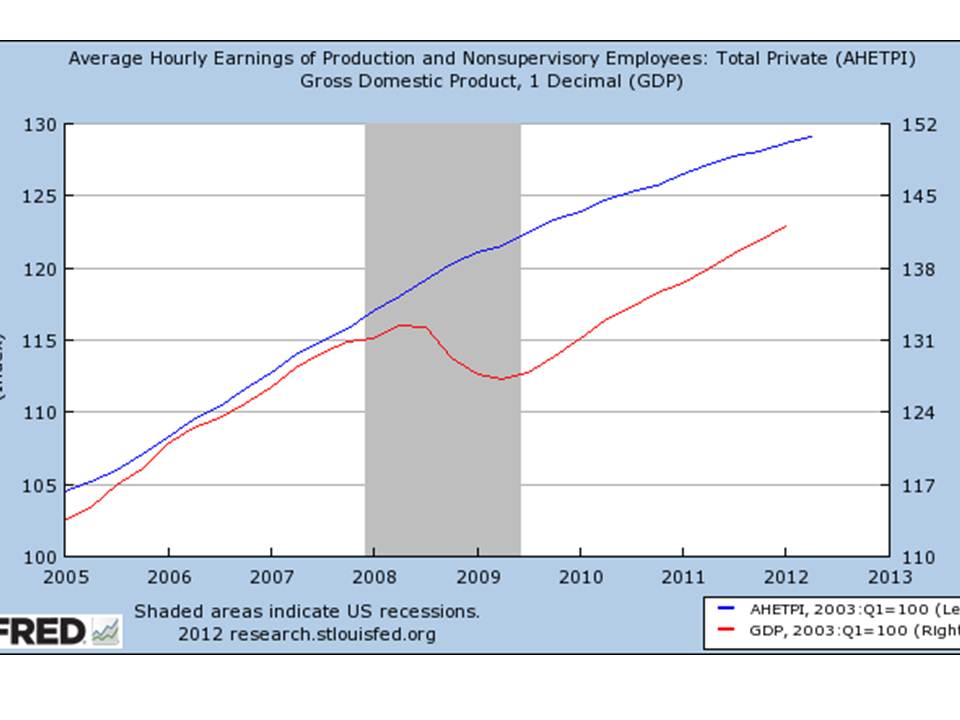
However, after some further tinkering, George decided that the appropriate scaling of the graph implied that the relationship between the two time paths was that displayed in the graph below.

As a result of that rescaling, George withdrew, or at least qualified, his earlier comment. So, it’s obviously getting complicated. But Marcus Nunes, a terrific blogger and an ingenious graph maker, properly observes that George’s argument should be unaffected by any rescaling of his graph. The important feature of the time path of nominal GDP is that it dipped sharply and then resumed its growth at a somewhat slower rate than before the dip while the time path of nominal wages has continued along its previous trend, with just a gentle flattening of the gradient, but without any dip as occurred in the NGDP time path.  The relative position of the two curves on the graph should not matter.

By coincidence George’s first post appeared the day before I published my post about W. H. Hutt on Say’s Law and the Keynesian multiplier in which I argued that money-wage adjustments — even very substantial money-wage adjustments — would not necessarily restore full employment. The notion that money-wage adjustments must restore full employment is a mistaken inference from a model in which trading occurs only at equilibrium prices.  But that is not the world that we inhabit. Trading takes place at prices that the parties agree on, whether or not those prices are equilibrium prices. The quantity adjustments envisaged by Keynes and also by Hutt in his brilliant interpretation of Say’s Law, can prevent price-and-wage adjustments, even very large price-and-wage adjustments, from restoring a full-employment equilibrium. Hutt thought otherwise, but made no effective argument to prove his case, relying simply on a presumption that market forces will always put everything right in the end. But he was clearly mistaken on that point, as no less an authority that F. A. Hayek, in his 1937 article, “Economics and Knowledge,” clearly understood. For sufficiently large shocks, there is no guarantee that wage-and-price adjustments on their own will restore full employment.

In a comment on Scott’s blog, I made the following observation.

[T]he point [George] raises about the behavior of wages is one that I have also been wondering about. I mentioned it in passing in a recent post on W. H. Hutt and Say’s Law and the Keynesian multiplier. I suggested the possibility that we have settled into something like a pessimistic expectations equilibrium with anemic growth and widespread unemployment that is only very slowly, if at all, trending downwards. To get out of such a pessimistic expectations equilibrium you would need either a drastic downward revision of expected wages or a drastic increase in inflationary expectations sufficient to cause a self-sustaining expansion in output and employment. Just because the level of wages currently seems about right relative to a full employment equilibrium doesn’t mean that level of wages needed to trigger an expansion would not need to be substantially lower than the current level in the transitional period to an optimistic-expectations equilibrium. This is only speculation on my part, but I think it is potentially consistent with the story about inflationary expectations causing the stock market to rise in the current economic climate.

George later replied on Scott’s blog as follows:

David Glasner suggests “the possibility that we have settled into something like a pessimistic expectations equilibrium with anemic growth and widespread unemployment…To get out of such a pessimistic expectations equilibrium you would need either a drastic downward revision of expected wages or a drastic increase in inflationary expectations.”

The rub, if you ask me, is that of reconciling “pessimistic expectations” with what appears, on the face of things, to be an overly optimistic positioning of expected wages.

I am not sure why George thinks there is a problem of reconciliation. As Hayek showed in his 1937 article, a sufficient condition for disequilibrium is that expectations be divergent. If expectations diverge, then the plans constructed on those plans cannot be mutually consistent, so that some, perhaps all, plans will not be executed, and some, possibly all, economic agents will regret some prior decisions that they took. Especially after a large shock, I see no reason to be surprised that expectations diverge or even that, as a group, workers are slower to change expectations than employers. I may have been somewhat imprecise in referring to a “pessimistic-expectations” equilibrium, because what I am thinking of is an inconsistency between the pessimism of entrepreneurs about future prices and the expectations of workers about wages, not a situation in which all agents are equally pessimistic. If everyone were equally pessimistic, economic activity might be at a low level, but we wouldn’t necessarily observe any disappointed buyers or sellers. But what qualifies as disappointment might not be so easy to interpret. But we likely would observe a reduction in output. So a true “pessimistic-expectations” equilibrium is a bit tricky to think about. But in practice, there seems nothing inherently surprising about workers’ expectations of future wages not adjusting downward as rapidly as employers’ expectations do. It may also be the case that it is the workers with relatively pessimistic expectations who are dropping out of the labor force, while those with more optimistic expectations continue to search for employment.

I don’t say that the slow recovery poses not difficult issues for advocates of monetary stimulus to address.  The situation today is not exactly the same as it was in 1932, but I don’t agree that it can be taken as axiomatic that a market economy will recover from a large shock on its own.  It certainly may recover, but it may not.  And there is no apodictically true demonstration in the whole corpus of economic or praxeological theory that such a recovery must necessarily occur.

W. H. Hutt on Say’s Law and the Keynesian Multiplier

In a post a few months ago, I referred to W. H. Hutt as an “unjustly underrated” and “all but forgotten economist” and “as an admirable human being,” who wrote an important book in 1939, The Theory of Idle Resources, seeking to counter Keynes’s theory of involuntary unemployment. In responding to a comment on a more recent post, I pointed out that Armen Alchian relied on one of Hutt’s explanations for unemployment to provide a microeconomic basis for Keynes’s rather convoluted definition of involuntary unemployment, so that Hutt unintentionally provided support for the very Keynesian theory that he was tried to disprove. In this post, I want to explore Hutt’s very important and valuable book ARehabilitation of Say’s Law, even though, following Alchian, I would interpret what Hutt wrote in a way that is at least potentially supportive of Keynes, while also showing that Hutt’s understanding of Say’s Law allows us to view Says Law and the Keynesian multiplier as two (almost?) identical ways of describing the same phenomenon.

But before I discuss Hutt’s understanding of Say’s Law, a few words about why I think Hutt was an admirable human being are in order. Born in 1899 into a working class English family (his father was a printer), Hutt attended the London School of Economics in the early 1920s, coming under the influence of Edwin Cannan, whose writings Hutt often referred to. After gaining his bachelor’s degree, Hutt, though working full-time, continued taking courses at LSE, even publishing several articles before taking a position at the University of Capetown in 1930, despite having no advanced degree in economics. Hutt remained in South Africa until the late 1960s or early 1970s, becoming an outspoken critic of legal discrimination against non-whites and later of the apartheid regime instituted in 1948. In his book, The Economics of the Colour Bar, Hutt traced the racial policies of the South African regime not just to white racism, but to the interest of white labor unions in excluding competition by non-whites. Hutt’s hostility to labor unions for their exclusionary and protectionist policies was evident in much of his work, beginning at least with his Theory of Collective Bargaining, his Strike-Threat System, and his many critiques of Keynesian economics. However, he was opposed not to labor unions as such, just to the legal recognition of the right of some workers to coerce others into a collusive agreement to withhold their services unless their joint demand for a stipulated money wage was acceded to by employers, a right that in most other contexts would be both legally and morally unacceptable. Whether or not Hutt took his moral opposition to collective bargaining to extremes, he certainly was not motivated by any venal motives. Certainly his public opposition to apartheid, inviting retribution by the South African regime, was totally disinterested, and his opposition to collective bargaining was no less sincere, even If less widely admired, than his opposition to apartheid, and no more motivated by any expectation of personal gain.

In the General Theory, launching an attack on what he carelessly called “classical economics,” Keynes devoted special attention to the doctrine he described as Say’s Law, a doctrine that had been extensively and inconclusively debated in the nineteenth century after Say formulated what he had called the Law of the Markets in his Treatise on Political Economy in 1803. The exact meaning of the Law of the Markets was never entirely clear, so that, in arguing about Say’s Law, one can never be quite sure that one knows what one is talking about. At any rate, Keynes paraphrased Say’s Law in the following way: supply creates its own demand. In other words, “if you make it, they will buy it, or at least buy something else, because the capacity to demand is derived from the capacity to supply.”

Here is Keynes at p. 18 of the General Theory:

From the time of Say and Ricardo the classical economists have taught that supply creates its own demand; — meaning by this in some significant, but not clearly defined, sense that the whole of the costs of production must necessarily be spent in the aggregate, directly or indirectly, on purchasing the product.

In J. S. Mill’s Principles of Political Economy the doctrine is expressly set forth:

What constitutes the means of payment for commodities. Each person’s means of paying for the productions of other people consist of those which he himself possesses. All sellers are inevitably, and by the meaning of the word, buyers. Could we suddenly double the productive powers of the country, we should double the supply of commodities in every market; but we should, by the same stroke, double the purchasing power. Everybody would bring a double demand as well as supply; everybody would be able to buy twice as much, because every one would have twice as much to offer in exchange.

Then, again at p. 26, Keynes restates Say’s Law in his own terminology:

In the previous chapter we have given a definition of full employment in terms of the behavior of labour. An alternative, though equivalent, criterion is that at which we have now arrived, namely, a situation in which aggregate employment is inelastic in response to an increase in effective demand for its output. Thus Say’s Law, that the aggregate demand price of output as a whole is equal ot its aggregate supply price for all volumes of output [“could we suddenly double the productive powers of the country . . . we should . . . double the purchasing power”], is equivalent the proposition that there is no obstacle to full employment. If, however, this is not the true law relating the aggregate demand and supply functions, there is a vitally important chapter of economic theory which remains to be written and without which all discussions concerning the volume of aggregate employment are futile.

Keynes restated the same point in terms of his doctrine that macroeconomic equilibrium, the condition for which being that savings equal investment, could occur at a level of output and income corresponding to less than full employment. How could this happen? Keynes believed that if the amount that households desired to save at the full employment level of income were greater than the amount that businesses would invest at that income level, expenditure and income would decline until desired (and actual) savings equaled investment. If Say’s Law held, then whatever households chose not to spend would get transformed into investment by business, but Keynes denied that there was any mechanism by which this transformation would occur. Keynes proposed his theory of liquidity preference to explain why savings by households would not necessarily find their way into increased investment by businesses, liquidity preference preventing the rate of interest from adjusting to induce as much investment as required to generate the full-employment level of output and income.

Now the challenge for Keynes was to explain why, if there is less than full employment, wages would not fall to induce businesses to hire the unemployed workers. From Keynes’s point of view it wasn’t enough to assert that wages are sticky, because a classical believer in Say’s Law could have given that answer just as well.  If you prevent prices from adjusting, the result will be a disequilibrium.  From Keynes’s standpoint, positing price or wage inflexibility was not an acceptable explanation for unemployment.  So Keynes had to argue that, even if wages were perfectly flexible, falling wages would not induce an increase in employment. That was the point of Keynes’s definition of involuntary unemployment as a situation in which an increased price level, but not a fall in money wages, would increase employment. It was in chapter 19 of the General Theory that Keynes provided his explanation for why falling money wages would not induce an increase in output and employment.

Hutt’s insight was to interpret Say’s Law differently from the way in which most previous writers, including Keynes, had interpreted it, by focusing on “supply failures” rather than “demand failures” as the cause of total output and income falling short of the full-employment level. Every failure of supply, in other words every failure to achieve market equilibrium, means that the total effective supply in that market is less than it would have been had the market cleared. So a failure of supply (a failure to reach the maximum output of a particular product or service, given the outputs of all other products and services) implies a restriction of demand, because all the factors engaged in producing the product whose effective supply is less than its market-clearing level are generating less demand for other products than if they were producing the market-clearing level of output for that product. Similarly, if workers don’t accept employment at market-clearing wages, their failure to supply involves a failure to demand other products. Thus, failures to supply can be cumulative, because any failure of supply induces corresponding failures of demand, which, unless there are further pricing adjustments to clear other affected markets, trigger further failures of demand. And clearly the price adjustments required to clear any given market will be greater when other markets are not clearing than when those other markets are clearing.

So, with this interpretation, Hutt was able to deploy Say’s Law in a way that sheds important light on the cumulative processes of contraction and expansion characterizing business-cycle downturns and recoveries. In his modesty, Hutt disclaimed originality in using Say’s Law as a key to understanding those cumulative processes, citing various isolated statements by older economists (in particular a remark of the Cambridge economist Frederick Lavington in his 1921 book The Trade Cycle: “The inactivity of all is the cause of the inactivity of each”) that vaguely suggest, but don’t spell out, the process that Hutt describes in meticulous detail. If Hutt’s analysis was anticipated in any important way, it was by Clower and Leijonhufvud in their paper “Say’s Principle, What it Means and Doesn’t Mean,” (reprinted here and here), which introduced a somewhat artificial distinction between Say’s Law, as Keynes conceived of it, and Say’s Principle, which is closer to how Hutt thought about it.  But to Clower and Leijonhufvud, Say’s Principle was an essential part of the explanation of the Keynesian multiplier.  The connection between them is simple, effective supply is identical to effective demand because every purchase is also a sale.  A cumulative process can be viewed as either a supply-side process (Say’s Law) or a demand-side process (the Keynesian multiplier), but they are really just two sides of the same coin.

So if you have followed me this far, you may be asking yourself, did Hutt really rehabilitate Say’s Law, as he claimed to have done? And if so, did he refute Keynes, as he also claimed to have done? My answer to the first question is a qualified yes. And my answer to the second question is a qualified no. I will not try to justify my qualification to my answer to the first question, except to note that the qualification depends on the assumptions made about how money is supplied in the relevant model of the economy. In a model in which money is endogenously supplied by private banks, Say’s Law holds; in a model in which the supply of money is fixed exogenously, Say’s Law does not hold. For more on this, see my paper, “A Reinterpretation of Classical Monetary Theory,” or my book Free Banking and Monetary Reform (pp. 62-66).

But if Hutt was right about Say’s Law, how can Keynes be right that cutting money wages is not a good way (but in Hutt’s view the best way) to cure a depression that is itself caused by the mispricing of assets and factors of production? The answer is that, for all the care Hutt exercised in working out his analysis, he was careless in making explicit his assumptions about the expectations of workers about future wages (i.e., the wages at which they would be able to gain employment). The key point is that if workers expect to be able to find employment at higher wages than they will in fact be offered, the aggregate supply curve of labor will intersect the aggregate demand curve for labor at a wage rate that is higher, and a quantity that is lower, than would be the case in an equilibrium in which workers’ expectations about future wages were correct. From the point of view of Hutt, there is a supply failure because the aggregate supply of labor is less than the hypothetical equilibrium supply under correct wage expectations. But there is no restriction on market pricing, just incorrect expectations of future wages. Expectations need not be rigid, but in a cumulative process, wage expectations may not adjust as fast as wages are falling. Though Keynes, himself, did not discuss the possibility explicitly, it is also possible that there could be multiple equilibria corresponding to different sets of expectations (e.g., optimistic or pessimistic). If the economy settles into a pessimistic equilibrium, unemployment could stabilize at levels that are permanently higher than those that would have prevailed under an optimistic set of expectations. Perhaps we are now stuck in (or approaching) such a pessimistic equilibrium.

Be that as it may, Hutt simply assumes that allowing all prices to be determined freely in unfettered markets must result in the quick restoration of a full-employment equilibrium. This is a reasonable position to take, but there is no way of proving it logically. Proofs that free-market adjustment leads to an equilibrium are based on some sort of tatonnement or recontracting process in which trading does not occur at disequilibrium prices. In the real world, there is no restriction on trading at disequilibrium process, so there is no logical argument that shows that the Say’s Law dynamic described by Hutt cannot go on indefinitely without reaching equilibrium. F. A. Hayek, himself, explained this point in his classic 1937 paper “Economics and Knowledge.”

In the light of our analysis of the meaning of a state of equilibrium it should be easy to say what is the real content of the assertion that a tendency toward equilibrium exists. It can hardly mean anything but that, under certain conditions, the knowledge and intentions of the different members of society are supposed to come more and more into agreement or, to put the same thing in less general and less exact but more concrete terms, that the expectations of the people and particularly of the entrepreneurs will become more and more correct. In this form the assertion of the existence of a tendency toward equilibrium is clearly an empirical proposition, that is, an assertion about what happens in the real world which ought, at least in principle, to be capable of verification. And it gives our somewhat abstract statement a rather plausible common-sense meaning. The only trouble is that we are still pretty much in the dark about (a) the conditionsunder which this tendency is supposed to exist and (b) the nature of the process by which individual knowledge is changed.

In the usual presentations of equilibrium analysis it is generally made to appear as if these questions of how the equilibrium comes about were solved. But, if we look closer, it soon becomes evident that these apparent demonstrations amount to no more than the apparent proof of what is already assumed[11] . The device generally adopted for this purpose is the assumption of a perfect market where every event becomes known instantaneously to every member. It is necessary to remember here that the perfect market which is required to satisfy the assumptions of equilibrium analysis must not be confined to the particular markets of all the individual commodities; the whole economic system must be assumed to be one perfect market in which everybody knows everything. The assumption of a perfect market, then, means nothing less than that all the members of the community even if they are not supposed to be strictly omniscient, are at least supposed to know automatically all that is relevant for their decisions. It seems that that skeleton in our cupboard, the “economic man,” whom we have exorcised with prayer and fasting, has returned through the back door in the form of a quasi-omniscient individual.

Alchian on Money Illusion and the Wage-Price Lag During Inflation

At the end of my post a couple of days ago, I observed that the last two sentences of the footnote that I reproduced from Alchian’s “Information Costs, Pricing, and Resource Unemployment,” required a lot of unpacking. So let’s come back to it and try to figure out what Alchian meant. The point of the footnote was to say that Keynes’s opaque definition of involuntary unemployment rested on a distinction between the information conveyed to workers by an increase in the price level, their money wage held constant, and the information conveyed to them by a reduction in their money wage, with the price level held constant. An increase in the price level with constant money wages conveys no information to workers about any change in their alternatives. Employed workers are not induced by an increase in prices to quit their current jobs in the expectation of finding higher paying jobs, and unemployed workers are not induced to refuse an offer from a prospective employer, as they would be if the employer cut the money wages at which he was willing pay his current employees or to hire new ones. That subtle difference in the information conveyed by a cut in real wages effected by rising prices versus the information conveyed by a cut in real wages effected by a cut in money wages, Alchian explained, is the reason that Keynes made his definition of involuntary unemployment contingent on the differing responses of workers to a reduced real wage resulting from a rising price level and from a falling money wage.

Here is where the plot thickens, because Alchian adds the following comment.

And this is perfectly consistent with Keynes’s definition of [involuntary] unemployment, and it is also consistent with his entire theory of market adjustment processes . . . , since he believed wages lagged behind nonwage prices – an unproved and probably false belief (R. A. Kessel and A. A. Alchian, “The Meaning and Validity of the Inflation-Induced Lag of Wages Behind Prices,” Amer. Econ. Rev. 50 [March 1960]:43-66). Without this belief a general price-level rise is indeed general; it includes wages, and as such there is no reason to believe a price-level rise is equivalent in real terms to a money-wage cut in a particular job.

So, according to Alchian, Keynes’s assumption that the information extracted by workers from a price-level increase is not the same as the information extracted from a nominal wage cut depends on the existence of a lag in the adjustment of wages to an inflationary disturbance. Keynes believed that during periods of inflation, output prices rise before, and rise faster than, wages rise, at least in the early stages of inflation. But if prices and wages rise simultaneously and at the same rate during inflation, then there would be no basis for workers to draw different inferences about their employment opportunities from observing price increases as opposed to observing a nominal wage cut. Alchian believes that the assumption that there is a wage-lag during inflation is both theoretically problematic, and empirically suspect, relying on several important papers that he co-authored with Reuben Kessel that found little support for the existence of such a lag in the historical data on wages and prices.

I have two problems with Alchian’s caveat about the existence of a wage-price lag.

First, Alchian’s premise (with which I agree totally) in the article from which I am quoting is that lack of information about the characteristics of goods being sold and about the characteristics of sellers or buyers (when the transaction involves a continuing relationship between the transactors) and about the prices and characteristics of alternatives induces costly search activities, the holding of inventories, and even rationing or queuing, as alternatives to immediate price adjustments as a response to fluctuations in demand or supply. The speed of price adjustment is thus an economically determined phenomenon, the speed depending on, among other things, the particular characteristics of the good or service being sold and the ease of collecting information about the good and service. For example, highly standardized commodities about which information is readily available tend to have more rapidly adjusting prices than those of idiosyncratic goods and services requiring intensive information gathering by transactors before they can come to terms on a transaction. If employment transactions typically involve a more intensive information gathering process about the characteristics of workers and employers than most other goods and services, then Alchian’s own argument suggests that there should be a lag in wage adjustment relative to the prices of most other goods. An inflation, on Alchian’s reasoning, ought to induce an initial response in the prices of the more standardized commodities with price adjustments in less standardized, more informationally complex, markets, like labor markets, coming later. So I don’t understand Alchian’s theoretical basis for questioning the existence of a wage lag.

Second, my memory is a bit hazy, and I will need to check his article on the wage lag, but I do believe that Alchian pointed out that there is a problem of interpretation in evaluating evidence on the wage lag, because inflation may occur concurrently, but independently, with another change that reduces the demand for labor and causes the real wage to fall. So if one starts, as did Keynes in his discussion of involuntary unemployment, from the premise that a recession is associated with a fall in the real demand for labor that requires a reduction in the real wage to restore full employment, then it is not clear to me why it would be rational for a worker to increase his reservation wage immediately upon observing that output prices are increasing. Workers will typically have some expectation about how rapidly the wage at which they can find employment will rise; this expectation is clearly related to their expectation of how fast prices will rise. If workers observe that prices are rising faster than they expected prices to rise, while their wage is not rising any faster than expected, there is uncertainty about whether their wage opportunities in general have fallen or whether the wage from their current employer has fallen relative to other opportunities. Saturos, in a comment on Tuesday’s post, argued that the two scenarios are indeed symmetrical and that to suggest otherwise is indeed an instance of money illusion. The argument is well taken, but I think that at least in transitional situations (when it seems to me theory supports the existence of a wage lag) and in which workers have some evidence of deteriorating macroeconomic conditions, there is a basis, independent of money illusion, for the Keynesian distinction about the informational content of a real wage cut resulting from a price level increase versus a real wage cut resulting from a cut in money wages.  But I am not sure that this is the last word on the subject.

Alchian on Why Wages Adjust Slowly and Why It Matters

In my previous post, I reproduced a footnote from Armen Alchian’s classic article “Information Costs, Pricing and Resource Unemployment,” a footnote explaining the theoretical basis for Keynes’s somewhat tortured definition of involuntary unemployment. In this post, I offer another excerpt from Alchian’s article, elaborating on the microeconomic rationale for “slow” adjustments in wages. In an upcoming post, I will try to tie some threads together and discuss the issue of whether there might be, contrary to Alchian’s belief, a theoretical basis for wages to lag behind other prices, ata least during the initial stages of inflation. Herewith are the first four paragraphs of section II (Labor Markets) of Alchian’s paper.

Though most analyses of unemployment rely on wage conventions, restriction, and controls to retard wage adjustments above market-clearing levels, [J. R.] Hicks and [W. H.] Hutt penetrated deeper. Hicks suggested a solution consistent with conventional exchange theory. He stated that “knowledge of opportunities is imperfect” and that the time required to obtain that knowledge leads to unemployment and a delayed effect on wages. [fn. J. R. Hicks, The Theory of Wages, 2d ed. (London, 1963), 45, 58. And headed another type – “the unemployment of the man who gives up his job to look for a better.”] It is precisely this enhanced significance that this paper seeks to develop, and which Hicks ignored when he immediately turned to different factors – unions and wage regulations, placing major blame on both for England’s heavy unemployment in the 1920s and 30s.

We digress to note that Keynes, in using a quantity-, instead of a price-, adjustment theory of exchange, merely postulated a “slow” reacting price without showing that slow price responses were consistent with utility or wealth-maximizing behavior in open, unconstrained markets. Keynes’s analysis was altered in the subsequent income-expenditure models where reliance was placed on “conventional” or “noncompetitive” wage rates. Modern “income-expenditure” theorists assumed “institutionally” or “irrationally” inflexible wages resulting from unions, money illusions, regulations, or factors allegedly idiosyncratic to labor. Keynes did not assume inflexibility for only wages. His theory rested on a more general scope of price inflexibility. [fn. For a thorough exposition and justification of these remarks on Keynes, see A. Leijonhufvud, On Keynesian Economics and the Economics of Keynes (Oxford, 1968).] The present paper may in part be viewed as an attempt to “justify” Keynes’s presumption about price response to disturbances in demand.

In 1939 W. H. Hutt exposed many of the fallacious interpretations of idleness and unemployment. Hutt applied the analysis suggested by Hicks but later ignored it when discussing Keynes’s analysis of involuntary unemployment and policies to alleviate it. [fn. W. H. Hutt, The Theory of Idle Resources (London, 1939), 165-69.] This is unfortunate, because Hutt’s analysis seems to be capable of explaining and accounting for a substantial portion of that unemployment.

If we follow the lead of Hicks and Hutt and develop the implications of “frictional” unemployment for both human and nonhuman goods, we can perceive conditions that will imply massive “frictional” unemployment and depressions in open, unrestricted, competitive markets with rational, utility maximizing, individual behavior.

So Alchian is telling us that it is at least possible to conceive of conditions in which massive unemployment and depressions are consistent with “open, unrestricted, competitive markets with rational, utility maximizing, individual behavior.” And presumably would be more going on in such periods of massive unemployment than the efficient substitution of leisure for work in periods of relatively low marginal labor productivity.

Alchian on the Meaning of Keynesian “Involuntary” Unemployment

In his classic paper “Information Costs, Pricing, and Resource Unemployment,” Armen Alchian explains how the absence of full information about the characteristics of goods and services, and about the prices at which they are available leads to a variety of phenomena that are inconsistent with implications of idealized “perfect markets” at which all transactors can buy or sell as much as they want to at known, market-clearing, prices. The main implications of less than full information are  the necessity of search, less than instantaneous price adjustment to changes in demand or cost conditions, the holding of (seemingly) idle or unemployed inventories, queuing, and even rationing. The paper was originally published in 1969 in the Western Economic Journal (subsequently Economic Inquiry) and was republished in a 1970 volume edited by Edmund Phelps, Microeconomic Foundations of Employment and Inflation Theory. It is included in The Collected Works of Armen Alchian (volume 1) published by the Liberty Fund.

Alchian’s explanation of Keynes’s definition of involuntary unemployment appears in footnote 27 in the version published in the Phelps volume (23 in the version published in volume 1 of The Collected Works). Here is the entire footnote:

An intriguing intellectual historical curioso may be explainable by this theory, as has been brought to my attention by Axel Leijonhufvud. Keynes’ powerful, but elliptical, definition of involuntary unemployment has been left in limbo. He wrote:

Men are involuntary unemployed if, in the event of a small rise in the price of wage-goods relative to the money-wage, both the aggregate supply of labour willing to work for the current money wage and the aggregate demand for it at that wage would be greater than the existing volume of employment.

[J. M. Keynes, The General Theory of Employment, Interest, and Money (The Macmillan Company, London, 1936).] To see the power and meaning of this definition (not cause) of unemployment, consider the following question: Why would a cut in money wages provoke a different response than if the price level rose relative to wages – when both would amount to the same change in relative prices, but differ only in the money price level? Almost everyone thought Keynes presumed a money wage illusion. However, an answer more respectful of Keynes is available. The price level rise conveys different information: Money wages everywhere have fallen relative to prices. On the other hand, a cut in one’s own wage money wage does not imply options elsewhere have fallen. A cut only in one’s present job is revealed. The money versus real wage distinction is not the relevant comparison; the wage in the present job versus the wage in all other jobs is the relevant comparison. This rationalizes Keynes’ definition of involuntary unemployment in terms of price-level changes. If wages were cut everywhere else, and if employees knew it, they would not choose unemployment – but they would if they believed wages were cut just in their current job. When one employer cuts wages, this does not signify cuts elsewhere. His employees rightly think wages are not reduced elsewhere. On the other hand, with a rise in the price level, employees have less reason to think their current real wages are lower than they are elsewhere. So they do not immediately refuse a lower real wage induced by a higher price level, whereas they would refuse an equal money wage cut in their present job. It is the revelation of information about prospects elsewhere that makes the difference. And this is perfectly consistent with Keynes’ definition of [involuntary] unemployment, and it is also consistent with his entire theory of market-adjustment processes (Keynes, The General Theory of Employment, Interest, and Money) since he believed that money wages lagged behind nonwage prices – an unproved and probably false belief (R. A. Kessel and A. A. Alchian, “The Meaning and Validity of the Inflation-Induced Lag of Wages Behind Prices,” American Economic Review 50 (March 1960): 43-66). Without that belief a general price-level rise is indeed general; it includes wages, and as such there is no reason to believe a price level rise is equivalent in real terms to a money wage cut in a particular job.

PS There is a lot of unpacking that needs to be done in the last two sentences, but that is best left for another post.

Edmund Phelps Should Read Hawtrey and Cassel

Marcus Nunes follows Karl Smith and Russ Roberts in wondering what Edmund Phelps was talking about in his remarks in the second Hayek v. Keynes debate.  I have already explained why I find all the Hayek versus Keynes brouhaha pretty annoying, so, relax, I am not going there again.  But Marcus did point out that in the first paragraph of Phelps’s remarks, he actually came close to offering the correct diagnosis of the causes of the Great Depression, an increase in the value of gold.  Unfortunately, he didn’t quite get the point, the diagnosis independently provided 10 years before the Great Depression by both Ralph Hawtrey and Gustave Cassel.  Here’s Phelps:

Keynes was a close observer of the British and American economies in an era in which their depressions were wholly or largely monetary in origin – Britain’s slump in the late 1920s after the price of the British currency was raised in terms of gold, and America’s Great Depression of the 1930s, when the world was not getting growth in the stock of gold to keep pace with productivity growth.  In both cases, there was a huge fall of the price level.  Major deflation is a telltale symptom of a monetary problem.

What Phelps unfortunately missed was that from 1925 to mid-1929, Great Britain was not in a slump, at least not in his terminology.  Unemployment was high, a carryover from the deep recession of 1920-21, and there were some serious structural problems, especially in the labor market.  But the overvaluation of the pound that Phelps blames for a non-existent (under his terminology) slump caused only mild deflation.  Deflation was mild, because the Federal Reserve, under the direction of the great Benjamin Strong, was aiming at a roughly stable US (and therefore, world) price level.  Although there was still deflationary pressure on Britain, the pound being overvalued compared to the dollar, the accommodative Fed policy (condemned by von Mises and Hayek as intolerably inflationary) allowed a gradual diminution of the relative overvaluation of sterling with only mild British deflation.   So from 1925 to 1929, the British economy actually grew steadily, while unemployment fell from over 11% in 1925 to just under 10% in 1929.

The problem that caused the Great Depression in America and the rest of the world (or at least that portion of the world that had gone back on the gold standard) was not that the world stock of gold was not growing as fast as productivity was growing – that was a separate long-run problem that Cassel had warned about that had almost nothing to do with the sudden onset of the Great Depression in 1929.  The problem was that in 1928 the insane Bank of France started converting its holdings of foreign exchange into gold.  As a result, a tsunami of gold, drawn mostly from other central banks, inundated the vaults of the Bank of France, forcing other central banks throughout the world to raise interest rates and to cash in their foreign exchange holdings for gold in a futile effort to stem the tide of gold headed for the vaults of the IBOF.

One central bank, the Federal Reserve, might have prevented the catastrophe, but, the illustrious Benjamin Strong tragically having been incapacitated by illness in early 1928, the incompetent crew replacing Strong kept raising the discount rate in a frenzied attempt to curb stock-market speculation on Wall Street.  Instead of accommodating the world demand for gold by allowing an outflow of gold from its swollen reserves — over 40% of total gold reserves held by central banks, the Fed actually was inducing an inflow of gold into the US in 1929.

That Phelps agrees that the 1925-29 period in Britain was characterized by  a deficiency of effective demand because the price level was falling slightly, while denying that there is now any deficiency of aggregate demand in the US because prices are rising slightly, though at the slowest rate in 50 years, misses an important distinction, which is that when real interest rates are negative as they are now, an equilibrium with negative inflation is impossible.  Forcing down inflation lower than it is now would trigger another financial panic.  With positive real interest rates in the late 1920s, the British economy was able to tolerate deflation without imploding.  It was only when deflation fell substantially below 1% a year that the British economy, like most of the rest of the world, started to implode.

If Phelps wants to brush up on his Hawtrey and Cassel, a good place to start would be here.

A New Version of My Paper (With Ron Batchelder) on Hawtrey and Cassel Is Available on SSRN

It’s now over twenty years since my old UCLA buddy (and student of Earl Thompson) Ron Batchelder and I started writing our paper on Ralph Hawtrey and Gustav Cassel entitled “Pre-Keynesian Monetary Theories of the Great Depression:  Whatever Happened to Hawtrey and Cassel?”  I presented it many years ago at the annual meeting of the History of Economics Society and Ron has presented it over the years at a number of academic workshops.  Almost everyone who has commented on it has really liked it.  Scott Sumner plugged it on his blog two years ago.  Scott’s own very important work on the Great Depression has been a great inspiration for me to continue working on the paper.  Doug Irwin has also written an outstanding paper on Gustav Cassel and his early anticipation of the deflationary threat that eventually turned into the Great Depression.

Unfortunately, Ron and I have still not done that last revision to make it the almost-perfect paper that we want it to be.  But I have finally made another set of revisions, and I am turning the paper back to Ron for his revisions before we submit it to a journal for publication.  In  the meantime, I thought that we should make an up-to-date version of the paper available on SSRN as the current version (UCLA working paper #626) on the web dates back to (yikes!) 1991.

Here’s the abstract.

A strictly monetary theory of the Great Depression is generally thought to have originated with Milton Friedman.  Designed to counter the Keynesian notion that the Great Depression resulted from instabilities inherent in modern capitalist economies, Friedman’s explanation identified the culprit as an inept Federal Reserve Board.  More recent work on the Great Depression suggests that the causes of the Great Depression, rooted in the attempt to restore an international gold standard that had been suspended after World War I started, were more international in scope than Friedman believed.  We document that current views about the causes of the Great Depression were anticipated in the 1920s by Ralph Hawtrey and Gustav Cassel who warned that restoring the gold standard risked causing a disastrous deflation unless an increasing international demand for gold could be kept within strict limits.  Although their early warnings of potential disaster were validated, and their policy advice after the Depression started was consistently correct, their contributions were later ignored and forgotten.  We offer some possible reasons for the remarkable disregard by later economists of the Hawtrey-Cassel monetary explanation of the Great Depression.

Was Milton Friedman a Closet Keynesian?

Commenting on a supremely silly and embarrassingly uninformed (no, Ms. Shlaes, A Monetary History of the United States was not Friedman’s first great work, Essays in Positive Economics, Studies in the Quantity Theory of Money, A Theory of the Consumption Function, A Program for Monetary Stability, and Capitalism and Freedom were all published before A Monetary History of the US was published) column by Amity Shlaes, accusing Ben Bernanke of betraying the teachings of Milton Friedman, teachings that Bernanke had once promised would guide the Fed for ever more, Paul Krugman turned the tables and accused Friedman of having been a crypto-Keynesian.

The truth, although nobody on the right will ever admit it, is that Friedman was basically a Keynesian — or, if you like, a Hicksian. His framework was just IS-LM coupled with an assertion that the LM curve was close enough to vertical — and money demand sufficiently stable — that steady growth in the money supply would do the job of economic stabilization. These were empirical propositions, not basic differences in analysis; and if they turn out to be wrong (as they have), monetarism dissolves back into Keynesianism.

Krugman is being unkind, but he is at least partly right.  In his famous introduction to Studies in the Quantity Theory of Money, which he called “The Quantity Theory of Money:  A Restatement,” Friedman gave the game away when he called the quantity theory of money a theory of the demand for money, an almost shockingly absurd characterization of what anyone had ever thought the quantity theory of money was.  At best one might have said that the quantity theory of money was a non-theory of the demand for money, but Friedman somehow got it into his head that he could get away with repackaging the Cambridge theory of the demand for money — the basis on which Keynes built his theory of liquidity preference — and calling that theory the quantity theory of money, while ascribing it not to Cambridge, but to a largely imaginary oral tradition at the University of Chicago.  Friedman was eventually called on this bit of scholarly legerdemain by his old friend from graduate school at Chicago Don Patinkin, and, subsequently, in an increasingly vitriolic series of essays and lectures by his then Chicago colleague Harry Johnson.  Friedman never repeated his references to the Chicago oral tradition in his later writings about the quantity theory, e.g., his essay on the quantity theory of money in the International Encyclopedia of the Social Sciences.  But the simple fact is that Friedman was never able to set down a monetary or a macroeconomic model that wasn’t grounded in the conventional macroeconomics of his time.

Friedman was above all else a superb applied price theorist who wound up doing a lot of worthwhile empirical work and historical on monetary economics, but his knowledge of the history of monetary theory seems to have been pretty much confined to whatever he learned from his teacher Lloyd Mints’s book, A History of Banking Theory in Great Britain and the United States and probably from a classic book, Studies in the Theory of International Trade, by Jacob Viner, another one of Friedman’s teachers at Chicago  That’s why when Friedman finally published an article in two part in the Journal of Political Economy in the early 1970s entitled “A Theoretical Framework for Monetary Analysis,” the papers pretty much flopped, and are now almost completely forgotten (but see here).  Actually Friedman’s intellectual forbears were really W. C. Mitchell and Friedman’s teacher at Columbia Arthur Burns from whom Friedman was schooled in the atheoretical, empirical approach of the old NBER founded by Mitchell.

But Krugman is not totally right either.  Although Friedman obviously liked the idea that the LM-curve was vertical, and liked the idea that money demand is very stable even more, those ideas were not essential to his theoretical position.  (Whether the stability of the demand for money was essential to his position would depend on whether Friedman’s 3-percent growth rule for the money supply is central to his thought.  Although Friedman obviously loved the 3-percent rule, I don’t think that objectively it was really that important to his intellectual position, his sentimental attachment to it notwithstanding.)  What really mattered was the idea that, in the long run, money is neutral and the long-run Phillips Curve is vertical.  Given those assumptions, Friedman could argue that ensuring reasonable monetary stability would lead to better economic performance than discretionary monetary or fiscal policy.  But Friedman, as far as I know, never actually considered the possibility of a negative equilibrium real interest rate.  That’s why, when we look for guidance from Friedman about the current situation, we can’t be completely sure what he would have said.  His comments on Japan suggest that he would have indeed favored quantitative easing.  But inasmuch as he did not explicitly advocate inflation, supporters and opponents of QE can make a case that Friedman would have been on their side.  My own view is that the argument that Friedman would have supported QE is not one of the five or even ten strongest arguments that could be made on its behalf.


About Me

David Glasner
Washington, DC

I am an economist in the Washington DC area. My research and writing has been mostly on monetary economics and policy and the history of economics. In my book Free Banking and Monetary Reform, I argued for a non-Monetarist non-Keynesian approach to monetary policy, based on a theory of a competitive supply of money. Over the years, I have become increasingly impressed by the similarities between my approach and that of R. G. Hawtrey and hope to bring Hawtrey’s unduly neglected contributions to the attention of a wider audience.

My new book Studies in the History of Monetary Theory: Controversies and Clarifications has been published by Palgrave Macmillan

Follow me on Twitter @david_glasner

Archives

Enter your email address to follow this blog and receive notifications of new posts by email.

Join 665 other subscribers
Follow Uneasy Money on WordPress.com