Archive for the 'expectations' Category


Thompson’s Reformulation of Macroeconomic Theory, Part III: Solving the FF-LM Model

In my two previous installments on Earl Thompson’s reformulation of macroeconomic theory (here and here), I have described the paradigm shift from the Keynesian model to Thompson’s reformulation — the explicit modeling of the second factor of production needed to account for a declining marginal product of labor, and the substitution of a factor-market equilibrium condition for equality between savings and investment to solve the model. I have also explained how the Hicksian concept of temporary equilibrium could be used to reconcile market clearing with involuntary Keynesian unemployment by way of incorrect expectations of future wages by workers occasioned by incorrect expectations of the current (unobservable) price level.

In this installment I provide details of how Thompson solved his macroeconomic model in terms of equilibrium in two factor markets instead of equality between savings and investment. The model consists of four markets: a market for output (C – a capital/consumption good), labor (L), capital services (K), and money (M). Each market has its own price: the price of output is P; the price of labor services is W; the price of capital services is R; the price of money, which serves as numeraire, is unity. Walras’s Law allows exclusion of one of these markets, and in the neoclassical spirit of the model, the excluded market is the one for output, i.e., the market characterized by the Keynesian expenditure functions. The model is solved by setting three excess demand functions equal to zero: the excess demand for capital services, XK, the excess demand for labor services, XL, and the excess demand for money, XM. The excess demands all depend on W, P, and R, so the solution determines an equilibrium wage rate, an equilibrium rental rate for capital services, and an equilibrium price level for output.

In contrast, the standard Keynesian model includes a bond market instead of a market for capital services. The excluded market is the bond market, with equilibrium determined by setting the excess demands for labor services, for output, and for money equal to zero. The market for output is analyzed in terms of the Keynesian expenditure functions for household consumption and business investment, reflected in the savings-equals-investment equilibrium condition.

Thompson’s model is solved by applying the simple logic of the neoclassical theory of production, without reliance on the Keynesian speculations about household and business spending functions. Given perfect competition, and an aggregate production function, F(K, L), with the standard positive first derivatives and negative second derivatives, the excess demand for capital services can be represented by the condition that the rental rate for capital equal the value of the marginal product of capital (MPK) given the fixed endowment of capital, K*, inherited from the last period, i.e.,

R = P times MPK.

The excess demand for labor can similarly be represented by the condition that the reservation wage at which workers are willing to accept employment equals the value of the marginal product of labor given the inherited stock of capital K*. As I explained in the previous installment, this condition allows for the possibility of Keynesian involuntary unemployment when wage expectations by workers are overly optimistic.

The market rate of interest, r, satisfies the following version of the Fisher equation:

r = R/P + (Pe – P)/P), where Pe is the expected price level in the next period.

Because K* is assumed to be fully employed with a positive marginal product, a given value of P determines a unique corresponding equilibrium value of L, the supply of labor services being upward-sloping, but relatively elastic with respect to the nominal wage for given wage expectations by workers. That value of L in turn determines an equilibrium value of R for the given value of P. If we assume that inflation expectations are constant (i.e., that Pe varies in proportion to P), then a given value of P must correspond to a unique value of r. Because simultaneous equilibrium in the markets for capital services and labor services can be represented by unique combinations of P and r, a factor-market equilibrium condition can be represented by a locus of points labeled the FF curve in Figure 1 below.

Thompson_Figure1

The FF curve must be upward-sloping, because a linear homogenous production function of two scarce factors (i.e., doubling inputs always doubles output) displaying diminishing marginal products in both factors implies that the factors are complementary (i.e., adding more of one factor increases the marginal productivity of the other factor). Because an increase in P increases employment, the marginal product of capital increases, owing to complementarity between the factors, implying that R must increase by more than P. An increase in the price level, P, is therefore associated with an increase in the market interest rate r.

Beyond the positive slope of the FF curve, Thompson makes a further argument about the position of the FF curve, trying to establish that the FF curve must intersect the horizontal (P) axis at a positive price level as the nominal interest rate goes to 0. The point of establishing that the FF curve intersects the horizontal axis at a positive value of r is to set up a further argument about the stability of the model’s equilibrium. I find that argument problematic. But discussion of stability issues are better left for a future post.

Corresponding to the FF curve, it is straightforward to derive another curve, closely analogous to the Keynesian LM curve, with which to complete a graphical solution of the model. The two LM curves are not the same, Thompson’s LM curve being constructed in terms of the nominal interest rate and the price level rather than in terms of nominal interest rate and nominal income, as is the Keynesian LM curve. The switch in axes allows Thompson to construct two versions of his LM curve. In the conventional case, a fixed nominal quantity of non-interest-bearing money being determined exogenously by the monetary authority, increasing price levels imply a corresponding increase in the nominal demand for money. Thus, with a fixed nominal quantity of money, as the price level rises the nominal interest rate must rise to reduce the quantity of money demanded to match the nominal quantity exogenously determined. This version of the LM curve is shown in Figure 2.

Thompson_Figure2

A second version of the LM curve can be constructed corresponding to Thompson’s characterization of the classical model of a competitively supplied interest-bearing money supply convertible into commodities at a fixed exchange rate (i.e., a gold standard except that with only one output money is convertible into output in general not one of many commodities). The quantity of money competitively supplied by the banking system would equal the quantity of money demanded at the price level determined by convertibility between money and output. Because money in the classical model pays competitive interest, changes in the nominal rate of interest do not affect the quantity of money demanded. Thus, the LM curve in the classical case is a vertical line corresponding to the price level determined by the convertibility of money into output. The classical LM curve is shown in Figure 3.

Thompson_Figure3

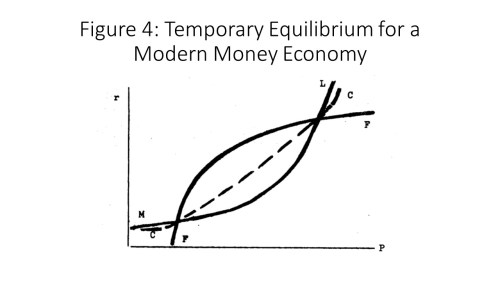
The full solution of the model (in the conventional case) is represented graphically by the intersection of the FF curve with the LM curve in Figure 4.

Thompson_Figure4

Note that by applying Walras’s Law, one could draw a CC curve representing equilibrium in the market for commodities (an analogue to the Keynesian IS curve) in the space between the FF and the LM curves and intersecting the two curves precisely at their point of intersection. Thus, Thompson’s reformulation supports Nick Rowe’s conjecture that the IS curve, contrary to the usual derivation, is really upward-sloping.

Stock Prices Rose by 5% in Two Weeks – Guess Why?

On Wednesday, July 25, the S&P 500 closed at 1337.89. On Wednesday, August 8, the S&P 500 closed at 1402.22, a gain of just under 5%. Care to guess why the market rose?

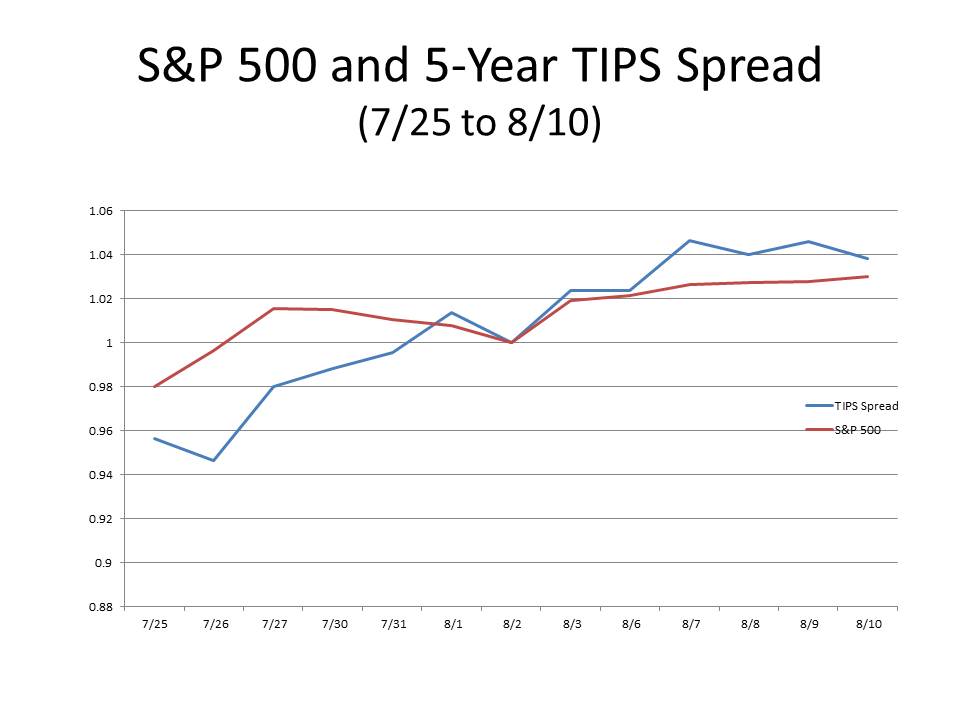
Well, it’s been a while since I’ve mentioned the stock market, but long-time readers of this blog already know that the stock market loves inflation (see here, here, and here), there having been a strong positive correlation between movements in inflation expectations and the direction of the stock market since early 2008, as I showed in my paper “The Fisher Effect Under Deflationary Expectations.” The correlation between inflation expectations and asset values is not a general implication of financial theory, which makes a strong and continuing correlation between inflation expectations and movements in stock prices something of an anomaly, an anomaly that reflects and underscores the dysfunctional state of the US and international economies since 2008, when monetary policy began to exert a deflationary bias even as the economy was sliding into a contraction. Using Bloomberg’s calculations of the breakeven TIPS spread on 1-, 2-, 5-, and 10-year Treasuries between July 25 and August 10, I calculated correlation coefficients between the Bloomberg TIPS spreads at those maturities and the S&P 500 of .764, 915, .906, and .87. Calculating the TIPS spreads on 5- and 10-year constant maturity Treasuries from the Treasury yield curve website, I found correlation coefficients of .904 and .887 between those TIPS spreads and the S&P 500. So the correlations are robust regardless of the specific TIPS spread one uses.

In the chart below, I draw a graph plotting movements in the 5-year TIPS spread (as calculated by Bloomberg) and in the S&P 500 between July 25 and August 10 (with both series normalized to equal 1 on August 2).

Get the picture?

Ever since March 2009, after the stock market hit bottom, having lost more than 50% of its value in the summer of 2008, the Fed has periodically signaled that it would take aggressive steps to stimulate the economy. The stock market, yearning for inflation, has repeatedly responded to signs that the Fed would respond to its desire for inflation, only to fall back in disappointment after it became clear that the Fed was not going to deliver the inflation that it had earlier dangled enticingly in front of desperate investors. Recently, as the signs of recovery that had been visible in the winter and early spring started to fade, the Fed has been sending out signals — faint and ambiguous, to be sure, but still signals — that it may finally provide some inflationary relief, and the stock market responded predictably and promptly. Will the Fed, perhaps relying on recent favorable employment data as an excuse, once again snooker the market?  Stay tuned.

Thompson’s Reformulation of Macroeconomic Theory, Part II: Temporary Equilibrium

I explained in my first post on Earl Thompson’s reformulation of macroeconomics that Thompson posited a model consisting of a single output serving as both a consumption good and as a second factor of production cooperating with labor to produce the output. The single output is traded in two markets: a market for sale to be consumed and a market for hire as a factor of production. The ratio of the rental price to the purchase price determines a real interest rate, and adding the expected rate of change in the purchase price from period to period to the real interest rate determines the nominal interest rate. The money wage is determined in a labor market, and the absolute price level is determined in the money market. A market for bonds exists, but the nominal interest rate determined by the ratio of the rental price of the output to its purchase price plus the expected rate of change in the purchase price from period to period governs the interest rate on bonds, conveniently allowing the bond market to be excluded from the analysis.

The typical IS-LM modeling approach is to posit a sticky wage that prevents equilibrium at full employment from being achieved except via an increase in aggregate demand. Wage rigidity is thus introduced as an ad hoc assumption to explain how an unemployment “equilibrium” is possible. However, by extending the model to encompass a second period, Thompson was able to derive wage stickiness in the context of a temporary equilibrium construct that does not rely on an arbitrary assumption of wage stickiness, but derives wage stickiness as an implication of incorrect expectations, in particular from overly optimistic wage expectations by workers who, upon observing unexpectedly low wage offers, choose to remain unemployed, preferring instead to engage in job search, leisure, or non-market labor activity.  The model assumptions are basically those of Lucas, and Thompson provides some commentary on the rationale for his assumptions.

One might, however, reasonably doubt that government policy makers have systematically better information than private decision makers regarding future prices. Such doubting would be particularly strong for commodity markets, where, in the real world, market specialists normally arbitrage between present and future markets. . . . But laws prohibiting long-term labor contracts have effectively prevented human capital from coming under the control of market specialists. As a consequence, the typical laborer, who is not naturally an expert in the market for his kind of service, makes his own employment decisions despite relative ignorance about the market. (p. 6)

I will just note parenthetically that my own view is that the information problem is exacerbated in the real world by the existence of many products and many different  kinds of services. Shocks are transmitted from sector to sector via complicated and indirect interrelationships between markets and sectors. In the process of transmission, initial shocks are magnified, some sectors being affected more than others in unpredictable, or at least unpredicted, ways causing sector-specific shocks that, in turn, get transmitted to other sectors. These interactions are analogous to the Cantillon effects associated with sector-specific variations in the rate of additional spending caused by monetary expansion.  Austrian economists tend to wring their hands and shake their heads in despair about the terrible distortions associated with Cantillon effects caused by monetary expansion, but seem to regard the Cantillon effects associated with monetary contraction as benign and remedial.  Highly aggregated models don’t capture these interactions and thus leave out an important feature of business-cycle contractions.

Starting from a position of full equilibrium, an exogenous shift creates a temporary equilibrium with Keynesian unemployment when there is an overall excess supply of labor at the original wage rates and some laborers mistakenly believe that the resulting lower wage offers from their present employers may be a result of a shift which lowers the value of their products in their present firms relative to other firms who hire workers in their occupations. As a consequence, some of these laborers refuse the lower wage offers from their present employers and spend their present labor service inefficiently searching for higher-wage jobs in their present occupation or resting in wait for what they expect to be the higher future wages.

Since monetary shifts, which are apparently observed to induce inefficient adjustments in employment, also change the temporary equilibrium level of prices of current outputs, we must assume that some workers do not know of the present change in the price level. Otherwise, all workers, in responding to a monetary shift, would be able to observe the price level change which accompanied the change in their wage offers and would not make the mistake of assuming that wage offers elsewhere have not similarly changed. . . . (p. 7)

The price level of current outputs is only an expectation function for these laborers, as they cannot be assumed to know the actual price level in the current period. This is represented . . . by allowing labor’s perception of current non-labor prices to depend only on last period’s prices, which are parameters rather than variables to be determined, and on current wage offers. (p. 8)

Because workers may construe an overall shift in the demand for labor as a relative shift in demand for their own type of labor, it follows that future wage and price expectations are inelastic with respect to observed increases in wage offers. Thus, a change in observed wages does not cause a corresponding revision of expected future wages and prices, so the supply of labor does not shift significantly when observed wages are higher or lower than expected.  When wages change because of an overall reduction in the demand for labor destined to cause future wages and prices to fall, workers with slowly adjusting expectations inefficiently supply services to employers on the basis of incorrect expectations. The temporary equilibrium corresponds to the intersection of a demand curve and a supply curve.  This is a type of wage rigidity different from that associated with the conventional Keynesian model.  The labor market is in equilibrium in the sense that current plans are being executed. However, current plans are conditional on incorrect expectations. There is an inefficiency associated with incorrect expectations. But it is an inefficiency that countercyclical policy can overcome, and that is why there is potentially a multiplier effect associated with an increase in aggregate demand.

Thompson’s Reformulation of Macroeconomic Theory, Part I: Two Basic Problems with IS-LM

As promised in my previous post, I am going to begin providing a restatement or paraphrase of, plus some commentary on, Earl Thompson’s important, but unpublished, paper “A Reformulation of Macroeconomic Theory.” It will take a number of posts to cover the main points in the paper, and I will probably intersperse posts on Earl’s paper with some posts on other topics. The posts are not written yet, so it remains to be seen how long it takes to go through it together.

The paper begins by identifying “four basic difficulties in received [i.e., Keynesian] theory.” In this post, I will discuss only the first two of the four that are listed, the two that undermine the theoretical foundations of the IS-LM model. The other two problems involve what Earl considered to be inconsistencies between the implications of the IS-LM model and some basic stylized facts of macroeconomics and business cycles, which seem to me less fundamental and less compelling than the two flaws he identified in the conceptual foundations of IS-LM.G

The first difficulty is that the Keynesian model assumes both that the marginal product of labor declines as workers are added and that every worker receives a real wage equal to his marginal product. Those two assumptions logically entail the existence of a second scarce factor of production – call it capital – to absorb the residual between total output and total wages. But even though investment as a category of expenditure is a critical variable in the Keynesian model, the status of capital as a factor of production is unacknowledged, while the rate of interest is determined independently of the market for capital goods by a theory of liquidity preference and the equality between savings and investment. A market for bonds is implicitly acknowledged, but, inasmuch as Walras’s Law allows one market to be disregarded, the bond market is not modeled explicitly. The anomaly of an interest rate in a static, one-period model has been noted, but the inconsistency between the conventional Keynesian model IS-LM model with the basic neoclassical theory of production and factor pricing has been glossed over by the irrelevant observation that Walras’s Law allows the bond market to be excluded, as if the bond market were a proxy for a market for real capital services.

How can the inconsistency between the Keynesian model and the neoclassical theory of production and distribution be reconciled? The simplest way to do so is to treat the single output as both a consumption good and a factor of production. This amounts to treating the single output as a Knightian crusonia plant. If used as a consumption good, the plant is purchased and consumed; if used as a factor of production, it is hired (implicitly or explicitly) at a rental price equal to its marginal product. The ratio of the marginal product of a unit of capital to its price is the real interest rate, and that ratio plus the expected percentage appreciation of the money price of the capital good from the current period to the next is the nominal interest rate. This is a basic property of intertemporal equilibrium. The theory of liquidity preference cannot contradict, but must be in accord with, this condition, something that Keynes himself recognized in chapter 17 of the General Theory and again in his 1937 paper “The General Theory of Employment.”

It is worth quoting from the latter paper at length, as Duncan Foley and Miguel Sidrauski did in their important 1970 article “Portfolio Choice, Investment, and Growth,” cited by Thompson as an important precursor to his own paper. Here is Keynes:

The owner of wealth, who has been induced not to hold wealth in the shape of hoarded money, still has two alternatives between which to choose. He can lend his money at the current rate of money-interest or he can purchase some kind of capital asset. Clearly in equilibrium these two alternatives must offer an equal advantage to the marginal investor in each of them. This is brought about by shifts in the money prices of capital assets relative to money loans. The prices of capital assets move until, having regard to their prospective yield and account being taken of all those elements of doubt and uncertainty interested and disinterested advice, fashion, convention, and what else you will, which affect the mind of the investor who is wavering between one kind of investment and another. . . .

Capital assets are capable, in general, of being newly produced. The scale on which they are produced depends, of course, on the relation between their costs of production and the prices which they are expected to realize in the market. Thus if the level of the rate of interest taken in conjunction with opinions about their prospective yield raise the price of capital assets, the volume of current investment (meaning by this the value of the output of newly produced capital assets) will be increased; while if, on the other hand, these influences reduce the prices of capital assets, the volume of current investment will be diminished.

Thus, Keynes clearly recognized that the volume of investment could be analyzed as the solution of a stock-flow problem with a given cost of producing capital assets in relation to the current and expected future price of capital assets. The solution of such a problem involves an equilibrium in which the money rate of interest must equal the real rental rate of capital services plus the expected rate of appreciation of capital assets. But nothing in the IS-LM model constrains the rate of interest to satisfy this condition.

Earl sums up this discussion compressed into a single paragraph at the beginning of his paper as follows:

An inconsistency thus appears within the received [i.e., IS-LM] theory once we recognize the necessity of a market for the services of a non-labor input, a recognition which amounts to adding an independent equilibrium equation without adding a corresponding variable.

In other words, the IS-LM model implies one interest rate, and the neoclassical theory of production and distribution implies another, and there is no new variable defined that could account for the discrepancy. Earl goes on to elaborate in a long footnote.

Numerous authors have pointed out the inconsistency of Keynesian interest theory with neoclassical marginal productivity theory. But they have not seen the need for the extra equation describing equilibrium in the capital services market, and thus they have not regarded the inconsistency as a direct logical threat to Keynesian models. Rather, they have unfortunately been satisfied, at least since the classic paper of Lerner, with a conjecture that the difference in interest rates vanishes when there are increasing costs of producing capital relative to consumption goods. The error in this conjecture, an error first suggested by Stockfish and fully exposed very recently by Floyd and Hynes, is simply that increasing costs of producing investment goods will not generally permit the interest rate determined by marginal productivity theory to vary in a Keynesian fashion.

In other words, the negative-sloping IS curve will be replaced by a corresponding (FF) curve, representing equilibria in the labor and capital-services markets, that is upward-sloping in terms of interest rates and price levels. The footnote continues:

A legitimate way to account for the difference in interest rates would be to follow Patinkin in assuming the presence of “bonds” which receive the “rate of interest” referred to in the standard theory, a rate of interest which differs from the money rate of return on real capital because of positive transactions costs in the process of lending to owners of capital. But received macroeconomic theory would still be inconsistent with marginal productivity theory because of arbitrage between the two interest rates, where the transactions costs in the process of lending to owners of capital will determine the relationship between the rates. This arbitrage would provide a constraint on the behavior of the bond rate which . . . is generally not satisfied in standard formulations.

The point here is that the interest rate on bonds is not determined in a vacuum. The interest rate on bonds is an epiphenomenon reflecting the deeper forces that determine the rate of return on real capital. Without an underlying market for real capital, the rate of interest on bonds would be indeterminate. Once the real rate of return of capital is determined, the rate of return on bonds can vary only within the limits allowed by the transactions costs of lending and borrowing by financial intermediaries. The footnote concludes with this observation:

Finally, there would be no difference in interest rates, and no extra equation, if the implicit market excluded with Walras’ law in a Keynesian model were simply a capital services market. However, this interpretation of a Keynesian model is inconsistent with the rest of the model.

What Thompson means here is that suppose we had a complete theoretical description of an economy consistent with the neoclassical theory of production and distribution, and we also had a complete description of the Keynesian expenditure functions for consumption and investment. It would then be legitimate, in accordance with Walras’s Law, to exclude the market for capital services, rather than, as Thompson proposes to do, to exclude the expenditure functions. If so, what is all the fuss about? And Earl’s answer is that in order to render the Keynesian income-expenditure model consistent with the excluded market for capital services, we would have to modify the Keynesian income-expenditure model into a two-period framework with an explicit solution for the current and expected future price level of output, implying that the expected rate of inflation would become an equilibrating variable determined as part of the solution of model. Obviously that would not be the Keynesian IS-LM model with which we are all familiar.

I hope this post will serve as a helpful introduction to how Thompson approached macroeconomics.  The next post in this series (but not necessarily the next post on this blog) will discuss the concept of temporary equilibrium and Keynesian unemployment.

Earl Thompson

Sunday, July 29, will be the second anniversary of the sudden passing of Earl Thompson, one of the truly original and creative minds that the economics profession has ever produced. For some personal recollections of Earl, see the webpage devoted to him on the UCLA website, where a list of his publications and working papers, most of which are downloadable, is available. Some appreciations and recollections of Earl are available on the web (e.g, from Tyler Cowen, Scott Sumner, Josh Wright, and Thomas Lifson).  I attach a picture of Earl taken by a department secretary, Lorraine Grams, in 1974, when Earl was about 35 years old.

I first met Earl when I was an undergraduate at UCLA in the late 1960s, his reputation for brilliant, inconclastic, eccentricity already well established. My interactions with Earl as undergraduate were minimal, his other reputation as a disorganized and difficult-to-follow lecturer having deterred me, as a callow sophomore, from enrolling in his intermediate micro class. Subsequently as a first-year graduate student, I had the choice of taking either Axel Leijonhufvud’s macro-theory sequence or Earl’s. Having enjoyed Axel’s intermediate macro course, I never even considered not taking the graduate sequence from Axel, who had just achieved academic stardom with the publication of his wonderful book On Keynesian Economics and the Economics of Keynes. However, little by little over the years, I had started reading some of Earl’s papers on money, especially an early version of his paper “The Theory of Money and Income Consistent with Orthodox Value Theory,” which, containing an explicit model of a competitive supply of money, a notion that I had been exposed to when taking Ben Klein’s undergraduate money and banking course and his graduate monetary theory course, became enormously influential on my own thinking, providing the foundation for my paper, “A Reinterpretation of Classical Monetary Theory” and for much of my book Free Banking and Monetary Reform, and most of my subsequent work in monetary economics. So as a second-year grad student, I decided to attend Earl’s weekly 3-hour graduate macro theory lecture. Actually I think at least half of us in the class may have been there just to listen to Earl, not to take the class for credit. Despite his reputation as a disorganized and hard to follow lecturer, each lecture, which was just Earl at the blackboard with a piece of chalk drawing various supply and demand curves, and occasionally something more complicated, plus some math notation, but hardly ever any complicated math or formal proofs, and just explaining the basic economic intuition of whatever concept he was discussing. By this time he had already worked out just about all of the concepts, and he was not just making it up as he was going along, which he could also do when confronted with a question about something he hadn’t yet thought through. But by then, Earl had thought through the elements of his monetary theory so thoroughly and for so long, that everything just fit into place beautifully. And when you challenged him about some point, he almost always had already anticipated your objection and proceeded to explain why your objection wasn’t a problem or even supported his own position.

I didn’t take detailed notes of his lectures, preferring just to try to understand how Earl was thinking about the topics that he was discussing, so I don’t have a clear memory of the overall course outline.  However his paper “A Reformulation of Macroeconomic Theory,” of which he had just produced an early draft, provides the outline of what he was covering. He started with a discussion of general equilibrium and its meaning, using Hicksian temporary equilibrium as his theoretical framework.  Perhaps without realizing it, he developed many of the ideas in Hayek’s Economics and Knowledge paper, which may, in turn, have influenced Hicks, who was for a short time Hayek’s student and colleague at LSE — in particular the idea that intertemporal equilibrium means consistency of plans so that economic agents are able to execute their plans as intended and therefore do not regret their decisions ex post. From there I think he developed a search-theoretic explanation of involuntary unemployment in which mistaken worker expectations of wages, resulting from an inability to distinguish between sector-specific and economy-wide shocks, causes labor-supply curves to be highly elastic at the currently expected wage, implying large fluctuations in employment, in response to economy-wide shocks, rather than rapid adjustments in nominal wages . With this theoretical background, Earl constructed a simple aggregative model as an alternative to the Keynesian model, the difference being that Earl dispensed with the Keynesian expenditure functions and the savings equals investment equilibrium condition, replacing them with a capital-market equilibrium condition derived from neo-classical production theory — an inspired modeling choice.

Thus, in one fell swoop, Earl created a model fully consistent with individual optimizing behavior, market equilibrium and Keynesian unemployment. Doing so involved replacing the traditional downward-sloping IS curve with an upward-sloping, factor-market equilibrium curve. At this point, the model could be closed either with a traditional LM curve corresponding to an exogenously produced money supply or with a vertical LM curve associated with a competitively produced money supply. That discussion in turn led to a deep excursion into the foundations of monetary theory, the historical gold standard, fiat money, and a comparison of the static and dynamic efficiency of alternative monetary institutions, combined with a historical perspective on the Great Depression, and the evolution of modern monetary institutions. It was a terrific intellectual tour de force, and a highlight of my graduate training at UCLA.

Unfortunately, “A Reformulation of Macroeconomic Theory” has never been published, though a revised version of the paper (dated 1977) is available on Earl’s webpage. The paper is difficult to read, at least for me, because Earl was much too terse in his exposition – many propositions are just stated with insufficient motivation or explanation — with readers often left scratching their heads about the justification for what they have read or why they should care.  So over the next week or so, I am going to write a series of posts summarizing the main points of the paper, and discussing why I think the argument is important, problems I have with his argument or ways in which the argument needs further elaboration or what not. I hope the discussions will lead people to read the original paper, as well as Earl’s other papers.

To QE or not to QE

Steve Horwitz, one of my favorite contemporary Austrian economists – and he would be likely be one of them even if there were not such a dearth of Austrian economists to plausibly choose from — published an opinion piece in US News and World Report opposing another round of quantitative easing. His first paragraph focuses on the size of the Fed balance sheet and the (unenumerated) “new and unprecedented” powers that the Fed has accumulated, as if the size of the Fed balance sheet were somehow logically related to its accumulation of those new and unprecedented powers. But the size of the Fed’s balance sheet and the extent of the powers that it is exercising are not really the nub of Horwitz’s argument; it is the prelude to an argument that begins in the next paragraph

[P]revious rounds of quantitative easing have done little . . . to generate recovery. Of course it’s . . . possible that it’s because it wasn’t enough, but a tripling of the Fed’s balance sheet hardly seems like an insufficient attempt at monetary stimulus.

In other words, if QE hasn’t worked till now, why should we think that another round will be any more successful? But if the objection is simply that QE doesn’t matter, one might well respond that, in that case, there also doesn’t seem to be much harm in trying.

Horwitz then turns to the argument that some proponents (notably Market Monetarists) of additional QE have been making, which is that for about two decades the level of aggregate nominal spending in the economy or nominal gross domestic product (NGDP) was growing at an annual rate in the neighborhood of 5%.  But since the 2008-09 downturn, the economy has fallen way below that growth path, so that the job of monetary policy is to bring the economy at least part of the way back to that path, instead of allowing it to lag farther and farther behind its former growth path. Horwitz raises the following objection to this argument.

[M]ost economic theories explaining why an insufficient money supply would lead to recession depend upon “stickiness” in prices and wages. Those same theories also indicate that, after a sufficient amount of time, people will adjust to that stickiness in prices and wages and the money supply will be sufficient again.

If that adjustment hasn’t taken place in almost four years, then perhaps it is not this “stickiness” that could perhaps be overcome by more monetary stimulus, but rather real resource misallocations that are causing delaying recovery. Those real misallocations cannot be fixed by more money. Instead, we need less regulation and more freedom for entrepreneurs to reallocate resources away from the mistakes of the boom, to where they are most valuable now.

I have three problems with this dismissal of monetary stimulus. First, Horwitz takes it as self-evident that a tripling of the Fed’s balance sheet is the equivalent of monetary stimulus. But that of course simply presumes that the demand of the public to hold the monetary base has not increased as fast or faster than the monetary base has increased. In fact, the slowdown in the growth of NGDP and inflation in the last four years suggests that the public has been more than willing to hold all the additional currency and reserves (the constituents of the monetary base) that the Fed has created. If so, there has been no effective monetary stimulus. But isn’t it unusual for the demand for the monetary base to have increased so much in so short a time? Yes, it certainly is unusual, but not unprecedented.  In the Great Depression there was a huge increase in the demand to hold currency and bank reserves, and voices were then raised warning of the inflationary implications of rapidly increasing the monetary base. In retrospect, almost everyone (with the exception of some fanatical Austrian economists who tend to regard Professor Horwitz as dangerously tolerant of mainstream economics) now views the voices that were warning of inflation in the 1930s with the same astonishment as Ralph Hawtrey expressed when he compared such warnings to someone “crying fire, fire in Noah’s flood.”

Second, Horwitz may be right that most economic theories explaining why an insufficient money supply can cause unemployment rely on some form of price stickiness to explain why market price adjustments can’t do the job without monetary expansion. But price stickiness is a very vague and imprecise term covering a lot of different, and possibly conflicting, interpretations. Horwitz’s point seems to be something like the following: “OK, I’ll grant you that prices and wages don’t adjust quickly enough to restore full employment immediately, but why should four years not be enough time to get wages and prices back into proper alignment?” That objection presumes that there is a unique equilibrium structure of wages and prices, and that price adjustments move the economy, however slowly, toward that equilibrium. But that is a mistaken view of economic equilibrium, which, in the real world, depends not only on price adjustments, but on price expectations. Unless price expectations are in equilibrium, price adjustments, whether rapid or slow, cannot guarantee that economic equilibrium will be reached.  The problem is that there is no economic mechanism that ensures the compatibility of the price expectations held by different economic agents, by workers and by employers.  This proposition about the necessary conditions for economic equilibrium should not be surprising to Horwitz, inasmuch as it was set out about 75 years ago in a classic article by one of his (and my) heroes, F. A. Hayek. If the equilibrium set of price expectations implies an expected inflation rate over the next two to five years greater than the 1.5% it is now generally estimated to be, then the economy can’t move toward equilibrium unless inflation and inflation expectations are raised significantly.

Third, although Horwitz finds it implausible that price stickiness could account for the failure to achieve a robust recovery, he is confident that “less regulation and more freedom for entrepreneurs to reallocate resources away from the mistakes of the boom, to where they are most valuable now” would produce such a recovery, and quickly. But he offers no reason or evidence to justify a supposition that the regulatory burden is greater, and entrepreneurial freedom less, today than it was in previous recoveries. To me that seems like throwing red meat to the ideologues, not the sort of reasoned argument that I would have expected from Horwitz.

HT:  Lars Christensen

George Selgin Asks a Question

I first met George Selgin almost 30 years ago at NYU where I was a visiting assistant professor in 1981, and he was a graduate student. I used to attend the weekly Austrian colloquium headed by Israel Kirzner, which included Mario Rizzo, Gerry O’Driscoll, and Larry White, and a group of very smart graduate students like George, Roger Koppl, Sandy Ikeda, Allanah Orrison, and others that I am not recalling. Ludwig Lachmann was also visiting NYU for part of the year, and meeting him was a wonderful experience, as he was very encouraging about an early draft of my paper “A Reinterpretation of Classical Monetary Theory,” which I was then struggling to get into publishable form. A few years later, while I was writing my book Free Banking and Monetary Reform, I found out (I can’t remember how, but perhaps through Anna Schwartz who was on George’s doctoral committee) that he was also writing a book on free banking based on his doctoral dissertation. His book, The Theory of Free Banking, came out before mine, and he kindly shared his manuscript with me as I was writing my book. Although we agreed on many things, our conceptions of free banking and our interpretations of monetary history and policy were often not in sync.

Despite these differences, I watched with admiration as George developed into a prolific economist with a long and impressive list of publications and accomplishments to his credit. I also admire his willingness to challenge his own beliefs and to revise his views about economic theory and policy when that seems to be called for, for example, recently observing in a post on the Free Banking blog that he no longer describes himself as an Austrian economist, and admires that Austrian bete noire, Milton Friedman, though he has hardly renounced his Hayekian leanings.

In one of his periodic postings (“A Question to Market Monetarists“) on the Free Banking blog, George recently discussed NGDP targeting, and raised a question to supporters of nominal GDP targeting, a challenging question to be sure, but a question not posed in a polemical spirit, but out of genuine curiosity. George begins by noting that his previous work in arguing for the price level to vary inversely with factor productivity bears a family resemblance to proposals for NGDP targeting, the difference being whether, in a benchmark case with no change in factor productivity and no change in factor supplies, the price level would be constant or would rise at some specified rate, presumably to overcome nominal rigidities. In NGDP targeting with an upward price trend (Scott Sumner’s proposal) or in NGDP targeting with a stationary price trend (George’s proposal), any productivity increase would correspond to price increases below the underlying price trend and productivity declines would correspond to price increases above underlying the price trend.

However, despite that resemblance, George is reluctant to endorse the Market Monetarist proposal for rapid monetary expansion to promote recovery. George gives three reasons for his skepticism about increasing the rate of monetary expansion to promote recovery, but my concern in this post is with his third, which is the most interesting from his point of view and the one that prompts the question that he poses. George suggests that given the 4.5-5.0% rate of growth in NGDP in the US since the economy hit bottom in the second quarter of 2009, it is not clear why, according to the Market Monetarists, the economy should not, by now, have returned to roughly its long-run real growth trend. (I note here a slight quibble with George’s 4.5-5.0% estimate of recent NGDP growth.  In my calculations, NGDP has grown at just 4.00% since the second quarter of 2009, and at 3.82% since the second quarter of 2010.)

Here’s how George characterizes the problem.

My third reason stems from pondering the sort of nominal rigidities that would have to be at play to keep an economy in a state of persistent monetary shortage, with consequent unemployment, for several years following a temporary collapse of the level of NGDP, and despite the return of the NGDP growth rate to something like its long-run trend.

Apart from some die-hard New Classical economists, and the odd Rothbardian, everyone appreciates the difficulty of achieving such downward absolute cuts in nominal wage rates as may be called for to restore employment following an absolute decline in NGDP. Most of us (myself included) will also readily agree that, if equilibrium money wage rates have been increasing at an annual rate of, say, 4 percent (as was approximately true of U.S. average earnings around 2006), then an unexpected decline in that growth rate to another still positive rate can also lead to unemployment. But you don’t have to be a die-hard New Classicist or Rothbardian to also suppose that, so long as equilibrium money wage rates are rising, as they presumably are whenever there is a robust rate of NGDP growth, wage demands should eventually “catch down” to reality, with employees reducing their wage demands, and employers offering smaller raises, until full employment is reestablished. The difficulty of achieving a reduction in the rate of wage increases ought, in short, to be considerably less than that of achieving absolute cuts.

U.S. NGDP was restored to its pre-crisis level over two years ago. Since then both its actual and its forecast growth rate have been hovering relatively steadily around 5 percent, or about two percentage points below the pre-crisis rate.The growth rate of U.S. average hourly (money) earnings has, on the other hand, declined persistently and substantially from its boom-era peak of around 4 percent, to a rate of just 1.5 percent.** At some point, surely, these adjustments should have sufficed to eliminate unemployment in so far as such unemployment might be attributed to a mere lack of spending. How can this be?

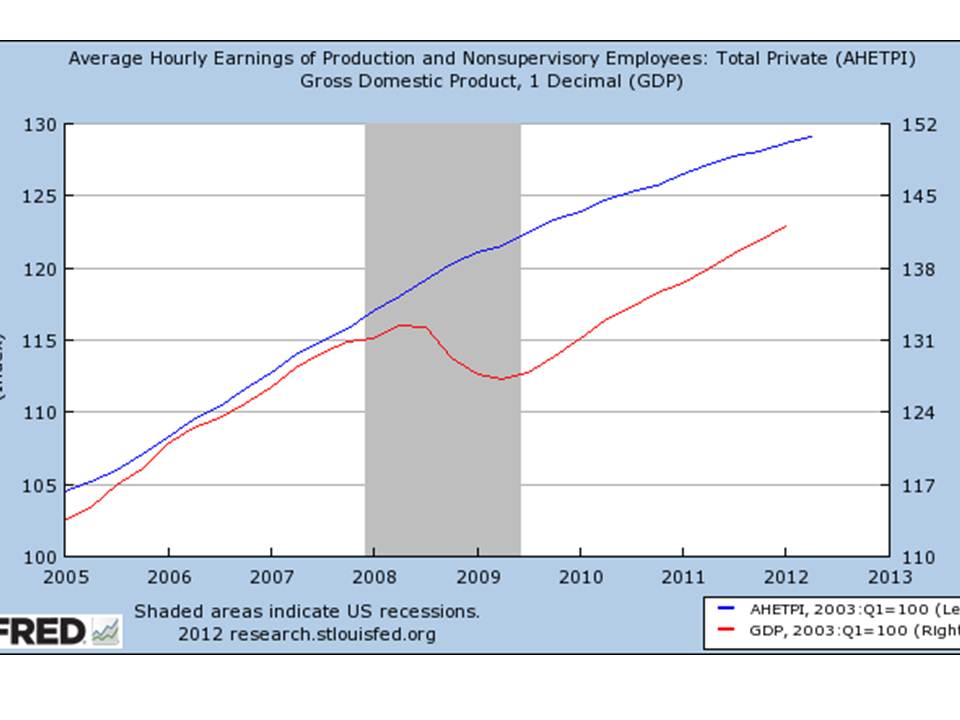
There have been a number of responses to George. Among them, Scott Sumner, Bill Woolsey and Lars Christensen. George, himself, offered a response to his own question, in terms of this graph plotting the time path of GDP versus the time path of nominal wages before and since the 2007-09 downturn.

Here’s George’s take on the graph:

Here one can clearly see how, while NGDP plummeted, hourly wages kept right on increasing, albeit at an ever declining rate. Allowing for compounding, this difference sufficed to create a gap between wage and NGDP levels far exceeding its pre-bust counterpart, and large enough to have been only slightly reduced by subsequent, reasonably robust NGDP growth, notwithstanding the slowed growth of wages.

The puzzle is, of course, why wages have kept on rising at all, despite high unemployment. Had they stopped increasing altogether at the onset of the NGDP crunch, wages and total spending might have recovered their old relative positions about two years ago. That, presumably, would have been too much to hope for. But if it is unreasonable to expect wage inflation to stop on a dime, is it not equally perplexing that it should lunge ahead like an ocean liner might, despite having its engines put to a full stop?

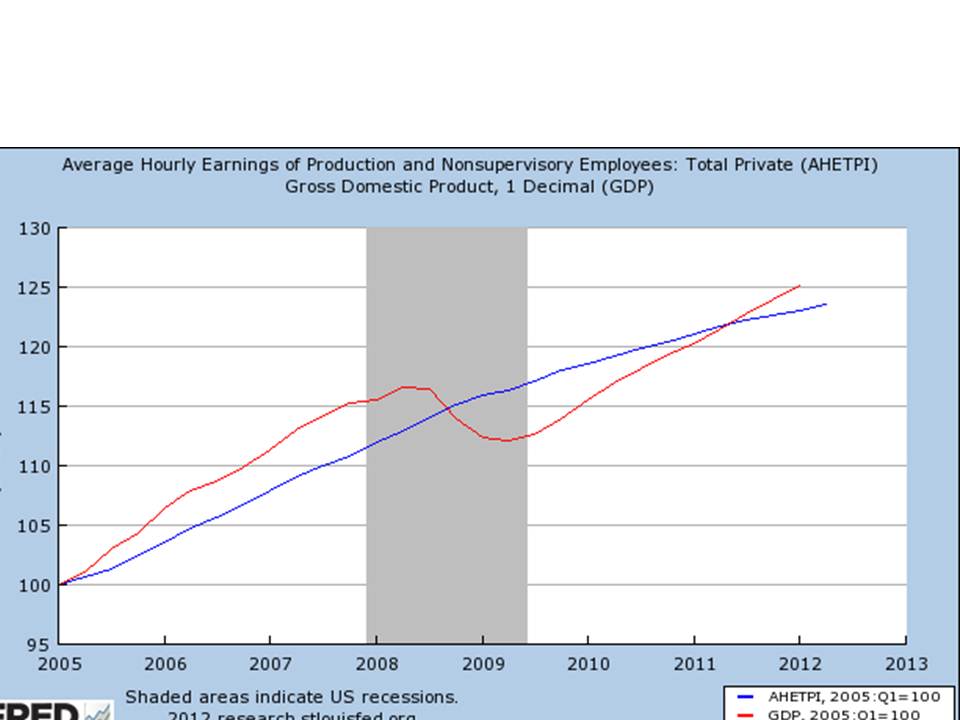
However, after some further tinkering, George decided that the appropriate scaling of the graph implied that the relationship between the two time paths was that displayed in the graph below.

As a result of that rescaling, George withdrew, or at least qualified, his earlier comment. So, it’s obviously getting complicated. But Marcus Nunes, a terrific blogger and an ingenious graph maker, properly observes that George’s argument should be unaffected by any rescaling of his graph. The important feature of the time path of nominal GDP is that it dipped sharply and then resumed its growth at a somewhat slower rate than before the dip while the time path of nominal wages has continued along its previous trend, with just a gentle flattening of the gradient, but without any dip as occurred in the NGDP time path.  The relative position of the two curves on the graph should not matter.

By coincidence George’s first post appeared the day before I published my post about W. H. Hutt on Say’s Law and the Keynesian multiplier in which I argued that money-wage adjustments — even very substantial money-wage adjustments — would not necessarily restore full employment. The notion that money-wage adjustments must restore full employment is a mistaken inference from a model in which trading occurs only at equilibrium prices.  But that is not the world that we inhabit. Trading takes place at prices that the parties agree on, whether or not those prices are equilibrium prices. The quantity adjustments envisaged by Keynes and also by Hutt in his brilliant interpretation of Say’s Law, can prevent price-and-wage adjustments, even very large price-and-wage adjustments, from restoring a full-employment equilibrium. Hutt thought otherwise, but made no effective argument to prove his case, relying simply on a presumption that market forces will always put everything right in the end. But he was clearly mistaken on that point, as no less an authority that F. A. Hayek, in his 1937 article, “Economics and Knowledge,” clearly understood. For sufficiently large shocks, there is no guarantee that wage-and-price adjustments on their own will restore full employment.

In a comment on Scott’s blog, I made the following observation.

[T]he point [George] raises about the behavior of wages is one that I have also been wondering about. I mentioned it in passing in a recent post on W. H. Hutt and Say’s Law and the Keynesian multiplier. I suggested the possibility that we have settled into something like a pessimistic expectations equilibrium with anemic growth and widespread unemployment that is only very slowly, if at all, trending downwards. To get out of such a pessimistic expectations equilibrium you would need either a drastic downward revision of expected wages or a drastic increase in inflationary expectations sufficient to cause a self-sustaining expansion in output and employment. Just because the level of wages currently seems about right relative to a full employment equilibrium doesn’t mean that level of wages needed to trigger an expansion would not need to be substantially lower than the current level in the transitional period to an optimistic-expectations equilibrium. This is only speculation on my part, but I think it is potentially consistent with the story about inflationary expectations causing the stock market to rise in the current economic climate.

George later replied on Scott’s blog as follows:

David Glasner suggests “the possibility that we have settled into something like a pessimistic expectations equilibrium with anemic growth and widespread unemployment…To get out of such a pessimistic expectations equilibrium you would need either a drastic downward revision of expected wages or a drastic increase in inflationary expectations.”

The rub, if you ask me, is that of reconciling “pessimistic expectations” with what appears, on the face of things, to be an overly optimistic positioning of expected wages.

I am not sure why George thinks there is a problem of reconciliation. As Hayek showed in his 1937 article, a sufficient condition for disequilibrium is that expectations be divergent. If expectations diverge, then the plans constructed on those plans cannot be mutually consistent, so that some, perhaps all, plans will not be executed, and some, possibly all, economic agents will regret some prior decisions that they took. Especially after a large shock, I see no reason to be surprised that expectations diverge or even that, as a group, workers are slower to change expectations than employers. I may have been somewhat imprecise in referring to a “pessimistic-expectations” equilibrium, because what I am thinking of is an inconsistency between the pessimism of entrepreneurs about future prices and the expectations of workers about wages, not a situation in which all agents are equally pessimistic. If everyone were equally pessimistic, economic activity might be at a low level, but we wouldn’t necessarily observe any disappointed buyers or sellers. But what qualifies as disappointment might not be so easy to interpret. But we likely would observe a reduction in output. So a true “pessimistic-expectations” equilibrium is a bit tricky to think about. But in practice, there seems nothing inherently surprising about workers’ expectations of future wages not adjusting downward as rapidly as employers’ expectations do. It may also be the case that it is the workers with relatively pessimistic expectations who are dropping out of the labor force, while those with more optimistic expectations continue to search for employment.

I don’t say that the slow recovery poses not difficult issues for advocates of monetary stimulus to address.  The situation today is not exactly the same as it was in 1932, but I don’t agree that it can be taken as axiomatic that a market economy will recover from a large shock on its own.  It certainly may recover, but it may not.  And there is no apodictically true demonstration in the whole corpus of economic or praxeological theory that such a recovery must necessarily occur.

Murdoch Tends to Corrupt

Allan Meltzer has had a long and distinguished career as an economist and scholar, making many notable contributions to monetary economics at both the theoretical and empirical levels, also writing valuable and highly regarded contributions to the history of economics and economic history, especially his 1989 book on Keynes and his recent monumental two-volume history of the Federal Reserve System. Meltzer has the added virtue of being a UCLA-trained economist, where as a student he began his long collaboration with his teacher Karl Brunner. So I take no pleasure in writing this post about what can only be described as an embarrassment, namely, the abysmal op-ed article (“What’s Wrong with the Federal Reserve?”) Meltzer wrote in today’s Wall Street Journal about the Fed and current monetary policy.

Meltzer immediately gets off to a bad start, from which he never recovers, with the following opening sentence.

By allowing its monetary policy to be influenced by elected politicians and market speculators, the Federal Reserve is putting its independence at risk.

Now you might have thought that a serious charge about the Fed’s conduct would require some supporting evidence that the Fed’s policy was being influenced by either politicians or speculators. Well, this is what seems to count as evidence for Professor Meltzer.

Consider the response to last week’s employment report for June—a meager 80,000 net new jobs created, and an unemployment rate stuck at 8.2%. Day traders and speculators immediately clamored for additional monetary easing. Even the president of the Federal Reserve Bank of Chicago joined in.

So the people that Professor Meltzer thinks are now controlling Fed policy are a bunch of day traders. This goes way past what even Ron Paul would say about who is controlling the Fed, i.e., international bankers (aka the Rothschilds). No, it’s a conspiracy of the day traders, apparently having co-opted the president of the Chicago Federal Reserve Bank. Talk about lowering the bar. But it gets worse. Let’s read on.

To his credit, Mr. Bernanke did not immediately agree. But he failed utterly to state the obvious: The country’s sluggish growth and stubbornly high unemployment rate was [sic] not caused by, nor could it [sic] be cured by, monetary policy.

OK, Professor Meltzer has discovered that the Fed is being controlled by a conspiracy of day traders working through the president of the Chicago Fed.  Except that Bernanke and the FOMC (except for that guy from Chicago) did not go along with the conspirators! What then is the evidence that Fed policy is controlled by the day traders? Apparently, the failure of Bernanke to make an abject admission of the Fed’s impotence.

Now what is Professor Meltzer’s evidence for the Fed’s impotence? Let him speak for himself:

Market interest rates on all maturities of government bonds are the lowest since the founding of the republic.

This is astonishing. Allan Meltzer is widely regarded as a founding fathers (along with Milton Friedman and Karl Brunner) of modern Moneterism, one of whose basic tenets is that nominal interest rates are primarily determined by inflation expectations. Thus, low interest rates, as Milton Friedman always pointed out, are symptomatic of tight monetary policy that keeps inflation, and inflation expectations, low, as they are now. But somehow Professor Meltzer has now concluded, like the Keynesians that Monetarists once disputed, that low interest rates are symptomatic of easy money. Meltzer later invokes Friedman’s authority to support the proposition that monetary policy is an unreliable instrument for stabilizing short-term fluctuations in the economy, causing one to wonder whether his memory lapses are random or selective.

Professor Meltzer’s memory of recent economic history is also dubious. Discussing the Fed’s adoption of QE2 in the fall of 2010, he writes:

Consider also how, in the summer of 2010, the Fed allowed itself to be spooked by cries about a double-dip recession and deflation. It added $600 billion to banks’ reserves by buying up federal Treasurys and mortgage-backed securities. Today, $500 billion of those reserves remain on bank balance sheets, and most of the rest of the dollars are held by foreign central banks. Not much help to the U.S. economy. By early autumn 2010, it had become clear that fears of a double-dip recession and deflation were just short-term hysteria.

Actually, Chairman Bernanke only signaled in late August and early September 2010 that the Fed would engage in renewed quantitative easing, thereby producing an immediate market response. The renewed purchases did not begin until the autumn. What became clear in the autumn was not that recession and deflation fears were just short-term hysteria, but that quantitative easing prevented the slide into recession that had been anticipated by a sharp dive in the stock market in August 2010.

Meltzer asserts that the cause of the weak recovery is uncertainty about future tax rates, health-care costs, and the regulatory burden. One would expect that, as an accomplished empirical economist, Professor Meltzer would attempt to back up his assertion with evidence. But he apparently regards it as too self-evident a proposition to require any empirical support.

Professor Meltzer again displays a shockingly cavalier attitude toward empirical evidence with the following assertion:

Evidence is growing that many think higher inflation is in our future. One sign is the premium that investors pay to hold index-linked Treasury bonds that protect against inflation.

These claims about inflation expectations are not backed up by data of any kind, even though they are readily available. The only problem is that the data don’t support Meltzer’s claims.  Breakeven TIPS spreads have edged up slightly in the last couple of weeks as fears of an imminent financial crisis in Europe have eased, but even at the 10-year time horizon the breakeven rate is barely above 2%, which is less than inflation expectations have been for most of the nearly four years since the onset of the financial crisis in 2008. And according to the estimates of inflation expectations by the Cleveland Fed, 10-year inflation expectations in June were at an all-time low, about 1.2%.

Although there is much more to criticize about this piece, it would be churlish to continue further. But I cannot help wonder why Professor Meltzer is so heedless of his reputation that he would allow his name to be attached to a piece of work so far below not just his own formerly high standards, but even below a standard of minimal competence. My only conjecture is that Rupert Murdoch is somehow responsible. Perhaps Murdoch has cast a demonic spell on Professor Meltzer. That seems as good an explanation as any.

Williamson v. Sumner

Stephen Williamson weighed in on nominal GDP targeting in a blog post on Monday. Scott Sumner and Marcus Nunes have already responded, and Williamson has already responded to Scott, so I will just offer a few semi-random comments about Williamson’s post, the responses and counter-response.

Let’s start with Williamson’s first post. He interprets Fed policy, since the Volcker era, as an implementation of the Taylor rule:

The Taylor rule takes as given the operating procedure of the Fed, under which the FOMC determines a target for the overnight federal funds rate, and the job of the New York Fed people who manage the System Open Market Account (SOMA) is to hit that target. The Taylor rule, if the FOMC follows it, simply dictates how the fed funds rate target should be set every six weeks, given new information.

So, from the mid-1980s until 2008, everything seemed to be going swimmingly. Just as the inflation targeters envisioned, inflation was not only low, but we had a Great Moderation in the United States. Ben Bernanke, who had long been a supporter of inflation targeting, became Fed Chair in 2006, and I think it was widely anticipated that he would push for inflation targeting with the US Congress.

Thus, under the Taylor rule, as implemented, ever more systematically, by the FOMC, the federal funds rate (FFR) was set with a view to achieving an implicit inflation target, presumably in the neighborhood of 2%. However, as a result of the Little Depression beginning in 2008, Scott Sumner et al. have proposed targeting NGDP instead of inflation. Williamson has problems with NGDP targeting that I will come back to, but he makes a positive case for inflation targeting in terms of Friedman’s optimal-supply-of-money rule, under which the nominal rate of interest is held at zero via a rate of inflation that is the negative of the real interest rate (i.e., deflation whenever the real rate of interest is positive). Back to Williamson:

The Friedman rule . . . dictates that monetary policy be conducted so that the nominal interest rate is always zero. Of course we know that no central bank does that, and we have good reasons to think that there are other frictions in the economy which imply that we should depart from the Friedman rule. However, the lesson from the Friedman rule argument is that the nominal interest rate reflects a distortion and that, once we take account of other frictions, we should arrive at an optimal policy rule that will imply that the nominal interest rate should be smooth. One of the frictions some macroeconomists like to think about is price stickiness. In New Keynesian models, price stickiness leads to relative price distortions that monetary policy can correct.

If monetary policy is about managing price distortions, what does that have to do with targeting some nominal quantity? Any model I know about, if subjected to a NGDP targeting rule, would yield a suboptimal allocation of resources.

I really don’t understand this. Williamson is apparently defending current Fed practice (i.e., targeting a rate of inflation) by presenting it as a practical implementation of Friedman’s proposal to set the nominal interest rate at zero. But setting the nominal interest rate at zero is analogous to inflation targeting only if the real rate of interest doesn’t change. Friedman’s rule implies that the rate of deflation changes by as much as the real rate of interest changes. Or does Williamson believe that the real rate of interest never changes? Those of us now calling for monetary stimulus believe that we are stuck in a trap of widespread entrepreneurial pessimism, reflected in very low nominal and negative real interest rates. To get out of such a self-reinforcing network of pessimistic expectations, the economy needs a jolt of inflationary shock therapy like the one administered by FDR in 1933 when he devalued the dollar by 40%.

As I said a moment ago, even apart from Friedman’s optimality argument for a zero nominal interest rate, Williamson thinks that NGDP targeting is a bad idea, but the reasons that he offers for thinking it a bad idea strike me as a bit odd. Consider this one. The Fed would never adopt NGDP targeting, because it would be inconsistent with the Fed’s own past practice. I kid you not; that’s just what he said:

It will be a cold day in hell when the Fed adopts NGDP targeting. Just as the Fed likes the Taylor rule, as it confirms the Fed’s belief in the wisdom of its own actions, the Fed will not buy into a policy rule that makes its previous actions look stupid.

So is Williamson saying that the Fed will not adopt any policy that is inconsistent with its actions in, say, the Great Depression? That will surely do a lot to enhance the Fed’s institutional credibility, about which Williamson is so solicitous.

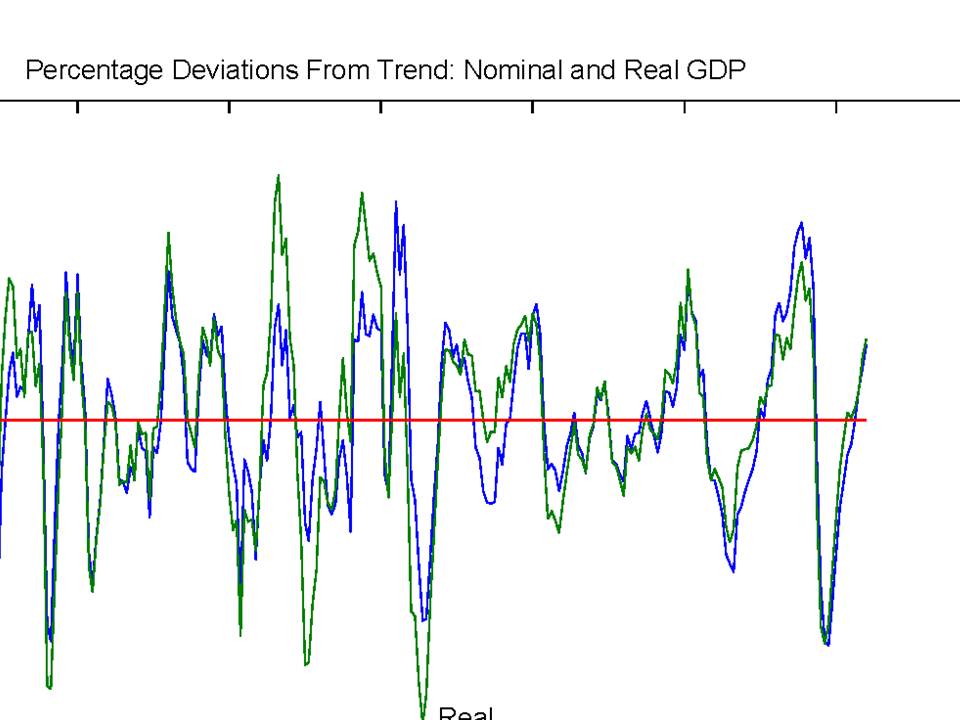
Then Williamson makes another curious argument based on a comparison of Hodrick-Prescott-filtered NGDP and RGDP data from 1947 to 2011. Williamson plotted the two series on the accompanying graph. Observing that while NGDP was less variable than RDGP in the 1970s, the two series tracked each other closely in the Great-Moderation period (1983-2007), Williamson suggests that, inasmuch as the 1970s are now considered to have been a period of bad monetary policy, low variability of NGDP does not seem to matter that much.

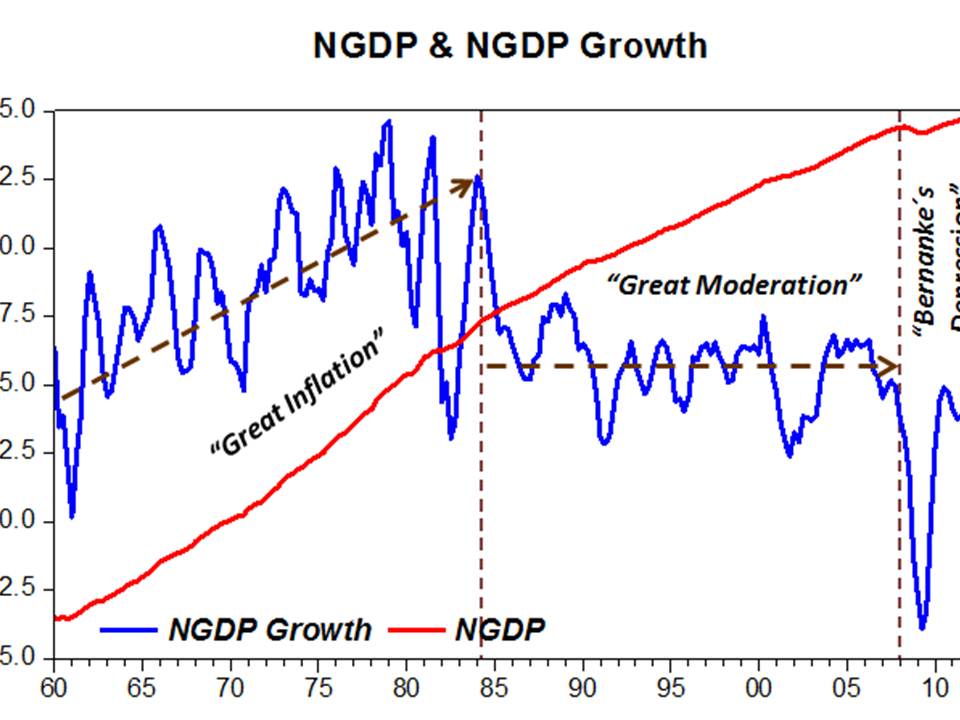
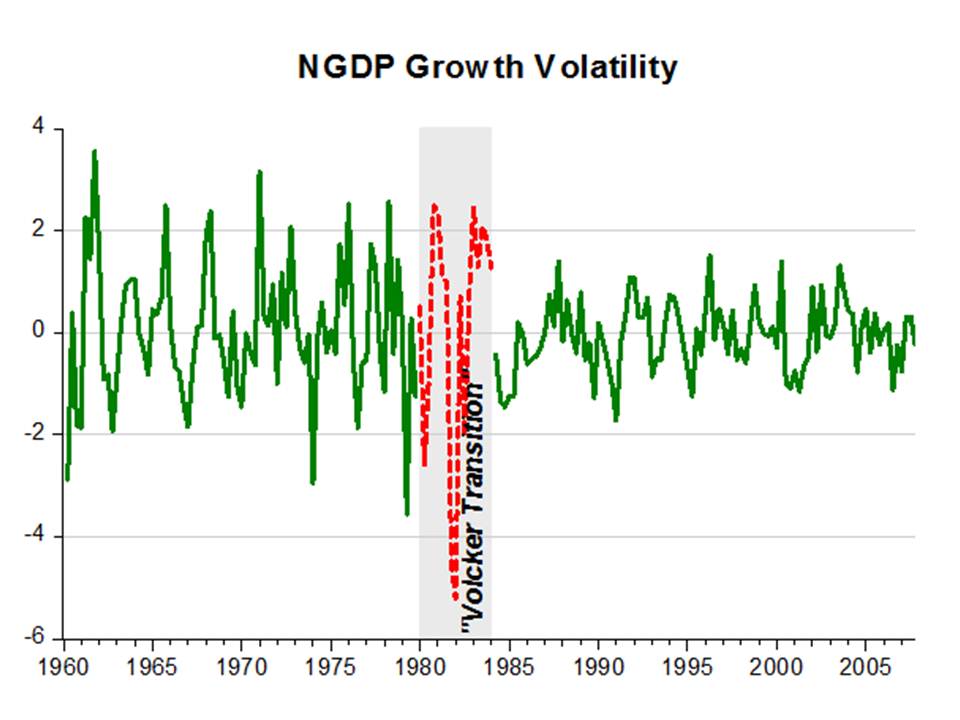
Marcus Nunes, I think properly, concludes that Williamson’s graph is wrong, because Williamson ignores the fact that there was a rising trend of NGDP growth during the 1970s, while during the Great Moderation, NGDP growth was stationary. Marcus corrects Williamson’s error with two graphs of his own (which I attach), showing that the shift to NGDP targeting was associated with diminished volatility in RGDP during the Great Moderation.

Furthermore, Scott Sumner questions whether the application of the Hodrick-Prescott filter to the entire 1947-2011 period was appropriate, given the collapse of NGDP after 2008, thereby distorting estimates of the trend.

There may be further issues associated with the appropriateness of the Hodrick-Prescott filter, issues which I am certainly not competent to assess, but I will just quote from Andrew Harvey’s article on filters for Business Cycles and Depressions: An Encyclopedia, to which I referred recently in my post about Anna Schwartz. Here is what Harvey said about the HP filter.

Thus for quarterly data, applying the [Hodrick-Prescott] filter to a random walk is likely to create a spurious cycle with a period of about seven or eight years which could easily be identified as a business cycle . . . Of course, the application of the Hodrick-Prescott filter yields quite sensible results in some cases, but everything depends on the properties of the series in question.

Williamson then wonders, if stabilizing NGDP is such a good idea, why not stabilize raw NGDP rather than seasonally adjusted NGDP, as just about all advocates of NGDP targeting implicitly or explicitly recommend? In a comment on Williamson’s blog, Nick Rowe raised the following point:

The seasonality question is interesting. We could push it further. Should we want the same level of NGDP on weekends as during the week? What about nighttime?

But then I think the same question could be asked for inflation targeting, or price level path targeting, because there is a seasonal pattern to CPI too. And (my guess is) the CPI is higher on weekends. Not sure if the CPI is lower or higher at night.

In a subsequent comment, Nick made the following, quite telling, observation:

Actually, thinking about seasonality is a regular repeated shock reminds me of something Lucas once said about rational expectations equilibria. I don’t remember his precise words, but it was something to the effect that we should be very wary of assuming the economy will hit the RE equilibrium after a shock that is genuinely new, but if the shock is regular and repeated agents will have figured out the RE equilibrium. Seasonality, and day of the week effects, will be presumably like that.

So, I think the point about eliminating seasonal fluctuations has been pretty much laid to rest. But perhaps Williamson will try to resurrect it (see below).

In his reply to Scott, Williamson reiterates his long-held position that the Fed is powerless to affect the economy except by altering the interest rate, now 0.25%, paid to banks on their reserves held at the Fed. Since the Fed could do no more than cut the rate to zero, and a negative interest rate would be deemed an illegal tax, Williamson sees no scope for monetary policy to be effective. Lars Chritensen, however, points out that the Fed could aim at a lower foreign exchange value of the dollar and conduct its monetary policy via unsterilized sales of dollars in the foreign-exchange markets in support of an explicit price level or NGDP target.

Williamson defends his comments about stabilizing seasonal fluctuations as follows:

My point in looking at seasonally adjusted nominal GDP was to point out that fluctuations in nominal GDP can’t be intrinsically bad. I think we all recognize that seasonal variation in NGDP is something that policy need not be doing anything to eliminate. So how do we know that we want to eliminate this variation at business cycle frequencies? In contrast to what Sumner states, it is widely recognized that some of the business cycle variability in RGDP we observe is in fact not suboptimal. Most of what we spend our time discussing (or fighting about) is the nature and quantitative significance of the suboptimalities. Sumner seems to think (like old-fashioned quantity theorists), that there is a sufficient statistic for subomptimality – in this case NGDP. I don’t see it.

So, apparently, Williamson does accept the comment from Nick Rowe (quoted above) on his first post. He now suggests that Scott Sumner and other NGDP targeters are too quick to assume that observed business-cycle fluctuations are non-optimal, because some business-cycle fluctuations may actually be no less optimal than the sort of responses to seasonal fluctuations that are general conceded to be unproblematic. The difference, of course, is that seasonal fluctuations are generally predictable and predicted, which is not the case for business-cycle fluctuations. Why, then, is there any theoretical presumption that unpredictable business-cycle fluctuations that falsify widely held expectations result in optimal responses? The rational for counter-cyclical policy is to minimize incorrect expectations that lead to inefficient search (unemployment) and speculative withholding of resources from their most valuable uses. The first-best policy for doing this, as I explained in the last chapter of my book Free Banking and Monetary Reform, would be to stabilize a comprehensive index of wage rates.  Practical considerations may dictate choosing a less esoteric policy target than stabilizing a wage index, say, stablizing the growth path of NGDP.

I think I’ve said more than enough for one post, so I’ll pass on Williamson’s further comments of the Friedman rule and why he chooses to call himself a Monetarist.

PS Yesterday was the first anniversary of this blog. Happy birthday and many happy returns to all my readers.

W. H. Hutt on Say’s Law and the Keynesian Multiplier

In a post a few months ago, I referred to W. H. Hutt as an “unjustly underrated” and “all but forgotten economist” and “as an admirable human being,” who wrote an important book in 1939, The Theory of Idle Resources, seeking to counter Keynes’s theory of involuntary unemployment. In responding to a comment on a more recent post, I pointed out that Armen Alchian relied on one of Hutt’s explanations for unemployment to provide a microeconomic basis for Keynes’s rather convoluted definition of involuntary unemployment, so that Hutt unintentionally provided support for the very Keynesian theory that he was tried to disprove. In this post, I want to explore Hutt’s very important and valuable book ARehabilitation of Say’s Law, even though, following Alchian, I would interpret what Hutt wrote in a way that is at least potentially supportive of Keynes, while also showing that Hutt’s understanding of Say’s Law allows us to view Says Law and the Keynesian multiplier as two (almost?) identical ways of describing the same phenomenon.

But before I discuss Hutt’s understanding of Say’s Law, a few words about why I think Hutt was an admirable human being are in order. Born in 1899 into a working class English family (his father was a printer), Hutt attended the London School of Economics in the early 1920s, coming under the influence of Edwin Cannan, whose writings Hutt often referred to. After gaining his bachelor’s degree, Hutt, though working full-time, continued taking courses at LSE, even publishing several articles before taking a position at the University of Capetown in 1930, despite having no advanced degree in economics. Hutt remained in South Africa until the late 1960s or early 1970s, becoming an outspoken critic of legal discrimination against non-whites and later of the apartheid regime instituted in 1948. In his book, The Economics of the Colour Bar, Hutt traced the racial policies of the South African regime not just to white racism, but to the interest of white labor unions in excluding competition by non-whites. Hutt’s hostility to labor unions for their exclusionary and protectionist policies was evident in much of his work, beginning at least with his Theory of Collective Bargaining, his Strike-Threat System, and his many critiques of Keynesian economics. However, he was opposed not to labor unions as such, just to the legal recognition of the right of some workers to coerce others into a collusive agreement to withhold their services unless their joint demand for a stipulated money wage was acceded to by employers, a right that in most other contexts would be both legally and morally unacceptable. Whether or not Hutt took his moral opposition to collective bargaining to extremes, he certainly was not motivated by any venal motives. Certainly his public opposition to apartheid, inviting retribution by the South African regime, was totally disinterested, and his opposition to collective bargaining was no less sincere, even If less widely admired, than his opposition to apartheid, and no more motivated by any expectation of personal gain.

In the General Theory, launching an attack on what he carelessly called “classical economics,” Keynes devoted special attention to the doctrine he described as Say’s Law, a doctrine that had been extensively and inconclusively debated in the nineteenth century after Say formulated what he had called the Law of the Markets in his Treatise on Political Economy in 1803. The exact meaning of the Law of the Markets was never entirely clear, so that, in arguing about Say’s Law, one can never be quite sure that one knows what one is talking about. At any rate, Keynes paraphrased Say’s Law in the following way: supply creates its own demand. In other words, “if you make it, they will buy it, or at least buy something else, because the capacity to demand is derived from the capacity to supply.”

Here is Keynes at p. 18 of the General Theory:

From the time of Say and Ricardo the classical economists have taught that supply creates its own demand; — meaning by this in some significant, but not clearly defined, sense that the whole of the costs of production must necessarily be spent in the aggregate, directly or indirectly, on purchasing the product.

In J. S. Mill’s Principles of Political Economy the doctrine is expressly set forth:

What constitutes the means of payment for commodities. Each person’s means of paying for the productions of other people consist of those which he himself possesses. All sellers are inevitably, and by the meaning of the word, buyers. Could we suddenly double the productive powers of the country, we should double the supply of commodities in every market; but we should, by the same stroke, double the purchasing power. Everybody would bring a double demand as well as supply; everybody would be able to buy twice as much, because every one would have twice as much to offer in exchange.

Then, again at p. 26, Keynes restates Say’s Law in his own terminology:

In the previous chapter we have given a definition of full employment in terms of the behavior of labour. An alternative, though equivalent, criterion is that at which we have now arrived, namely, a situation in which aggregate employment is inelastic in response to an increase in effective demand for its output. Thus Say’s Law, that the aggregate demand price of output as a whole is equal ot its aggregate supply price for all volumes of output [“could we suddenly double the productive powers of the country . . . we should . . . double the purchasing power”], is equivalent the proposition that there is no obstacle to full employment. If, however, this is not the true law relating the aggregate demand and supply functions, there is a vitally important chapter of economic theory which remains to be written and without which all discussions concerning the volume of aggregate employment are futile.

Keynes restated the same point in terms of his doctrine that macroeconomic equilibrium, the condition for which being that savings equal investment, could occur at a level of output and income corresponding to less than full employment. How could this happen? Keynes believed that if the amount that households desired to save at the full employment level of income were greater than the amount that businesses would invest at that income level, expenditure and income would decline until desired (and actual) savings equaled investment. If Say’s Law held, then whatever households chose not to spend would get transformed into investment by business, but Keynes denied that there was any mechanism by which this transformation would occur. Keynes proposed his theory of liquidity preference to explain why savings by households would not necessarily find their way into increased investment by businesses, liquidity preference preventing the rate of interest from adjusting to induce as much investment as required to generate the full-employment level of output and income.

Now the challenge for Keynes was to explain why, if there is less than full employment, wages would not fall to induce businesses to hire the unemployed workers. From Keynes’s point of view it wasn’t enough to assert that wages are sticky, because a classical believer in Say’s Law could have given that answer just as well.  If you prevent prices from adjusting, the result will be a disequilibrium.  From Keynes’s standpoint, positing price or wage inflexibility was not an acceptable explanation for unemployment.  So Keynes had to argue that, even if wages were perfectly flexible, falling wages would not induce an increase in employment. That was the point of Keynes’s definition of involuntary unemployment as a situation in which an increased price level, but not a fall in money wages, would increase employment. It was in chapter 19 of the General Theory that Keynes provided his explanation for why falling money wages would not induce an increase in output and employment.

Hutt’s insight was to interpret Say’s Law differently from the way in which most previous writers, including Keynes, had interpreted it, by focusing on “supply failures” rather than “demand failures” as the cause of total output and income falling short of the full-employment level. Every failure of supply, in other words every failure to achieve market equilibrium, means that the total effective supply in that market is less than it would have been had the market cleared. So a failure of supply (a failure to reach the maximum output of a particular product or service, given the outputs of all other products and services) implies a restriction of demand, because all the factors engaged in producing the product whose effective supply is less than its market-clearing level are generating less demand for other products than if they were producing the market-clearing level of output for that product. Similarly, if workers don’t accept employment at market-clearing wages, their failure to supply involves a failure to demand other products. Thus, failures to supply can be cumulative, because any failure of supply induces corresponding failures of demand, which, unless there are further pricing adjustments to clear other affected markets, trigger further failures of demand. And clearly the price adjustments required to clear any given market will be greater when other markets are not clearing than when those other markets are clearing.

So, with this interpretation, Hutt was able to deploy Say’s Law in a way that sheds important light on the cumulative processes of contraction and expansion characterizing business-cycle downturns and recoveries. In his modesty, Hutt disclaimed originality in using Say’s Law as a key to understanding those cumulative processes, citing various isolated statements by older economists (in particular a remark of the Cambridge economist Frederick Lavington in his 1921 book The Trade Cycle: “The inactivity of all is the cause of the inactivity of each”) that vaguely suggest, but don’t spell out, the process that Hutt describes in meticulous detail. If Hutt’s analysis was anticipated in any important way, it was by Clower and Leijonhufvud in their paper “Say’s Principle, What it Means and Doesn’t Mean,” (reprinted here and here), which introduced a somewhat artificial distinction between Say’s Law, as Keynes conceived of it, and Say’s Principle, which is closer to how Hutt thought about it.  But to Clower and Leijonhufvud, Say’s Principle was an essential part of the explanation of the Keynesian multiplier.  The connection between them is simple, effective supply is identical to effective demand because every purchase is also a sale.  A cumulative process can be viewed as either a supply-side process (Say’s Law) or a demand-side process (the Keynesian multiplier), but they are really just two sides of the same coin.

So if you have followed me this far, you may be asking yourself, did Hutt really rehabilitate Say’s Law, as he claimed to have done? And if so, did he refute Keynes, as he also claimed to have done? My answer to the first question is a qualified yes. And my answer to the second question is a qualified no. I will not try to justify my qualification to my answer to the first question, except to note that the qualification depends on the assumptions made about how money is supplied in the relevant model of the economy. In a model in which money is endogenously supplied by private banks, Say’s Law holds; in a model in which the supply of money is fixed exogenously, Say’s Law does not hold. For more on this, see my paper, “A Reinterpretation of Classical Monetary Theory,” or my book Free Banking and Monetary Reform (pp. 62-66).

But if Hutt was right about Say’s Law, how can Keynes be right that cutting money wages is not a good way (but in Hutt’s view the best way) to cure a depression that is itself caused by the mispricing of assets and factors of production? The answer is that, for all the care Hutt exercised in working out his analysis, he was careless in making explicit his assumptions about the expectations of workers about future wages (i.e., the wages at which they would be able to gain employment). The key point is that if workers expect to be able to find employment at higher wages than they will in fact be offered, the aggregate supply curve of labor will intersect the aggregate demand curve for labor at a wage rate that is higher, and a quantity that is lower, than would be the case in an equilibrium in which workers’ expectations about future wages were correct. From the point of view of Hutt, there is a supply failure because the aggregate supply of labor is less than the hypothetical equilibrium supply under correct wage expectations. But there is no restriction on market pricing, just incorrect expectations of future wages. Expectations need not be rigid, but in a cumulative process, wage expectations may not adjust as fast as wages are falling. Though Keynes, himself, did not discuss the possibility explicitly, it is also possible that there could be multiple equilibria corresponding to different sets of expectations (e.g., optimistic or pessimistic). If the economy settles into a pessimistic equilibrium, unemployment could stabilize at levels that are permanently higher than those that would have prevailed under an optimistic set of expectations. Perhaps we are now stuck in (or approaching) such a pessimistic equilibrium.

Be that as it may, Hutt simply assumes that allowing all prices to be determined freely in unfettered markets must result in the quick restoration of a full-employment equilibrium. This is a reasonable position to take, but there is no way of proving it logically. Proofs that free-market adjustment leads to an equilibrium are based on some sort of tatonnement or recontracting process in which trading does not occur at disequilibrium prices. In the real world, there is no restriction on trading at disequilibrium process, so there is no logical argument that shows that the Say’s Law dynamic described by Hutt cannot go on indefinitely without reaching equilibrium. F. A. Hayek, himself, explained this point in his classic 1937 paper “Economics and Knowledge.”

In the light of our analysis of the meaning of a state of equilibrium it should be easy to say what is the real content of the assertion that a tendency toward equilibrium exists. It can hardly mean anything but that, under certain conditions, the knowledge and intentions of the different members of society are supposed to come more and more into agreement or, to put the same thing in less general and less exact but more concrete terms, that the expectations of the people and particularly of the entrepreneurs will become more and more correct. In this form the assertion of the existence of a tendency toward equilibrium is clearly an empirical proposition, that is, an assertion about what happens in the real world which ought, at least in principle, to be capable of verification. And it gives our somewhat abstract statement a rather plausible common-sense meaning. The only trouble is that we are still pretty much in the dark about (a) the conditionsunder which this tendency is supposed to exist and (b) the nature of the process by which individual knowledge is changed.

In the usual presentations of equilibrium analysis it is generally made to appear as if these questions of how the equilibrium comes about were solved. But, if we look closer, it soon becomes evident that these apparent demonstrations amount to no more than the apparent proof of what is already assumed[11] . The device generally adopted for this purpose is the assumption of a perfect market where every event becomes known instantaneously to every member. It is necessary to remember here that the perfect market which is required to satisfy the assumptions of equilibrium analysis must not be confined to the particular markets of all the individual commodities; the whole economic system must be assumed to be one perfect market in which everybody knows everything. The assumption of a perfect market, then, means nothing less than that all the members of the community even if they are not supposed to be strictly omniscient, are at least supposed to know automatically all that is relevant for their decisions. It seems that that skeleton in our cupboard, the “economic man,” whom we have exorcised with prayer and fasting, has returned through the back door in the form of a quasi-omniscient individual.
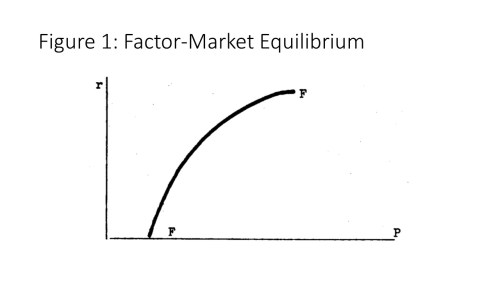
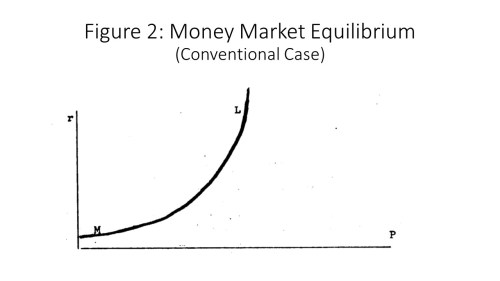
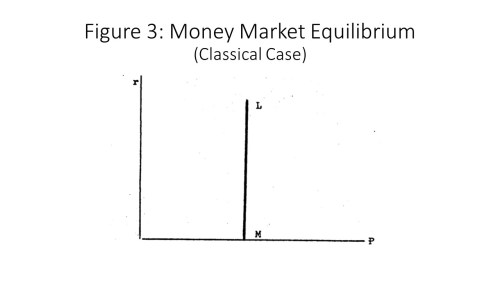
About Me

David Glasner
Washington, DC

I am an economist in the Washington DC area. My research and writing has been mostly on monetary economics and policy and the history of economics. In my book Free Banking and Monetary Reform, I argued for a non-Monetarist non-Keynesian approach to monetary policy, based on a theory of a competitive supply of money. Over the years, I have become increasingly impressed by the similarities between my approach and that of R. G. Hawtrey and hope to bring Hawtrey’s unduly neglected contributions to the attention of a wider audience.

My new book Studies in the History of Monetary Theory: Controversies and Clarifications has been published by Palgrave Macmillan

Follow me on Twitter @david_glasner

Archives

Enter your email address to follow this blog and receive notifications of new posts by email.

Join 665 other subscribers
Follow Uneasy Money on WordPress.com