The S&P 500 rose by 4% today on news that the Federal Reserve System and other central banks were taking steps to provide liquidity to banks, especially European banks with heavy exposure to sovereign debt issued by countries in the Eurozone. Other stock markets in Europe and Asia also rose sharply, and the euro rose about 1% against the dollar.
What was encouraging about today’s announcement was that the news reflected coordination and cooperation among the world’s leading central banks, sending a positive signal that central bankers were capable of working in concert to stabilize monetary conditions. One other point worth noting, already mentioned by Scott Sumner, is that the provision of liquidity so much welcomed by the markets was associated with rising, not falling interest rates, confirming that under current conditions, monetary ease works not by reducing, but by raising, nominal interest rates.
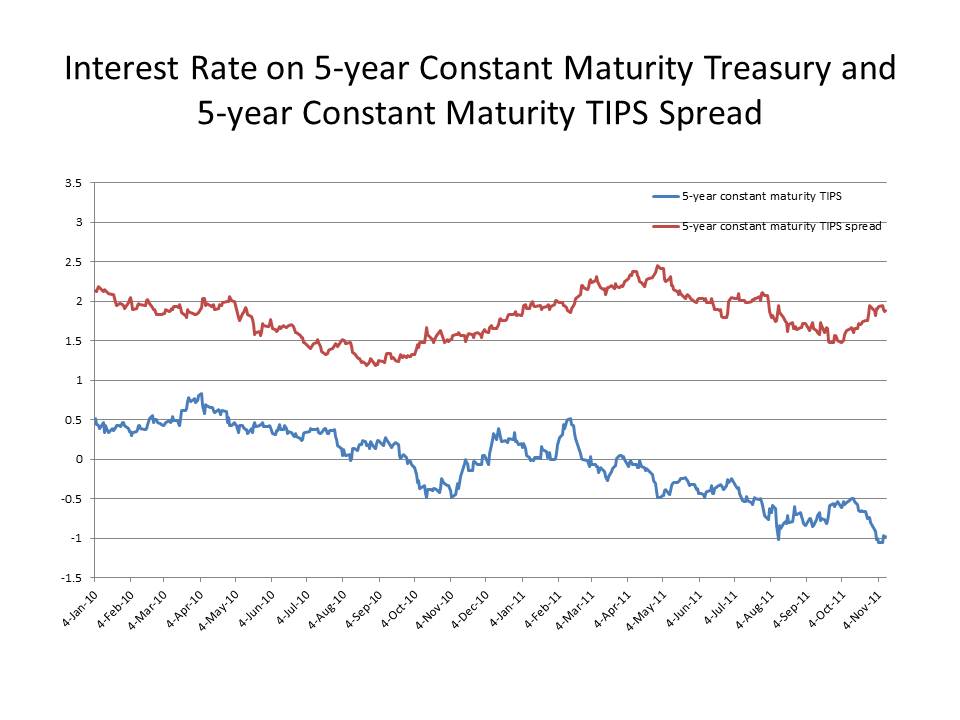
It is worth drilling down just a bit deeper to see what caused the increase in interest rates. I like to focus on the 5- and 10-year constant maturity Treasuries, and the corresponding 5- and 10-year constant maturity TIPS bonds from which one can infer an estimate of real interest rates. The yield on the 5-year Treasury rose by 3 basis points from 0.93% to 0.96%. At the same time the yield on the 5-year TIPS fell from -0.77% to -0.80%, so that the breakeven TIPS spread, an estimate (or, according to the Cleveland Federal Reserve Bank, more likely a slight overestimate) of inflation expectations, rose 1.70% to 1.76%. What that says is that, even though the nominal interest rate was rising, inflation expectations were rising even faster, so that the real interest rate was falling even deeper into negative territory. The negative real interest rate provides a measure of how pessimistic investors are about the profitability of investment. Poor profit expectations (flagging animal spirits in Keynesian terminology) are a drag on investment, but that is exactly why rising expectations of inflation can induce additional real investment to take place, despite investor pessimism. As expected inflation rises, additional not so profitable real investment opportunities, become worth undertaking, because the negative return on holding cash makes investing in real capital less unattractive than just holding cash or other low-yielding financial instruments. The profitability of additional real investment projects will increase economic activity and output , raising future income levels, which is why the stock market rose even as real interest rates fell. (For more on the underlying theory and the empirical evidence supporting it, see my paper “The Fisher Effect under Deflationary Expectations” here.)
Now let’s look at the 10-year constant maturity Treasury and the 10-year constant maturity TIPS bond. The yield on the 10-year Treasury rose 8 basis points from 2% to 2.08%, while the yield on the 10-year TIPS rose from 0.01% to 0.03%, implying an increase in the breakeven TIPS spread from 1.99% to 2.05%. At both 5- and 10-year time horizons, inflation expectations rose by 6 basis points. But the difference is that real interest rates rose over a 10-year time horizon even though real interest rates fell over a 5-year time horizon. That suggests that the markets are projecting improved long-run prospects for profitable investment as a result of higher inflation. That was just the relationship that we observed a year ago after the start of QE2, when inflation expectations were rising and nominal interest rates were rising even faster, when investors’ projections for future profit opportunities were becoming increasingly positive. After a rough 2011, that still seems to be the way that markets are reacting to prospects for rising inflation.
In its story on the stock-market rally, the New York Times wrote:
Market indexes gained more than 4 percent after central banks acted to contain the debt crisis in the euro zone. But a half-dozen similar rallies in the last 18 months have quickly withered.
What unfortunately has happened is that each time the markets start to expect enough inflation to get a real recovery going, the inflation hawks on the FOMC throw a tantrum and make sure that we get the inflation rate back down again. Will they prevail yet again? For Heaven’s sake, let’s hope not.

 Uneasy Money