Archive for the 'expectations' Category


Rising Inflation Expectations Work Their Magic

The S&P 500 rose by almost 2% today, closing at 1395.95, the highest level since June 2008, driven by an increase of 6 basis points in the breakeven TIPS spread on 10-year Treasuries, the spread rising to 2.34%. According to the Cleveland Federal Reserve Bank, which has developed a sophisticated method of extracting the implicit inflation expectations from the relationship between conventional Treasuries and TIPS, the breakeven TIPS spread overstates the expected inflation rate, so even at a 10-year time horizon, the market expectation of inflation is still well under 2%. The yield on 10-year Treasuries rose by 10 basis points, suggesting an increase of 4 basis points in the real 10-year interest rate.

Since the beginning of 2012, the S&P 500 has risen by almost 10%, while expected inflation, as measured by the TIPS spread on 10-year Treasuries, has risen by 33 basis points. The increase in inflation expectations was at first associated with falling real rates, the implied real rate on 10-year TIPS falling from -0.04% on January 3 to -0.32% on February 27. Real rates seem to have begun recovering slightly, rising to -0.20% today, suggesting that profit expectations are improving. The rise in real interest rates provides further evidence that the way to get out of the abnormally low interest-rate environment in which we have been stuck for over three years is through increased inflation expectations. Under current abnormal conditions, expectations of increasing prices and increasing demand would be self-fulfilling, causing both nominal and real interest rates to rise along with asset values. As I showed in this paper, there is no theoretical basis for a close empirical correlation between inflation expectations and stock prices under normal conditions. The empirical relationship emerged only in the spring of 2008 when the economy was already starting the downturn that culminated in the financial panic of September and October 2008. That the powerful relationship between inflation expectations and stock prices remains so strikingly evident suggests that further increases in expected inflation would help, not hurt, the economy.  Don’t stop now.

There Are Microfoundations, and There Are Microfoundations; They’re Not the Same

Microfoundations are latest big thing on the econoblogosphere. Krugman, Wren-Lewis (and again), Waldmann, Smith (all two of them!) have weighed in on the subject. So let me take a shot.

The idea of reformulating macroeconomics was all the rage when I studied economics as an undergraduate and graduate student at UCLA in the late 1960s and early 1970s. The UCLA department had largely taken shape in the 1950s and early 1960s around its central figure, Armen Alchian, undoubtedly the greatest pure microeconomist of the second half of the twentieth century in the sense of understanding and applying microeconomics to bring the entire range of economic, financial, legal and social phenomena under its purview, and co-author of the greatest economics textbook ever written. There was simply no problem that he could not attack, using the simple tools one learns in intermediate microeconomics, with a piece of chalk and a blackboard. Alchian’s profound insight (though in this he was anticipated by Coase in his paper on the nature of the firm, and by Hayek’s criticisms of pure equilibrium theory) was that huge chunks of everyday economic activity, such as advertising, the holding of inventories, business firms, contracts, and labor unemployment, simply would not exist in the world characterized by perfect information and zero uncertainty assumed by general-equilibrium theory. For years, Alchian used to say, he could not make sense of Keynes’s General Theory and especially the Keynesian theory of involuntary unemployment, because it seemed to exclude the possibility of equilibration by way of price and wage adjustments, the fundamental mechanism of microeconomic equilibration. It was only when Axel Leijonhufvud arrived on the scene at UCLA, still finishing up his doctoral dissertation, published a few years after his arrival at UCLA as On Keynesian Economics and the Economics of Keynes that Alchian came to understand the deep connections between the Keynesian theory of involuntary unemployment and the kind of informational imperfections that Alchian had been working on for years at the micro-level.

So during my years at UCLA, providing microfoundations for macroeconomics was viewed as an intellectual challenge for gaining a better understanding of Keynesian involuntary unemployment, not as a means of proving that it doesn’t exist. Reformulating macroeconomic theory (I use this phrase in homage to the unpublished paper by the late Earl Thompson, one of Alchian’s very best students) based on microfoundations did not mean simply discarding Keynesian theory into the dustbin of history.  Unemployment was viewed as a search process in which workers choose unemployment because it would be irrational to accept the first offer of employment received regardless of the wage being offered. But a big increase in search activity by workers can have feedback effects on aggregate demand preventing a smooth transition to a new equilibrium after an interval of increased search. Alchian, an early member of the Mont Pelerin Society, was able to see the deep connection between Leijonhufvud’s microeconomic rationalization of Keynesian involuntary unemployment and the obscure work, The Theory of Idle Resources, of another member of the MPS, the admirable human being, and unjustly underrated, unfortunately now all but forgotten, economist, W. H. Hutt, who spent most of his professional life engaged in a battle against what he considered the fallacies of J. M. Keynes, especially Keynes’s theory of unemployment.

Unfortunately, this promising approach towards gaining a deeper and richer understanding of the interaction between imperfect information and uncertainty, on the one hand, and, on the other, a process of dynamic macroeconomic adjustment in which both prices and quantities are changing, so that deviations from equilibrium can be cumulative rather than, as conventional equilibrium models assume, self-correcting, has yet to fulfill its promise. Here the story gets complicated, and it would take a much longer explanation than I could possibly reduce to a blog post to tell it adequately. But my own view, in a nutshell, is that the rational-expectations revolution — especially the dogmatic view of how economics ought to be practiced espoused by Robert Lucas and his New Classical, Real Business Cycle and New Keynesian acolytes — has subverted the original aims of the microfoundations project. Rather than relax the informational assumptions underlying conventional equilibrium analysis to allow for a richer and more relevant analysis than is possible when using the tools of standard general-equilibrium theory, Lucas et al. developed sophisticated tools that enabled them to nominally relax the informational assumptions of equilibrium theory while using the tyrannical methodology of rational expectations combined with full market clearing to preserve the essential results of the general-equilibrium model. The combined effect of the faux axiomatic formalism and the narrow conception of microfoundations imposed by the editorial hierarchy of the premier economics journals has been to recreate the gap between the Keynesian theory of involuntary unemployment and rigorous microeconomic reasoning that Alchian, some forty years ago, thought he had found a way to bridge.

Update (1:16PM EST):  A commenter points out that the first sentence of my concluding paragraph was left unfinished.  That’s what happens when you try to get a post out at 2AM.  The sentence is now complete; I hope it’s not to disappointing.

When Ben Bernanke Talks, People Listen

Yesterday, the stock market (S&P 500) dropped sharply upon hearing Chairman Bernanke’s testimony before Congress in which he declined to promise that the Fed would engage in another round of quantitative easing as many observers were anticipating. The news sent the market tumbling, and the dollar rose 1% against the euro. Readers of a certain age will recall a well-known advertising slogan for a now defunct stock- brokerage house, E. F. Hutton: when E. F. Hutton talks, people listen. Ben Bernanke is not a stock trader, but when he talks, people do pay attention. By day’s end, however, the market recovered a bit of the ground that it lost immediately after Bernanke’s testimony was released, falling by just half a percent. What happened?

My guess is that the markets may have been factoring in two separate pieces of information. The first was the upward revision in real GDP growth in the fourth quarter of 2011 from 2.8% to 3%. Thus, the market was in positive territory before Bernanke’s testified. The news was reflected in rising real interest rates associated with improving expectations of real GDP growth. The improved expectations of future real GDP growth were countered by Bernanke’s testimony, which suggested that the anticipated easing might not be forthcoming. That sent inflation expectations south, and the market followed inflation expectations, as I have found that it usually has done ever since tight money sent the economy into steep decline in the spring of 2008 when the Fed was mistakenly focused on countering rising energy prices instead of supporting a faltering economy.

The combination of the two effects, the improvement in the real strength of the economy, a positive, was more than offset by the disappointment about the future course of monetary policy. The net effect was a slight fall in prices, but it is interesting to see an example of the two effects going in opposite directions on the same day.

Today the market more than recovered yesterday’s losses, the S&P 500 reaching a new post-crisis high. Real and nominal interest rates both rose, reflecting increasing optimism about economic recovery, and inflation expectations were unchanged. So there are some grounds for cautious optimism, but an oil-price shock could stall this fragile recovery yet again, especially if the inflation hawks on the FOMC have their way, yet again.

More on Inflation and Recovery

David Pearson, a regular and very acute commenter on this blog, responded with the following comment to my recent post about the remarkable 1933 recovery triggered by FDR’s devaluation of the dollar a month after taking office.

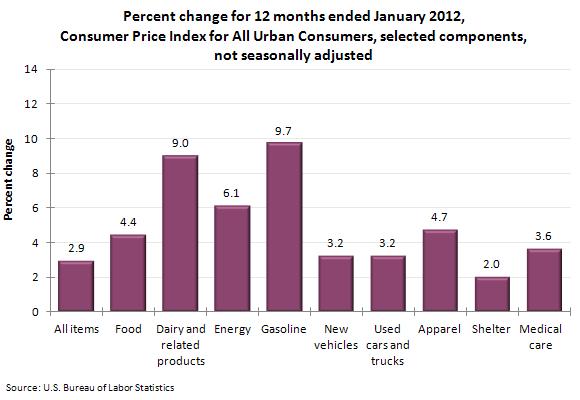
Here is a chart [reproduced below] showing the 12-mo. change in a broad range of CPI components. IMO, FDR would have been quite happy with this performance following 1933. The question is, if the Fed eased to produce 4-5% inflation, as MM’s recommend, what would each of these components look like, and how would that affect l.t. household real wage growth expectations? In turn, what impact would that have on current real household spending?

I inferred from David’s comment and the chart to which he provided a link that he believes that recent inflation has been distorting relative prices, and that he worries that increasing inflation would amplify the relative-price distortions. I thought that it would be useful to track the selected components in this chart more than one year back, so I created another chart showing the average rate of change in the CPI and in the selected components from January 2008 to January 2010 along side the changes from January 2011 to January 2012. There seems to be some inverse correlation between the rate of price increase in a component in the 2008-10 period and the price increase in 2011. Of the 6 components that increased by less than 1% per year in the 2008-10 period, four increased in 2011 by 4.7% or more in 2011, the remaining components increasing by 4.4% or less in 2011. So the rapid increases in some components in 2011 may simply reflect a reversion to a more normal pattern of relative prices.

I agree that inflation is not neutral. There are relative price effects; some prices adjust faster than others, but I don’t think we know enough about the process of price adjustment in the real world to be able to say that overall inflation in conditions of high unemployment amplifies relative distortions. What we do know is that even after a pickup in inflation in 2011, inflation expectations remain low (though somewhat higher than last summer) and real interest rates are negative or nearly negative at up to a 10-year time horizon. Negative real interest rates are an expectational phenomenon, reflecting the extremely pessimistic outlook of investors. Increasing future price-level expectations is one way – I think the best way — to improve the investment outlook for businesses. We are in an expectational trap, not a liquidity trap, and an increase in price-level expectations would generate a cycle of increased investment and output and income and entrepreneurial optimism that will be self-sustaining. Say’s Law in action; supply creates its own demand.

In a more recent comment on the same post, David Pearson worries that insofar as inflation would tend to reduce real wages, it will cause wage earners and households to cut back on consumption, thereby counteracting any stimulus to investment by business from expectations of rising prices. To the extent that expectations of future wage growth fall, workers may also revise downward their reservation wages, so, even if David is right, the effect on employment is not clear. But I doubt that short-term changes in the inflation rate cause significant changes in expectations of future wage and income growth which are dependent on a variety of micro factors peculiar to individual workers and their own particular circumstances. As usual David makes a good argument for his point of view, but I am not persuaded. But then I don’t suppose that I have persuaded him either.

Lars Christensen on the Eurozone Crisis RIP

UPDATE:  In my enthusiasm and haste to plug Lars Chritensen’s post on the possible end of the Eurozone crisis, I got carried away and conflated two separate effects.  The dollar’s appreciation against from July to September was associated with a steep drop in inflation expectations, the TIPS spread fallling from about 2.4% in July to about 1.7% on 10-year Treasuries.  The dollar rose against the euro from July to September from the exchange rate moving from the $1.42 to $1.45 range in early July to the $1.35 to $1.38 range in September.  From September to December, inflation expectations rose modestly, the TIPS spread on 10-year Treasuries recovering to about 1.9%.  It has only been since December that the dollar has been appreciating against the euro even as inflation expectations have risen to over 2% as reflected by the TIPS spread on 10-year Treasuries.  The actual data are thus more consistent with Lars’s take on the Eurozone crisis than suggested by my original comment  .Sorry for that slip-up on my part.

Check out this fascinating post by Lars Christensen on how the Eurozone Crisis (not to be confused with the Greek Debt Crisis) came to an end last July.  The key to understanding what happened is that on July 1 the dollar/euro exchange rate was $1.4508/euro.  Yesterday it was about $1.32/euro.  The appreciation of the dollar would have been a disaster for the US and the rest of the world, except for the fact that inflation expectations in the US have increased, not decreased, since July (even as measured inflation — both headline and core — has fallen).  Ever since 2008, US inflation expectations and the dollar/euro exchange rate have been positively correlated (i.e., increased inflation expectations in the US have been associated with a falling value of the dollar relative to the euro).  Since July US inflation expectations have increased while the dollar has appreciated against the euro.

HT:  Lars Christensen and Marcus Nunes

Charles Schwab Almost Gets It Right

No question about it Charles Schwab is a very smart man, and performed a great service by making the stock brokerage business a lot more competitive than it used to be before he came on the scene. But does that qualify him as an expert on monetary policy? Not necessarily. But I am not sure what qualifies anyone as an expert on monetary policy, so I don’t want to suggest that a lack of credentials disqualifies Mr. Schwab, or anyone else, even Ron Paul, from offering an opinion on monetary policy. But in his op-ed piece in today’s Wall Street Journal, Mr. Schwab certainly gets off to a bad start when he says:

We’re now in the 37th month of central government manipulation of the free-market system through the Federal Reserve’s near-zero interest rate policy. Is it working?

Thirty-seven months ago, the US and the world economy were in a state of crisis, with stock prices down almost 50 percent from their level six months earlier. To suggest that taking steps to alleviate that crisis constitutes government manipulation of the free-market system is clearly an ideologically loaded statement, acceptable to a tiny sliver of professional economists, lacking any grounding in widely accepted economic principles. The tiny sliver of economists who would agree with Mr. Schwab’s assessment may just be right — though I think they are wrong — but on as controversial a topic as this, it bespeaks a certain arrogance to assert as simple fact what is in fact the view of a tiny, and not especially admired, minority of the economics profession.  (I don’t mean the preceding sentence to be construed as in any way an attack on economists favoring a free-market monetary system.  I know and admire a number of economists who take that view, I am just emphasizing how unorthodox that view is considered by most of the profession.)

It’s actually a pity that Mr. Schwab chose to couch his piece in such ideological terms, because much of what he says makes a lot of sense.  For example:

Business and consumer loan demand remains modest in part because there’s no hurry to borrow at today’s super-low rates when the Fed says rates will stay low for years to come. Why take the risk of borrowing today when low-cost money will be there tomorrow?

Many of us in the Market Monetarist camp already have pointed out that the Fed’s low interest policy is a double-edged sword, because the policy, as Mr. Schwab correctly points out, tends to reinforce self-fulfilling market pessimism about future economic conditions. The problem arises because the economy now finds itself in what Ralph Hawtrey called a “credit deadlock.” In a credit deadlock, pessimistic expectations on the part of traders, consumers and bankers is so great that reducing interest rates does little to stimulate investment spending by businesses, consumer spending by households, and lending by banks. While recognizing the obstacles to the effectiveness of monetary policy conducted in terms of the bank rate, Hawtrey argued that there are alternative instruments at the disposal of the monetary authorities by which to promote recovery.

Mr. Schwab goes on to provide a good description of the symptoms of a credit-deadlock except that he attributes the cause of the deadlock entirely to Fed actions rather than to an underlying pessimism that preceded them.

The Fed policy has resulted in a huge infusion of capital into the system, creating a massive rise in liquidity but negligible movement of that money. It is sitting there, in banks all across America, unused. The multiplier effect that normally comes with a boost in liquidity remains at rock bottom. Sufficient capital is in the system to spur growth—it simply isn’t being put to work fast enough.

He makes a further astute observation about the ambiguous effects of the Fed’s announcement that it is planning to keep interest rates at current levels through 2014.

The Fed’s Jan. 25 statement that it would keep short-term interest rates near zero until at least late 2014 is sending a signal of crisis, not confidence. To any potential borrower, the Fed’s policy is saying, in effect, the economy is still in critical condition, if not on its deathbed. You can’t keep a patient on life support and expect people to believe he’s gotten better.

Mr. Schwab then argues that all that is required to cure the credit deadlock is for the Fed to declare victory and begin a strategic withdrawal from the field of battle.

This is what investors, business people and everyday Americans should hope to hear from Mr. Bernanke after the next Federal Open Market Committee meeting:

The Federal Reserve used its emergency powers effectively and appropriately when the financial crisis began, but it is very clear that the economy is on the mend and that the benefit of inserting massive liquidity into the economy has passed. We will let interest rates move where natural markets take them. Our experiment with market manipulation will stop beginning today. Effective immediately, we will begin to move Fed rate policy toward its natural longer-term equilibrium. With the extremes of the financial crisis of 2008 and 2009 long behind us, free markets are the best means to create stable growth. Our objective is now to let the system work on its own. It is now healthy enough to do just that. We hope today’s announcement does two things immediately: first, that it highlights our confidence—supported by the data—that the U.S. economy is out of its emergency state and in the process of mending, and second, that it reflects our belief that the Federal Reserve’s role in economic policy is limited.

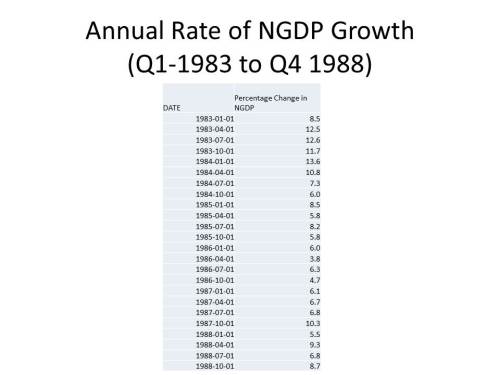
What Mr. Schwab fails to note is that the value of money (its purchasing power at any moment) and the rate of inflation cannot be determined in a free market. That is the job of the monetary authority. Aside from the tiny sliver of the economics profession that believes that the value of money ought to be determined by some sort of free-market process, that responsibility is now taken for granted. The problem at present is that the expected future price level (or the expected rate of growth in nominal GDP) is below the level consistent with full employment. The problem with Fed policy is not that it is keeping rates too low, but that it is content to allow expectations of inflation (or expectations of future growth in nominal GDP) to remain below levels necessary for a strong recovery. The Reagan recovery, as I noted recently, is hailed as a model for the Obama administration and the Fed by conservative economists like John Taylor, and the Wall Street Journal editorial page, and presumably by Mr. Charles Schwab himself. The salient difference between our anemic pseudo recovery and the Reagan recovery is that inflation averaged 3.5 to 4 percent and nominal GDP growth in the Reagan recovery exceeded 10 percent for 5 consecutive quarters (from the second quarter of 1983 to the second quarter of 1984).  The table below shows the rate of NGDP growth during the last six years of the Reagan administration from 1983 through 1988.  This is why, as I have explained many times on this blog (e.g., here and here)and in this paper, since the early days of the Little Depression in 2008, the stock market has loved inflation.
Here’s how Hawtrey put it in his classic A Century of Bank Rate:

The adequacy of these small changes of Bank rate, however, depends upon psychological reactions. The vicious circle of expansion or contraction is partly, but not exclusively, a psychological phenomenon. It is the expectation of expanding demand that leads to a creation of credit and so causes demand to expand; and it is the expectation of flagging demand that deters borrowers and so causes demand to flag. . . . The vicious circle may in either case have any degree of persistence and force within wide limits; it may be so mild as to be easily counteracted, or it may be so violent as to require heroic measures. (p. 275)

Therefore the monetary authorities of a country which has been cut loose from any metallic or international standard find themselves compelled to some degree to regulate the foreign exchanges, either by buying and selling foreign currencies or gold, or (deplorable alternative) by applying exchange control. Thus at any moment the problem of monetary policy presents itself as a choice between a modification of the rate of exchange credit an adjustment of the credit system through Bank rate. And if the modification of the rate of exchange is such as to favour stable activity, the need for a change in Bank rate may be all the less. When a credit deadlock has thrown Bank rate out of action, modification of rates of exchange may be found to be the most valuable and effective instruments of monetary policy. (p. 277)

There is thus no doubt that the Fed could achieve (within reasonable margins of error) any desired price level or rate of growth in nominal GDP by announcing its target and expressing its willingness to drive down the dollar exchange rate in terms of one or several currencies until its price level or NGDP target were met. That, not abdication of its responsibility, is the way the Fed can strengthen the ever so faint signs of a budding recovery (remember those green shoots?).
Which Fed Policy Is Boosting Stocks?

In yesterday’s (December 27, 2011) Wall Street Journal, Cynthia Lin (“Fed Policy Delivers a Tonic for Stocks”) informs us that the Fed’s Operation Twist program “has been a boon for investors during the year’s final quarter.”

The program, which has its final sale of short-dated debt for the year on Wednesday, pushed up a volatile U.S. stock market over the past few months and helped lower mortgage rates, breathing some life into the otherwise struggling U.S. housing sector, they said. Last week, Freddie Mac showed a variety of loan rates notching or matching record lows; the 30-year fixed rate fell to 3.91%, a record low.

In Operation Twist, the Fed sells short-dated paper and buys longer-dated securities. The program’s aim is to push down longer-term yields making Treasurys less attractive and giving investors more reason to buy riskier bonds and stocks. While share prices have risen considerably since then, Treasury yields have barely budged from their historic lows. Fear about the euro zone has caused an overwhelming number of investors to seek safety in Treasury debt. . . .

The Fed’s stimulus plan is the central bank’s third definitive attempt to aid the U.S.’s patchy economy since 2008. As expectations grew that the Fed would act in the weeks leading up to the bank’s actual announcement, which came Sept. 21, 10-year yields dropped nearly 0.30 percentage point. Since the Fed’s official statement, yields have risen modestly, to 2.026% on Friday, from 1.95% on Sept. 20. Fed Chairman Ben Bernanke said in October that rejiggering the bank’s balance sheet with Operation Twist would bring longer-term rates down 0.20 percentage points.

Sounds as if we should credit Chairman Bernanke with yet another brilliant monetary policy move. There have been so many that it’s getting hard to keep track of all his many successes. Just one little problem. On September 1, around the time that expectations that the Fed would embark on Operation Twist were starting to become widespread, the yield on the 10-year Treasury stood at 2.15% and the S&P 500 closed at 1204.42. Three weeks later on September 22, the 10-year Treasury stood at 1.72%, but the S&P 500, dropped to 1129.56. Well, since then the S&P 500 has bounced back, rising about 10% to 1265.43 at yesterday’s close. But, guess what? So did the yield on the 10-year Treasury, rising to 2.02%. So, the S&P 500 may have been risen since Operation Twist began, but it would be hard to argue that the reason that stocks rose was that the yield on longer-term Treasuries was falling. On the contrary, it seems that stocks rise when yields on long-term Treasuries rise and fall when yields on long-term Treasuries fall.

Regular readers of this blog already know that I have a different explanation for movements in the stock market. As I argued in my paper “The Fisher Effect Under Deflationary Expectations,” movements in asset prices since the spring of 2008 have been dominated by movements (up or down) in inflation expectations. That is very unusual. Aside from tax effects, there is little reason to expect stocks to be affected by inflation expectations, but when expected deflation exceeds the expected yield on real capital, asset holders want to sell their assets to hold cash instead, thereby causing asset prices to crash until some sort of equilibrium between the expected yields on cash and on real assets is restored. Ever since the end of the end of the financial crisis in early 2009, there has been an unstable equilibrium between very low expected inflation and low expected yields on real assets. In this environment small changes in expected inflation cause substantial movements into and out of assets, which is why movements in the S&P 500 have been dominated by changes in expected inflation.  And this unhealthy dependence will not be broken until either expected inflation or the expected yield on real assets increases substantially.

The close relationship between changes in expected inflation (as measured by the breakeven TIPS spread for 10-year Treasuries) and changes in the S&P 500 from September 1 through December 27 is shown in the chart below.

In my paper on the Fisher effect, I estimated a simple regression equation in which the dependent variable was the daily percentage change in the S&P 500 and the independent variables were the daily change in the TIPS yield (an imperfect estimate of the expected yield on real capital), the daily change in the TIPS spread and the percentage change in the dollar/euro exchange rate (higher values signifying a lower exchange value of the dollar, thus providing an additional measure of inflation expectations or possibly a measure of the real exchange rate). Before the spring of 2008, this equation showed almost no explanatory power, from 2008 till the end of 2010, the equation showed remarkable explanatory power in accounting for movements in the S&P 500. My regression results for the various subperiods between January 2003 till the end of 2010 are presented in the paper.

I estimated the same regression for the period from September 1, 2011 to December 27, 2011. The results were startlingly good. With a sample of 79 observations, the adjusted R-squared was .636. The coefficients on both the TIPS and the TIPS spread variables were positive and statistically significant at over a 99.9% level. An increase of .1 in the real interest rate was associated with a 1.2% increase in the S&P and an increase of .1 in expected inflation was associated with a 1.7% increase in the S&P 500. A 1% increase the number of euros per dollar (i.e., a fall in the value of the dollar in terms of euros) was associated with a 0.57% increase in the S&P 500. I also introduced a variable defined as the daily change in the ratio of the yield on a 10-year Treasury to the yield on a 2-year Treasury, calculating this ratio for each day in my sample. Adding the variable to the regression slightly improved the fit of the regression, the adjusted R-squared rising from .636 to .641. However, the coefficient on the variable was positive and not statistically significant. If the supposed rationale of Operation Twist had been responsible for the increase in the S&P 500, the coefficient on this variable would have been negative, not positive. So, contrary to the story in yesterday’s Journal, Operation Twist has almost certainly not been responsible for the rise in stock prices since it was implemented.

Why has the stock market been rising? I’m not sure, but most likely market pessimism about the sway of the inflation hawks on the FOMC was a bit overdone during the summer when the inflation expectations and the S&P 500 both were dropping rapidly. The mere fact that Chairman Bernanke was able to implement Operation Twist may have convinced the market that the three horseman of the apocalypse on the FOMC (Plosser, Kocherlakota, and Fisher) had not gained an absolute veto over monetary policy, so that the doomsday scenario the market may have been anticipating was less likely to be realized than had been feared. I suppose that we should be thankful even for small favors.

No Monetary Policy Is Not Just Another Name for Fiscal Policy

I just read John Cochrane’s essay “Inflation and Debt” in the Fall 2011 issue of National Affairs. On his webpage, Cochrane gives this brief summary of what the paper is about.

An essay summarizing the threat of inflation from large debt and deficits. The danger is best described as a “run on the dollar.” Future deficits can lead to inflation today, which the Fed cannot control. I also talk about the conventional Keynesian (Fed) and monetarist views of inflation, and why they are not equipped to deal with the threat of deficits. This essay complements the academic (equations) “Understanding Policy” article (see below) and the Why the 2025 budget matters today WSJ oped (see below).

And here’s the abstract to his “Understanding Policy in the Great Recession” article:

I use the valuation equation of government debt to understand fiscal and monetary policy in and following the great recession of 2008-2009. I also examine fiscal and monetary policy alternatives to avoid deflation, and how fiscal pressures might lead to inflation. I conclude that the central bank might be almost powerless to avoid inflation or deflation; that an eventual fiscal inflation can come well before fiscal deficits or monetization are realized, and that it is likely to come with stagnation rather than a boom.

The crux of Cochrane’s argument is that government currency is a form of debt so that inflation is typically the result of a perception by bondholders and potential purchasers of government debt that the government will not be able to raise enough revenues to cover its expenditures and repay its debt obligations, implying an implicit default through inflation. However, the expectation of future inflation because of an anticipated future fiscal crisis may suddenly — when an expectational tipping point is reached — trigger a “run” on the currency well before the crisis, a run manifesting itself in rapidly rising nominal interest rates and rising inflation even before the onset of a large fiscal deficit.

This is certainly an important, though hardly original, insight, and provides due cause for concern about our long-term fiscal outlook. The puzzle is why Cochrane thinks the possibility of a run on the dollar because of an anticipated future fiscal crisis is at all relevant to an understanding of why we are stuck in a lingering Little Depression. Cochrane is obviously very pleased with his fiscal theory of inflations, believing it to have great explanatory power.  But that explanatory power, as far as I can tell, doesn’t quite extend to explaining the origins of, or the cure for, the crisis in which we now find ourselves.

Cochrane’s recent comments on a panel discussion at the Hoover Institution give the flavor of his not very systematic ideas about the causes of the Little Depression, and the disconnect between those ideas and his fiscal theory of inflation.

Why are we stagnating? I don’t know. I don’t think anyone knows, really. That’s why we’re here at this fascinating conference.

Nothing on the conventional macro policy agenda reflects a clue why we’re stagnating. Score policy by whether its implicit diagnosis of the problem makes any sense.

The “jobs” bill. Even if there were a ghost of a chance of building new roads and schools in less than two years, do we have 9% unemployment because we stopped spending on roads & schools? No. Do we have 9% unemployment because we fired lots of state workers? No.

Taxing the rich is the new hot idea. But do we have 9% unemployment-of anything but tax lawyers and lobbyists–because the capital gains rate is too low? Besides, in this room we know that total marginal rates matter, not just average Federal income taxes of Warren Buffet. Greg Mankiw figured his marginal tax rate at 93% including Federal, state, local, and estate taxes. And even he forgot about sales, excise, and corporate taxes. Is 93% too low, and the cause of unemployment?

The Fed is debating QE3. Or is it 5? And promising zero interest rates all the way to the third year of the Malia Obama administration. All to lower long rates 10 basis points through some segmented-market magic. But do we really have 9% unemployment because 3% mortgages with 3% inflation are strangling the economy from lack of credit? Or because the market is screaming for 3 year bonds, but Treasury issued at 10 years instead? Or because $1.5 trillion of excess reserves aren’t enough to mediate transactons?

I posed this question to a somewhat dovish Federal Reserve bank president recently. He answered succinctly, “Aggregate demand is inadequate. We fill it. ” Really? That’s at least coherent. I read the same model as an undergraduate. But as a diagnosis, it seems an awfully simplistic uni-causal, uni-dimensional view of prosperity. Medieval doctors had three humors, not just one.

Of course in some sense we are still suffering the impact of the 2008 financial crisis. Reinhart and Rogoff are endlessly quoted that recessions following financial crises are longer. But why? That observation could just mean that policy responses to financial crises are particularly wrongheaded.

In sum, the patient is having a heart attack. The doctors debating whether to give him a double espresso vs. a nip of brandy. And most likely, the espresso is decaf and the brandy watered.

So what if this really is not a “macro” problem? What if this is Lee Ohanian’s 1937-not about money, short term interest rates, taxes, inadequately stimulating (!) deficits, but a disease of tax rates, social programs that pay people not to work, and a “war on business.” Perhaps this is the beginning of eurosclerosis. (See Bob Lucas’s brilliant Millman lecture for a chilling exposition of this view).

If so , the problem is heart disease. If so, macro tools cannot help. If so, the answer is “Get out of the way.”

Cochrane seems content to take the most naïve Keynesian model as the only possible macro explanation of the current slump, and, after cavalierly dismissing it, concludes that there is no macroeconomic explanation for the slump, leaving “get out of the way” as the default solution. That’s because he seems convinced that all that you need to know about money is that expected future fiscal deficits can cause inflation now, because the expectation triggers a “run” on the currency. This is an important point to recognize, but it does not exhaust all that we know or should know about monetary theory and monetary policy. It is like trying to account for the price level under the gold standard by only taking into account the real demand for gold (i.e., the private demand for gold for industrial and ornamental purposes) and ignoring the monetary demand for gold (i.e., the demand by banks and central banks to hold gold as reserves or for coinage). If you looked only at the private demand for gold, you couldn’t possibly account for the Great Depression.

PS I also have to register my amazement that Cochrane could bring himself to describe Lucas’s Millman lecture as brilliant. It would be more accurate to describe the lecture as an embarrassment.

HT:  David Levey

NGDP Targeting v. Nominal Wage Targeting

This post follows up on an observation I made in my post about George Selgin’s recent criticism of John Taylor’s confused (inasmuch as the criticism was really of level versus rate targeting which is a completely different issue from whether to target nominal GDP or the price level) critique of NGDP targeting. I found Selgin’s discussion helpful to me in thinking through a question that came up in earlier discussions (like this) about the relative merits of targeting NGDP (or a growth path for NGDP) versus targeting nominal wages (or a growth path for nominal wages).

The two policies are similar inasmuch as wages are the largest component of nominal income, so if you stabilize the nominal wage, chances are that you will stabilize nominal income, and if you stabilize nominal income (or its growth path), chances are that you will stabilize the nominal wage (or its growth path). Aside from that, the advantage of NGDP targeting is that it avoids a perverse response to an adverse supply shock, which, by causing an increase in the price level and inflation, induces the monetary authority to tighten monetary policy, exacerbating the decline in real income and employment. However, a policy of stabilizing nominal income, unlike a policy of price level (or inflation) targeting, implies no tightening of monetary policy. A policy of stabilizing nominal GDP sensibly accepts that an adverse supply shock, by reducing total output, automatically causes output prices to increase, so that trying to counteract that automatic response to the supply shock subjects the economy to an unnecessary, and destabilizing, demand-side shock on top of the initial supply-side shock.

Here’s Selgin’s very useful formulation of the point:

[A]lthough it is true that unsound monetary policy tends to contribute to undesirable and unnecessary fluctuations in prices and output, it does not follow that the soundest conceivable policy is one that eliminates such fluctuations altogether. The goal of monetary policy ought, rather, to be that of avoiding unnatural fluctuations in output–that is, departures of output from its full-information level–while refraining from interfering with fluctuations that are “natural.”

The question I want to explore is which policy, NGDP targeting or nominal-wage targeting, does the better job of minimizing departures from what Selgin calls the “full-information” level of output. To simplify the discussion let’s compare a policy of constant NGDP with a policy of constant nominal wages. In this context, constant nominal wages means that the average level of wages is constant, any change in a particular nominal meaning an equivalent change in the relative wage. Let’s now suppose that our economy is subjected to an adverse supply shock, meaning that the supply of a non-labor input has been reduced or withheld. The reduction in the supply of the non-labor input increases its rate of remuneration and reduces the real wage of labor. If the share of labor in national income falls as a result of the supply shock (as it typically does after a supply shock), then the equilibrium nominal (as well as the real) wage must fall under a policy of constant nominal GDP. Under a policy of stabilizing nominal wages, it would be necessary to counteract the adverse supply shock with a monetary expansion to prevent nominal wages from falling.

Is it possible to assess which is the better policy? I think so. In most employment models, workers accept unemployment when they observe that wage offers are low relative to their expectations. If workers are accustomed to constant nominal wages, and then observe falling nominal wages, the probability rises that they will choose unemployment in the mistaken expectation that they will find a higher wages by engaging in search or by waiting. Thus, falling nominal wages induces inefficient (“involuntary”) unemployment, with workers accepting unemployment because their wage expectations are too optimistic.  Because of their overly-optimistic expectations, workers’ decisions to accept unemployment cause a further contraction in economic activity, inducing a further unexpected decline in nominal wages and a further increase in involuntary unemployment, producing a kind of Keynesian multiplier process whose supply-side analogue is Say’s Law.

So my conclusion is that even nominal GDP targeting does not provide enough monetary stimulus to offset the contractionary tendency of a supply shock.  Although my example was based on a comparison of constant nominal GDP with constant nominal wages, I think an analogous argument would lead to a similar conclusion in a comparison between nominal NGDP targeting at say 5 percent with nominal wage inflation of say 3 percent.  The quantitative difference between nominal GDP targeting and nominal wage targeting may be small, but, at least directionally, nominal wage targeting seems to be the superior policy.

Selgin Takes Down Taylor on NGDP Targeting

A couple of weeks ago (November 18, 2011), responding to the recent groundswell of interest in NGDP targeting, John Taylor wrote a critique of NGDP targeting on his blog (“More on Nominal GDP Targeting”). Taylor made two main points in his critique. First, noting that recent proposals for NGDP targeting (in contrast to earlier proposals advanced in the 1980s) propose targeting the level (or more precisely a trend line) of NGDP rather than the growth rate of NGDP, Taylor conceded that in recoveries from recessions there is a case for allowing NGDP to grow faster than the long-run trend. Strict rate targeting would not accommodate faster than normal NGDP growth in recoveries, level targeting would. However, Taylor argued that level targeting has a corresponding drawback.

[I]f an inflation shock takes the price level and thus NGDP above the target NGDP path, then the Fed will have to take sharp tightening action which would cause real GDP to fall much more than with inflation targetting and most likely result in abandoning the NGDP target.

Taylor’s second point was that NGDP targeting is not an adequate rule, because it allows the monetary authorities too much discretion in choosing how to hit the specified target. Taylor regards this as a dangerous concession of arbitrary authority to the central bank.

NGDP targeting may seem like a policy rule, but it does not give much quantitative operational guidance about what the central bank should do with the instruments. It is highly discretionary. Like the wolf dressed up as a sheep, it is discretion in rules clothing.

In reply Scott Sumner wrote a good defense of NGDP targeting, focusing mainly on the forward-looking orientation of NGDP targeting in contrast to the backward-looking orientation of the rule favored by Taylor. Further, Taylor’s criticism is beside the point, having nothing to do with NGDP targeting; it’s all about level targeting versus growth targeting. Scott also points out that his own version of NGDP targeting precisely specifies what the central bank is supposed to do to implement its objective, avoiding entirely Taylor’s charge of giving too much discretion to the central bank.

All well and good, but no coup de grace.

It took almost two weeks, but the coup de grace was finally administered with admirable clarity and efficiency at 3:58 PM on December 1, 2011 by George Selgin on the Free Banking Blog. Selgin’s main point is that it is illegitimate for Taylor to posit an inflation shock to the price level, because inflation shocks don’t just happen, they must be caused by some other, more fundamental, cause. That cause can either be classified as a (negative) shift in aggregate supply or a (positive) shift in aggregate demand. If the shift affected aggregate supply, meaning that aggregate demand has not changed, there is no particular reason to suppose that any change has occurred in NGDP. So there is no reason for the Fed to tighten monetary policy to counteract the increase in the price level. On the other hand, if the inflation shock was caused by an increase in aggregate demand, then NGDP has certainly increased, and a tightening action would be required, but the cause of the tightening would have been the targeting of NGDP,  but the failure to do so.

Now in fairness to Professor Taylor, one could interpret his point in a different way: Central bankers are not infallible. Try as they might, they will not succeed in hitting their NGDP targets every time. But each miss will require an offsetting change in the opposite direction. The result of random errors in targeting, may be increased instability in NGDP. But if that was what Taylor meant, he should have said so. Selgin identifies the source of Taylor’s confusion as follows:

But lurking below the surface of Professor Taylor’s nonsensical critique is, I sense, a more fundamental problem, consisting of his implicit treatment of stabilization of aggregate demand or spending, not as a desirable end in itself, but as a rough-and-ready (if not seriously flawed) means by which the Fed might attempt to fulfill its so-called dual mandate–a mandate calling for it to concern itself with both the control of inflation and the stability of employment and real output.

What Selgin is arguing for is a policy targeting a (nearly) constant level of NGDP, taking seriously the vague (and essentially non-operational) goal, mentioned by Hayek in his early work, of a constant level of monetary expenditure.

[A]lthough it is true that unsound monetary policy tends to contribute to undesirable and unnecessary fluctuations in prices and output, it does not follow that the soundest conceivable policy is one that eliminates such fluctuations altogether. The goal of monetary policy ought, rather, to be that of avoiding unnatural fluctuations in output–that is, departures of output from its full-information level–while refraining from interfering with fluctuations that are “natural.”

I find Selgin’s formulation really interesting, because a few months ago I was trying to think through the following problem. Suppose there is a supply shock that causes real output to fall. Unless the supply shock is caused by a reduced supply of labor, the real wage must fall. Under a policy of stabilizing nominal income, the nominal wage as well as the real wage would (or at least could) fall if, as a result of the supply shock, labor’s share of factor income also declined. But a falling nominal wage would tend to cause inefficient (involuntary) unemployment, because workers, observing unexpectedly reduced wages, would therefore not accept the relatively low wage offers, becoming unemployed in the mistaken expectation of finding better paying jobs while unemployed. A policy of stabilizing nominal wages would avoid inefficient (involuntary) unemployment, which is an argument for making stable wages (as advocated by Hawtrey and Earl Thompson) rather than stable nominal income the goal of economic policy.  Thus, it seems to me that from the standpoint of optimal employment policy, a policy of stabilizing wages may do better than a policy of stabilizing NGDP.  Of course, if one adopts a policy of targeting a sufficiently high growth rate of NGDP, the likelihood that nominal wage would fall as a result of a supply shock would be correspondingly reduced.

I also want to comment further on Taylor’s criticism of NGDP targeting as unacceptably discretionary, but that will have to wait for another day.


About Me

David Glasner
Washington, DC

I am an economist in the Washington DC area. My research and writing has been mostly on monetary economics and policy and the history of economics. In my book Free Banking and Monetary Reform, I argued for a non-Monetarist non-Keynesian approach to monetary policy, based on a theory of a competitive supply of money. Over the years, I have become increasingly impressed by the similarities between my approach and that of R. G. Hawtrey and hope to bring Hawtrey’s unduly neglected contributions to the attention of a wider audience.

My new book Studies in the History of Monetary Theory: Controversies and Clarifications has been published by Palgrave Macmillan

Follow me on Twitter @david_glasner

Archives

Enter your email address to follow this blog and receive notifications of new posts by email.

Join 665 other subscribers
Follow Uneasy Money on WordPress.com