Archive for the 'expectations' Category


Both Sraffa and Hayek Were Right and Wrong About the Natural Rate of Interest

Last September, after Robert Murphy and Lord Keynes wrote about the Sraffa-Hayek debate of 1932 about the natural rate of interest, I wrote a post about that controversy in which I took an intermediate position defending Hayek against Sraffa’s charge that his use of the natural-rate concept was incoherent, while observing as well that the natural rate of interest in nominal terms is not unique, because any real intertemporal equilibrium is consistent with any choice of price level and any rate of inflation. The condition for a real intertemporal equilibrium with money is simply that the level and rate of change of prices be foreseen correctly.  In such an equilibrium, own rates could differ, but by no more than necessary to compensate for different real service flows and different costs of storage associated with different assets, inasmuch as the expected net real return from holding every asset must be equal in equilibrium. But while expected real returns from holding assets must be equal, that unique real return is consistent with any nominal return reflecting any arbitrary rate of price change.  It is not by choosing a particular nominal rate of interest — a rate that equals the natural rate — that the monetary authority brings about intertemporal equilibrium.  Rather, it is the consistency between whatever nominal interest rate the monetary authority has chosen and the expectations by economic agents of future prices that is the necessary and sufficient condition for intertemporal equilibrium. Any nominal interest rate can become the natural rate if it is supported by an equilibrium set of price expectations. Hayek almost, but not quite, understood this point. His incomplete understanding seems to have prevented him from responding effectively to Sraffa’s charge that his concept of a natural rate of interest was incoherent based on the potential existence of many different own rates of interest in a barter equilibrium.

As a result of last September’s post about Sraffa and Hayek, my colleague Paul Zimmerman and I wrote a paper about the Sraffa-Hayek debate and Keynes’s role in the debate and his later discussion of own rates in chapter 17 of the General Theory. I gave a talk about this paper at Brock University in St. Catherines, Ontario on Sunday at the annual meeting of the History of Economics Society. At some point in the near future, I hope the paper will be ready to circulate on the internet and to submit for publication. When it is I will provide a link to it on the blog. So it was an interesting coincidence that two days after the conference, the Sraffa-Hayek debate about the natural rate and about own rates was the subject of renewed interest in the blogosphere.

The latest round was started by Andrew Laiton who wrote about multiple own rates of interest. Laiton apparently thinks that there could be multiple real own rates, but seems to me to overlook the market forces that tend to equalize own rates, market forces wonderfully described by Keynes in chapter 17. Nick Rowe followed up with a post in which he seems to accept that real own rates could differ across commodities, but doesn’t think that that matters. All that matters is that the monetary authority choose a particular own rate and sets its nominal rate to match the chosen own rate. (Daniel Kuehn agrees with Nick here.)

Nick is right that there is no natural rate that can be defined apart from a particular choice of a nominal price path for at least one commodity over time. But in an economy with n commodities and t time periods, there are nt possible choices (actually many more possible choices if we take into account all possible baskets of commodities and all possible rates of price change). The job of the monetary authority is to pin down a path of nominal prices.  Given that nominal choice, the natural rate consistent with intertemporal equilibrium would find expression in a particular nominal term structure of interest rates consistent with the equilibrium price expectations of agents. Hayek himself proposed constant NGDP as a possible monetary rule. What Hayek failed to see is that it was the choice of a particular value or time path of nominal GDP that would determine a particular nominal value of the natural rate, not, as Hayek believed, that by choosing a nominal interest rate equal to the natural rate, the monetary authority would ensure that NGDP remained constant over time.
Money Wages and Money Illusion

A couple of weeks ago, in the first of three posts about Armen Alchian’s discussion of the microeconomic underpinnings for Keynesian involuntary unemployment, I quoted the following passage from a footnote in Alchian’s classic paper, “Information Costs, Pricing, and Resource Unemployment.”

[C]onsider the following question: Why would a cut in money wages provoke a different response than if the price level rose relative to wages – when both would amount to the same change in relative prices, but differ only in the money price level? Almost everyone thought Keynes presumed a money wage illusion. However, an answer more respectful of Keynes is available. The price level rise conveys different information: Money wages everywhere have fallen relative to prices. On the other hand, a cut in one’s own wage money wage does not imply options elsewhere have fallen. A cut only in one’s present job is revealed. The money versus real wage distinction is not the relevant comparison; the wage in the present job versus the wage in all other jobs is the relevant comparison. This rationalizes Keynes’ definition of involuntary unemployment in terms of price-level changes. If wages were cut everywhere else, and if employees knew it, they would not choose unemployment – but they would if they believed wages were cut just in their current job. When one employer cuts wages, this does not signify cuts elsewhere. His employees rightly think wages are not reduced elsewhere. On the other hand, with a rise in the price level, employees have less reason to think their current real wages are lower than they are elsewhere. So they do not immediately refuse a lower real wage induced by a higher price level, whereas they would refuse an equal money wage cut in their present job. It is the revelation of information about prospects elsewhere that makes the difference.

Saturos made the following comment on that post:

“The price level rise conveys different information: Money wages everywhere have fallen relative to prices. On the other hand, a cut in one’s own wage money wage does not imply options elsewhere have fallen.”

But that is money illusion. If my money wage rises by less than inflation, that says nothing about whether other money wages have risen by less than inflation. There is no explanation for a separate behavioral response to a cut in one’s observed real wage through nominal wages or prices – unless workers are observing their nominal wages instead of their real wages, i.e. money illusion.

I gave only a cursory response to Saturos’s comment, though I did come back to it in the third of my series of posts on Alchian’s discussion of Keynesian unemployment. But my focus was primarily on Alchian’s discussion of the validity of the inflation-induced-wage-lag hypothesis, a hypothesis disputed by Alchian and attributed by him to Keynes. I discussed my own reservations about Alchian’s position on the wage lag in that post, but here I want to go back and discuss Saturos’s objection directly. My claim is that there is a difference between the assumption that workers observe only nominal, not real, wages, in the process of making decisions about whether to accept or reject wage offers and the assumption of money illusion.

Here is how to think about the difference. In any period, some workers are searching for employment, and presumably they (or at least some of them) can search more efficiently (i.e., collect more wage offers) while unemployed than employed.  In obtaining wage offers, workers can only observe a nominal wage offer for their services; they can’t observe a real wage, because it is too costly and time-consuming for any individual to collect observations for all the goods and services that enter into a reasonably comprehensive price index, and then compute a price level from those price observations. However, based on experience and other sources of information, workers, like other economic agents, form expectations about what prices they will observe (i.e., the prices that will clear markets). In any period, workers’ wage expectations are determined, in part, by their expectations of movements in the general price level. The higher the expected rate of inflation, the higher the expected wage. The absence of money illusion means that workers change their expectations of wage offers (given expectations about changes in real wages) in line with their expectations of inflation. However, within any period, workers’ expectations are fixed. (Actually, the period can be defined as the length of time during which expectations are held fixed.) This is simply the temporary-equilibrium construct introduced by Hicks in Value and Capital and again in Capital and Growth.

With expectations fixed during a given period, workers, observing wage offers, either accept or reject those offers by comparing a given nominal nominal wage offer with the nominal reservation wage settled upon at the beginning of the period, a reservation wage conditional on the expectation of inflation for that period formed at the beginning of the period. Thus, the distinction made by Alchian between the information conveyed by a nominal-wage cut at a constant price level versus the information conveyed by a constant money wage at an unexpectedly high price level is perfectly valid, and entails no money illusion. The only assumption is that, over some finite period of time, inflation or price-level expectations are held constant instead of being revised continuously and instantaneously. Another way of saying this is that the actual rate of inflation does not always equal the expected rate of inflation. But to repeat, there is no assumption of money illusion. I am pretty sure that I heard Earl Thompson explain this in his graduate macrotheory class at UCLA around 1972-73, but I had to work through the argument again for myself before remembering that I had heard it all from Earl about 40 years earlier.

Yikes! Inflation Expectations Turned Negative Yesterday

In the wake of the FOMC’s decision Wednesday to ignore reality (and its own forecasts), the stock market dove yesterday. Inflation expectations, as approximated by the breakeven TIPS spread, also dove. And for the first time since March 2009, when the S&P 500 fell below 700, the implied breakeven TIPS spread on a one-year Treasury turned negative. I point this out just to illustrate the gravity of the current situation, not because there is a huge difference between the expectation of slightly positive inflation and slightly negative deflation.

Check out this chart for the one-year breakeven TIPS spread, this one for the 2-year, this one for the 5-year, and this one for the 10-year.

Chairman Bernanke has been reduced to defending the indefensible. Paul Krugman properly castigated the FOMC’s abdication of responsibility this week. Scott Sumner believes that Bernanke’s heart is in the right place, but his hands are tied, and is therefore unable to do what he knows in his heart ought to be done. If Scott is right, then Bernanke has only one honorable course of action: to resign and to explain that he cannot continue to serve as Fed Chairman, presiding over, and complicit in, a policy that he knows is mistaken and leading us to disaster.

The FOMC Kicks the Can Down the Road

At its meeting today, the Federal Open Market Committee (FOMC) decided . . . , well, decided not to decide. Faced with a feeble US economic recovery showing clear signs of getting weaker still, and a perilous economic situation in Europe poised to spin out of control into a full-blown financial crisis, the FOMC opted to continue the status quo, prolonging its so-called Operation Twist in which the Fed is liquidating its holdings of short-dated Treasuries and replacing them with longer-dated Treasuries, on the theory that changing the maturity structure of the Fed’s balance sheet will reduce long-term interest rates, thereby providing some further incentive for long-term borrowing, as if the problem holding back a recovery were long-term nominal interest rates that are not low enough.

What I found most interesting in today’s statement was the FOMC’s assessment of inflation. In the opening paragraph of its statement, the FOMC states:

Inflation has declined, mainly reflecting lower prices of crude oil and gasoline, and longer-term inflation expectations have remained stable.

What is the basis for the FOMC’s statement that inflation expectations are stable?  Does the FOMC not take seriously the estimate of inflation expectations just published by the Cleveland Fed showing that inflation expectations over a 10-year time horizon are at an all-time low of 1.19% and the expectation for the next 12 months is 0.6%, the lowest since March 2009 when the stock market reached its post-crisis low?  And the FOMC’s April projection for PCE inflation in 2012 was in a range 1.9 to 2.0%; its current projection is now 1.2 to 1.7%.  In contrast to 2008, when the FOMC was in a tizzy about inflation expectations becoming unanchored because of rapidly rising food and energy prices, the FOMC seems remarkably calm and unperturbed about a 0.3% fall in headline inflation in May.

Then in the next paragraph the FOMC makes another — shall we say, puzzling — statement:

The Committee anticipates that inflation over the medium term will run at or below the rate that it judges most consistent with its dual mandate.

So the FOMC admits that inflation is likely to be less than its own inflation target. Let’s be sure that we understand this. The economy is weakening, growth is slowing, unemployment, after nearly four years above 8 percent, is once again rising, and the Fed’s own expectation of the inflation rate for 2012 is well below the FOMC target. And what is the FOMC response?  Steady as you go.

In a news story about the FOMC decision, Marketwatch reporter Steve Goldstein writes:

The Federal Reserve on Wednesday softened its growth and inflation forecasts over the next three years, as the central bank said the unemployment rate will hold above 8% through the end of 2012. The Fed also cut its inflation forecast down aggressively, to between 1.2% and 1.7% this year, as opposed to its forecast in April between 1.9% and 2%. The central bank targets 2% inflation over the medium term, so the reduced inflation forecast is likely to ratchet up expectations of additional central bank easing, possibly as soon as August. The Fed’s forecast for growth this year is down to a range of 1.9% to 2.4%, down from 2.4% to 2.9% in April — and its April 2011 forecast that 2012 growth would range between 3.5% and 4.2%. Also of note, it appears that the two newest voters, Jerome Powell and Jeremy Stein, are among the most dovish; the most recent breakdown of when the right time to raise hikes shows the only change is in 2015, which now has six members in that camp, up from four in April. Powell and Stein were recently sworn in as Fed governors.

So the optimistic take on all this is that the FOMC has set the stage for taking aggressive action at its next meeting. Since bottoming out last week, stock prices recovered, apparently in expectation of easing by the Fed. Today’s announcement is not what the market was hoping for, but there are at least signs that the FOMC will take action soon. In our desperation, we have been reduced to grasping at straws.

Money Is Always* and Everywhere* Non-Neutral

Via Scott Sumner I found another of Nick Rowe’s remarkably thoughtful and thought-provoking posts about the foundations of monetary theory. The object – at least as I read him – of Nick’s post is to explain how and why money can (or must) be neutral. And Nick performs this little (or maybe not so little) feat by juxtaposing two giants in the history of monetary theory, David Hume from the eighteenth century and Don Patinkin from the twentieth. Both, it seems, were convinced of the theoretical, indeed logical, necessity of monetary neutrality, but both felt constrained by observational experience to acknowledge that money has real effects, which is just another of saying that money is not (or at least not always) neutral.

I am not going to discuss Nick’s post in detail. Instead, I want to question what I take to be an underlying premise of his post, that there is a theoretical presumption that money is neutral, at least in the long run. In questioning the neutrality of money, I do not mean that one cannot easily write down a model in which it is possible to derive the conclusion that a change in the quantity of money changes the equilibrium in that model by changing all money prices proportionately, leaving all relative prices and all real quantities of goods produced and consumed unchanged. What I assert is that the real world conditions under which this result would obtain do not exist, with the possible exception of a currency reform in which a new currency unit is introduced to replace the old unit at a defined rate between the new and old units. In such a case, but only in such a case, it is likely that the results of the change would be confined to money prices, with no effect on real quantities. (It is because of this trivial exception that I inserted asterisks after “always” and “everywhere” in the title of this post.)

Let me give a few, certainly not all, of the reasons why money is never neutral. First, most agree as David Hume explained over 250 years ago that changes in the quantity of money do have short-term real effects. The neutrality of money is thus usually presented as a proposition valid only in the long-run. But there is clearly no compelling reason to think that it is valid in the long run either, because, as Keynes recognized, the long run is a succession of short runs. But each short-run involves a variety of irreversible investments and irrevocable commitments, so that any deviation from the long-run equilibrium path one might have embarked on at time 0 will render it practically impossible to ever revert back to the long-run path from which one started. If money has real short-term effects, in an economy characterized by path dependence, money must have long-term effects. Real irreversible investments are just one example of such path dependencies. There are also path dependencies associated with investments in human capital or employment decisions. Indeed, path dependencies are inherent in any economy in which trading is allowed at disequilibrium prices, which is to say every economy that exists or ever existed.

If workers’ chances of being employed depend on their previous employment history, short-term increases in employment necessarily have long-term effects on the future employability of workers. Chronic high employment now degrades the quality of the labor force in the future. If arguments that potential GDP has fallen since 2008 have any validity, a powerful reason why potential GDP has fallen is surely the increase in chronic unemployment since 2008.

Another way to make this point is that the proposition of long-run neutrality presupposes that there is one and only one equilibrium time path for the economy. The economy is in equilibrium if and only if it is on that unique time path. Under long-run neutrality, you can deviate from that equilibrium time path for a while, but sooner or later you must get back on it. When you’re back on it, monetary neutrality has been restored. But if there is no single equilibrium time path, there is no presumption of neutrality in the short run or the long run.

Let me also mention another reason besides time dependence and irreversibility why it is a mistake to conceive of an economy as having a unique equilibrium time path. As I have observed in previous posts on this blog, every economic equilibrium is dependent on the expectations held by the agents. A change in expectations changes the equilibrium. Or, as I have expressed it previously, expectations are fundamental. If a change in monetary policy induces, or is associated with, a change in expectations, the economic equilibrium changes. So money can’t be neutral. Ever.

PS Let me just mention that I have drawn in this post on an unpublished paper by Richard Lipsey “The Neutrality of Money,” which he was kind enough to share with me. Lipsey particularly emphasized path dependence as a reason why money, as he put, “is an artifact of economic models,” not a universally correct prediction about the world. Lipsey developed the idea of path dependence more fully in another much longer paper co-athored with Kenneth Carlaw that he shared with me, “Does History Matter? Empirical Analysis of Evolutionary versus New Classical Views of the Economy” forthcoming in the Journal of Evolutionary Economics. Perhaps in a future post, I will discuss the Carlaw Lipsey paper at greater length.

1970s Stagflation

Karl Smith, Scott Sumner, and Yichuan Wang have been discussing whether the experience of the 1970s qualifies as “stagflation.” The term stagflation seems to have been coined in the 1973-74 recession, which was characterized by a rising inflation rate and a rising unemployment rate, a paradoxical conjunction of events for which economic theory did not seem to have a ready explanation. Scott observed that inasmuch as average real GDP growth over the decade was a quite respectable 3.2%, applying the term “stagflation” to the decade seems to be misplaced. Karl Smith says that although real GDP growth was fairly strong unemployment rates were much higher after the early 1970s than they had been in the 1960s and even in the lackluster 1950s (a decade of low inflation and low growth). Yichuan Wang weighs in with the observation that high growth in GDP produced almost no measurable effect on real GDP growth even though a simple Phillips Curve or AD/AS framework would suggest that all that extra growth in nominal GDP should have produced some payoff in added real GDP growth.

Here are some further observations on what happened in the 1970s. Inflation expectations began increasing in the late 1960s, so that a very modest tightening of monetary policy in 1969-70 produced a minor recession, but an almost imperceptible reduction in inflation. Nixon, not wanting to run for reelection with a stagnating economy — the memory of running unsuccessfully for President in 1960 during a recession having seared in his consciousness — forced an unwilling Fed to increase money growth rapidly while cynically imposing wage and price controls to keep a lid on inflation. The political strategy was a smashing success, but the stage was set for a ratcheting up of inflation and inflation expectations, though markets were actually slow to anticipate the rapid rise in inflation that followed.

Thus, the early part of the decade fits in well with Scott’s interpretation. Rising aggregate demand produced rising inflation and rising real GDP growth. Unfortunately, wage and price control quickly began to have harmful economic effects, producing shortages and other disruptions in economic activity that may have shaved a few percentage points off real GDP growth over the next few years. More serious was the first big oil-price shock in late 1973 in the wake of the Yom Kippur war, causing a quadrupling of oil prices over a period of a few months as well as horrific gasoline shortages attributable to the effects of remaining price controls on the petroleum sector, controls that, for political reasons, could not be removed even though other price controls had mercifully been allowed to expire. So in 1974, there was a rapid increase in inflation expectations fueled both by a tardy realization of the inflationary implications of the Nixon/Burns monetary policy of 1971-73, and a presumption that increases in oil prices would be accommodated in output prices rather than prices of complementary inputs being forced down. But because of general anti-inflation sentiment, monetary policy was tightened at precisely the moment when aggregate supply was contracting as a result of rising inflation expectations and an exogenous oil-price shock. That meant that real GDP began falling sharply even while output-price inflation was accelerating. It was that temporary conjunction of falling real GDP, rising unemployment, and rising inflation in 1974 that gave rise to the term “stagflation.” After initially focusing on inflation, the newly installed Ford administration quickly pivoted and provided economic stimulus to generate a recovery and the temporary inflationary bulge worked its way through the system. The recovery was robust enough to have enabled Ford to have been re-elected but for Ford’s monumental gaffe in his debate against Jimmy Carter, denying that Poland was under Soviet domination, and for lingering resentment against Ford from his pre-emptive pardon of Richard Nixon for any crimes that he committed during his Presidency.

By the time that Jimmy Carter took office, the US economy was well into a cyclical expansion, but Carter, after replacing Arthur Burns as Fed chairman with the clueless G. William Miller, encouraged Miller to continue a policy of rapid monetary expansion, producing rising inflation in 1977 and 1978. Once again, excess monetary stimulus produced rising inflation and rising inflation expectations just before a second oil-price shock, precipitated by the Iranian Revolution, began in 1979. The combination of rising inflation expectations and rapidly rising oil prices (exacerbated by the continuing controls on petroleum pricing causing renewed shortages of gasoline and other refined products) induced a leftward shift in aggregate supply, causing inflation to rise while output fell. Hence the second episode of stagflation.

So what does this all mean? Well, if one looks at the periods of rapid increases in aggregate demand in which oil price shocks were absent, we observe very high rates of real GDP growth. In the 1960s from the third quarter of 1961 to the third quarter of 1969, real GDP growth averaged 4.8%. Over the same period, the average annual rate of increase in the GDP price deflator was 2.6%. For the 10 quarters from the first quarter of 1971 through the second quarter of 1973, real GDP growth averaged 5.9%, and for 15 quarters from the second quarter of 1975 to the fourth quarter of 1978, real GDP growth averaged 5.1%. The average annual rate of increase in the GDP deflator in the 1971-73 period was 5.2% and in the 1975-78 period, the rate of increase in prices was 6.4%. In the periods of recession or slow growth associated with the oil-price shocks (i.e, 1973-74 and 1979, the rate of increase in the GDP deflator was 9.3% in the former period, and 8.4% in the latter. Thus inflation was higher in recession or slow growth periods than in rapid growth periods. That was stagflation.  Although economic expansions were about as fast in the 1970s as the 1960s, it would not be outlandish to suggest that rapid increases in nominal GDP in the 1970s did produce faster real GDP growth than would have occurred otherwise, though one might also argue that those temporary increases in real GDP growth had a non-trivial downside.

Why was unemployment so much higher in the 1970s than in the 1960s even though the rate of labor force participation was higher? I think that the obvious answer is that there was an influx of women and baby boomers into the work force without much previous work experience. Typically, new entrants into the labor force spend more time searching for employment than workers with previous experience, so it would not be surprising to observe a higher measured unemployment rate in the 1970s than in the 1960s even though jobs were not harder to find for most of the 1970s than they were in the 1960s.

The Cleveland Fed Reports Inflation Expectations Are Dropping Fast; Bernanke Doesn’t Seem to Care

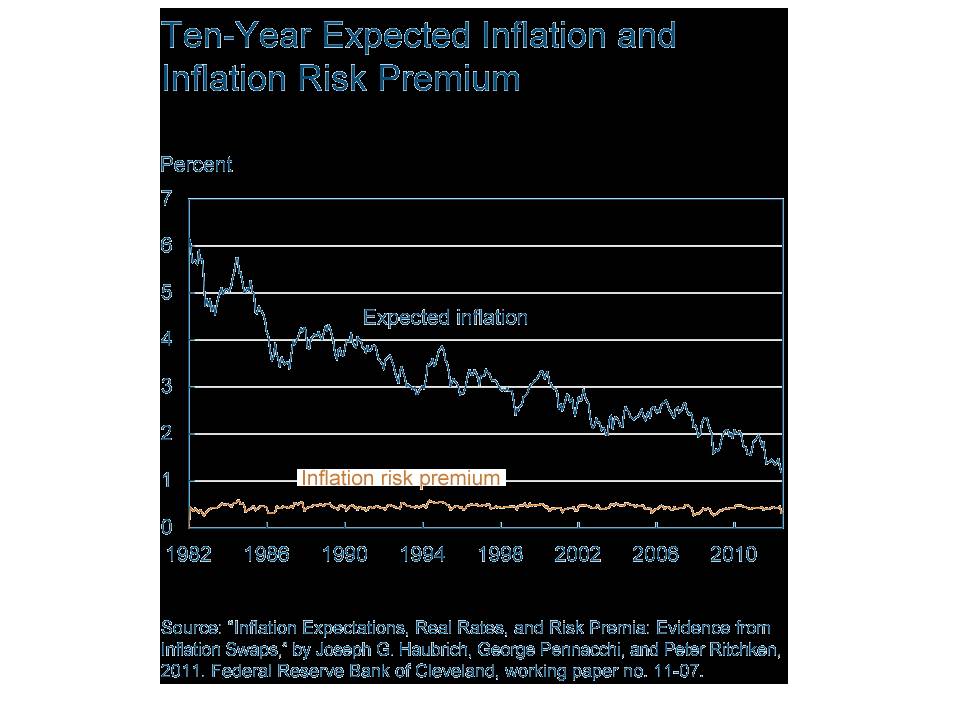
Coinciding with the latest report on the consumer price index, showing the largest one month drop in the CPI since 2008, the Cleveland Fed issued its monthly update on inflation expectations.

News Release: June 14, 2012

The Federal Reserve Bank of Cleveland reports that its latest estimate of 10-year expected inflation is 1.19 percent. In other words, the public currently expects the inflation rate to be less than 2 percent on average over the next decade.

As the attached chart shows, the current expected rate of inflation over a 10-year time horizon is at an all-time low, dropping 30 basis points in the last two months. But in his testimony to Congress this week, Chairman Bernanke did not seem to think there was any problem with monetary policy. It’s all those other guys’ fault.  Well, who exactly is responsible for falling inflation expectations, Mr. Bernanke, if not the FOMC? Does a sharp drop in inflation expectations, the sharpest since the horrific summer of 2008 give you any cause for concern? If so, is there any change in policy that the FOMC plans to undertake at its next meeting? Or is the FOMC only concerned about inflation expectations when they show signs of becoming unanchored on the upside, not the downside?

UPDATE (3:44 PM EDST):  A quick look at the excel file showing the Cleveland Fed’s estimates of inflation expectations at maturities from 1 to 30 years shows that one-year expectation fell last month to 0.6% from 1.4% the previous month.  That is the lowest one-year inflation expectation since March of 2009 (-.0.3%) when the S&P 500 fell to 676, 10% below the previous trough of 752, in November 2008.  We are treading on very thin ice, and the only thing that may be keeping us afloat is the market’s expectation that the FOMC has no alternative but to adopt another round of Quantitative Easing.  Let’s see if the confidence of the market is justified.

Alchian on the Meaning of Keynesian “Involuntary” Unemployment

In his classic paper “Information Costs, Pricing, and Resource Unemployment,” Armen Alchian explains how the absence of full information about the characteristics of goods and services, and about the prices at which they are available leads to a variety of phenomena that are inconsistent with implications of idealized “perfect markets” at which all transactors can buy or sell as much as they want to at known, market-clearing, prices. The main implications of less than full information are  the necessity of search, less than instantaneous price adjustment to changes in demand or cost conditions, the holding of (seemingly) idle or unemployed inventories, queuing, and even rationing. The paper was originally published in 1969 in the Western Economic Journal (subsequently Economic Inquiry) and was republished in a 1970 volume edited by Edmund Phelps, Microeconomic Foundations of Employment and Inflation Theory. It is included in The Collected Works of Armen Alchian (volume 1) published by the Liberty Fund.

Alchian’s explanation of Keynes’s definition of involuntary unemployment appears in footnote 27 in the version published in the Phelps volume (23 in the version published in volume 1 of The Collected Works). Here is the entire footnote:

An intriguing intellectual historical curioso may be explainable by this theory, as has been brought to my attention by Axel Leijonhufvud. Keynes’ powerful, but elliptical, definition of involuntary unemployment has been left in limbo. He wrote:

Men are involuntary unemployed if, in the event of a small rise in the price of wage-goods relative to the money-wage, both the aggregate supply of labour willing to work for the current money wage and the aggregate demand for it at that wage would be greater than the existing volume of employment.

[J. M. Keynes, The General Theory of Employment, Interest, and Money (The Macmillan Company, London, 1936).] To see the power and meaning of this definition (not cause) of unemployment, consider the following question: Why would a cut in money wages provoke a different response than if the price level rose relative to wages – when both would amount to the same change in relative prices, but differ only in the money price level? Almost everyone thought Keynes presumed a money wage illusion. However, an answer more respectful of Keynes is available. The price level rise conveys different information: Money wages everywhere have fallen relative to prices. On the other hand, a cut in one’s own wage money wage does not imply options elsewhere have fallen. A cut only in one’s present job is revealed. The money versus real wage distinction is not the relevant comparison; the wage in the present job versus the wage in all other jobs is the relevant comparison. This rationalizes Keynes’ definition of involuntary unemployment in terms of price-level changes. If wages were cut everywhere else, and if employees knew it, they would not choose unemployment – but they would if they believed wages were cut just in their current job. When one employer cuts wages, this does not signify cuts elsewhere. His employees rightly think wages are not reduced elsewhere. On the other hand, with a rise in the price level, employees have less reason to think their current real wages are lower than they are elsewhere. So they do not immediately refuse a lower real wage induced by a higher price level, whereas they would refuse an equal money wage cut in their present job. It is the revelation of information about prospects elsewhere that makes the difference. And this is perfectly consistent with Keynes’ definition of [involuntary] unemployment, and it is also consistent with his entire theory of market-adjustment processes (Keynes, The General Theory of Employment, Interest, and Money) since he believed that money wages lagged behind nonwage prices – an unproved and probably false belief (R. A. Kessel and A. A. Alchian, “The Meaning and Validity of the Inflation-Induced Lag of Wages Behind Prices,” American Economic Review 50 (March 1960): 43-66). Without that belief a general price-level rise is indeed general; it includes wages, and as such there is no reason to believe a price level rise is equivalent in real terms to a money wage cut in a particular job.

PS There is a lot of unpacking that needs to be done in the last two sentences, but that is best left for another post.

How Did We Get into a 2-Percent Inflation Trap?

It is now over 50 years since Paul Samuelson and Robert Solow published their famous paper “Analytical Aspects of Anti-Inflation Policy,” now remembered mainly for offering the Phillips Curve as a menu of possible combinations of unemployment and inflation, reflecting a trade-off between inflation and unemployment. By accepting a bit more inflation, policy-makers could bring down the rate of unemployment, vice-versa. This view of the world enjoyed a brief heyday in the early 1960s, but, thanks to a succession of bad, and sometimes disastrous, policy choices, and more than a little bad luck, we seemed, by the late 1970s and early 1980s, to be stuck with the worst of both worlds: high inflation and high unemployment. In the meantime, Milton Friedman (and less famously Edmund Phelps) countered Samuelson and Solow with a reinterpretation of the Phillips Curve in which the trade-off between inflation and unemployment was only temporary, inflation bringing down unemployment only when it is unexpected. But once people begin to expect inflation, it is incorporated into wage demands, so that the stimulative effect of inflation wears off, unemployment reverting back to its “natural” level, determined by “real” forces. Except in the short run, monetary policy is useless as a means of reducing unemployment. That theoretical argument, combined with the unpleasant experience of the 1970s and early 1980s, combined with a fairly rapid fall in unemployment after inflation was reduced from 12 to 4% in the 1982 recession, created an enduring consensus that inflation is a bad thing and should not be resorted to as a method of reducing unemployment.

I generally accept the Friedman/Phelps argument (actually widely anticipated by others, including, among others, Mises, Hayek and Hawtrey, before it was made by Friedman and Phelps) though it is subject to many qualifying conditions, for example, workers acquire skills by working, so a temporary increase in employment can have residual positive effects by increasing the skill sets and employability of the work force, so that part of the increase in employment resulting from inflation may turn out to be permanent even after inflation is fully anticipated. But even if one accepts Friedman’s natural-rate hypothesis in its most categorical form, the Friedman argument does not imply that inflation is never an appropriate counter-cyclical tool. Indeed, the logic of Friedman’s argument, properly understood and applied, implies that inflation ought to be increased when the actual rate of unemployment exceeds the natural rate of unemployment.

But first let’s understand why Friedman’s argument implies that it is a bad bargain to reduce the unemployment rate temporarily by raising the rate of inflation.  After all, one could ask, why not pocket a temporary increase in output and employment and accept a permanently higher rate of inflation? The cost of the higher rate of inflation is not zero, but it is not necessarily greater than the increased output and employment achieved in the transition. To this there could be two responses, one is that inflation produces distortions of its own that are not sustainable, so that once the inflation is expected, output and employment will not remain at old natural level, but will, at least temporarily, fall below the original level, so the increase in output and employment will be offset by a future decrease in output and employment. This is, in a very general sense, an Austrian type of argument about the distorting effects of inflation requiring some sort of correction before the economy can revert back to its equilibrium path even at a new higher rate of inflation, though it doesn’t have to be formulated in the familiar terms of Austrian business cycle theory.

But that is not the argument against inflation that Friedman made. His argument against inflation was that using inflation to increase output and employment does not really generate an increase in output, income and employment properly measured. The measured increase in output and employment is achieved only because individuals and businesses are misled into increasing output and employment by mistakenly accepting job offers at nominal wages that they would not have accepted had they realized that pries and general would be rising. Had they correctly foreseen the increase in prices and wages, workers would not have accepted job offers as quickly as they did, and if they had searched longer, they would have found that even better job offers were available. More workers are employed, but the increase in employment comes at the expense of mismatches between workers and the jobs that they have accepted. Since the apparent increase in output is illusory, there is little or no benefit from inflation to outweigh the costs of inflation. The implied policy prescription is therefore not to resort to inflation in the first place.

Even if we accept it as valid, this argument works only when the economy is starting from a position of full employment. But if output and employment are below their natural or potential levels, the argument doesn’t work. The reason the argument doesn’t work is that when an economy starts from a position of less than full employment, increases in output and employment are self-reinforcing and cumulative. There is a multiplier effect, because as the great Cambridge economist, Frederick Lavington put it so well, “the inactivity of all is the cause of the inactivity of each.” Thus, the social gain to increasing employment is greater than the private gain, so in a situation of less-than-full employment, tricking workers to accept employment turns out to be socially desirable, because by becoming employed they increase the prospects for others to become employed. When the rate of unemployment is above the natural level, a short-run increase in inflation generates an increase in output and employment that is permanent, and therefore greater than the cost associated with a temporary increase in inflation. As the unemployment rate drops toward the natural level, the optimal level of inflation drops, so there is no reason why the public should anticipate a permanent increase in the rate of inflation. When actual unemployment exceeds the natural rate, inflation, under a strict Friedmanian analysis, clearly pays its own way.

But we are now trapped in a monetary regime in which even a temporary increase in inflation above 2-percent apparently will not be tolerated even though it means perpetuating an unemployment rate of 8 percent that not so long ago would have been considered intolerable. What is utterly amazing is that the intellectual foundation for our new 2-percent-inflation-targeting regime is Friedman’s natural-rate hypothesis, and a straightforward application of Friedman’s hypothesis implies that the inflation rate should be increased whenever the actual unemployment rate exceeds the natural rate. What a holy mess.

How Monetary Policy Works

These are exciting times. Europe is in disarray, unable to cope with a crisis requiring adjustments in relative prices, wages, and incomes that have been rendered impossible by a monetary policy that has produced almost no growth in nominal GDP in the Eurozone since 2008, placing an intolerable burden on the Eurozone’s weakest economies. The required monetary easing by the European Central Bank is unacceptable to Germany, so the process of disintegration continues. The US, showing signs of gradual recovery in the winter and early spring, remains too anemic to shake off the depressing effects of the worsening situation in Europe. With US fiscal policy effectively stalemated until after the election, the only policy-making institution still in play is the Federal Open Market Committee (FOMC) of the Federal Reserve. The recent track record of the FOMC can hardly inspire much confidence in its judgment, but it’s all we’ve got. Yesterday’s stock market rally shows that the markets, despite many earlier disappointments, have still not given up on the FOMC.  But how many more disappointments can they withstand?

In today’s Financial Times, Peter Fisher (head of fixed income at BlackRock) makes the case (“Fed would risk diminishing returns with further ‘QE'”) against a change in policy by the Fed. Fisher lists four possible policy rationales for further easing of monetary policy by the Fed: 1) the “bank liquidity” rationale, 2) the “asset price” rationale, 3) the “credit channel” rationale, and 4) the “radical monetarist” rationale.

Fisher dismisses 1), because banks are awash in excess reserves from previous bouts of monetary easing. I agree, and that’s why the Fed should stop paying banks interest on reserves. He dismisses 2) because earlier bouts of monetary easing raised asset prices but had only very limited success in stimulating increased output.

While [the Fed] did drive asset prices higher for a few months, there was little follow-through in economic activity in 2011. This approach provides little more than a bridging operation and the question remains: a bridge to what?

This is not a persuasive critique. Increased asset prices reflected a partial recovery in expectations of future growth in income and earnings. A credible monetary policy with a clearly articulated price level of NGDP target would have supported expectations of higher growth than the anemic growth since 2009, in which asset prices would have risen correspondingly higher, above the levels in 2007, which we have still not reached again.

Fisher rejects 3), the idea “that if the Fed holds down long-term interest rates it will stimulate private credit creation and, thus, economic expansion.” Implementing this idea, via “operation twist” implies taking short-term Treasuries out of the market and replacing them with longer-term Treasuries, but doing so denies “banks the core asset on which they build their balance sheets,” thus impairing the provision of credit by the banking system instead of promoting it.

I agree.

Finally Fisher rejects 4), “the idea more central bank liabilities will eventually translate into ‘too much money chasing too few goods and services’ at least so as to avoid a fall in the general price level.” Fisher asks:

What assets would the Fed buy? More Treasuries? Would the Fed embark on such a radical course in a presidential election year?

Perhaps the Fed could buy foreign currencies, engineer a much weaker dollar and, thereby, stimulate inflation and growth. Would the rest of the world permit this? I doubt it. They would probably respond in kind and we would all have a real currency war. Nor is it clear the US external sector is large enough to import enough inflation to make a difference. If energy and commodity prices soared, would American consumers “chase” consumption opportunities or would they suppress consumption and trigger a recession? Recent experience suggests the latter. How much “chasing behaviour” would we get in a recession? Engineering a dollar collapse would be to play with fire and gasoline. It might create inflation or it might create a depression.

These are concerns that have been expressed before, especially in astute and challenging comments by David Pearson to many of my posts on this blog. They are not entirely misplaced, but I don’t think that they are weighty enough to undermine the case for monetary easing, especially monetary easing tied to an explicit price level or NGDP target. As I pointed out in a previous post, Ralph Hawtrey addressed the currency-war argument 80 years ago in the middle of the Great Depression, and demolished it. FDR’s 40-percent devaluation of the dollar in 1933, triggering the fastest four-month expansion in US history, prematurely aborted by the self-inflicted wound of the National Recovery Administration, provides definitive empirical evidence against the currency-war objection. As for the fear that monetary easing and currency depreciation would lead to an upward spiral of energy and commodity prices that would cause a retrenchment of consumer spending, thereby triggering a relapse into recession, that is certainly a risk. But if you believe that we are in a recession with output and employment below the potential output and employment that the economy could support, you would have to be awfully confident that that scenario is the most likely result of monetary easing in order not to try it.

The point of tying monetary expansion to an explicit price level or spending target is precisely to provide a nominal anchor for expectations. That nominal anchor would provide a barrier against the kind of runaway increase in energy and commodity prices that would supposedly follow from a commitment to use monetary policy to achieve a price-level or spending target.  Hawtrey’s immortal line about crying “fire, fire” in Noah’s flood is still all too apt.


About Me

David Glasner
Washington, DC

I am an economist in the Washington DC area. My research and writing has been mostly on monetary economics and policy and the history of economics. In my book Free Banking and Monetary Reform, I argued for a non-Monetarist non-Keynesian approach to monetary policy, based on a theory of a competitive supply of money. Over the years, I have become increasingly impressed by the similarities between my approach and that of R. G. Hawtrey and hope to bring Hawtrey’s unduly neglected contributions to the attention of a wider audience.

My new book Studies in the History of Monetary Theory: Controversies and Clarifications has been published by Palgrave Macmillan

Follow me on Twitter @david_glasner

Archives

Enter your email address to follow this blog and receive notifications of new posts by email.

Join 665 other subscribers
Follow Uneasy Money on WordPress.com