Archive for the 'Earl Thompson' Category


What Kind of Equilibrium Is This?

In my previous post, I suggested that Stephen Williamson’s views about the incapacity of monetary policy to reduce unemployment, and his fears that monetary expansion would simply lead to higher inflation and a repeat of the bad old days the 1970s when inflation and unemployment spun out of control, follow from a theoretical presumption that the US economy is now operating (as it almost always does) in the neighborhood of equilibrium. This does not seem right to me, but it is the sort of deep theoretical assumption (e.g., like the rationality of economic agents) that is not subject to direct empirical testing. It is part of what the philosopher Imre Lakatos called the hard core of a (in this case Williamson’s) scientific research program. Whatever happens, Williamson will process the observed facts in terms of a theoretical paradigm in which prices adjust and markets clear. No other way of viewing reality makes sense, because Williamson cannot make any sense of it in terms of the theoretical paradigm or world view to which he is committed. I actually have some sympathy with that way of looking at the world, but not because I think it’s really true; it’s just the best paradigm we have at the moment. But I don’t want to follow that line of thought too far now, but who knows, maybe another time.

A good illustration of how Williamson understands his paradigm was provided by blogger J. P. Koning in his comment on my previous post copying the following quotation from a post written by Williamson a couple of years on his blog.

In other cases, as in the link you mention, there are people concerned about disequilibrium phenomena. These approaches are or were popular in Europe – I looked up Benassy and he is still hard at work. However, most of the mainstream – and here I’m including New Keynesians – sticks to equilibrium economics. New Keynesian models may have some stuck prices and wages, but those models don’t have to depart much from standard competitive equilibrium (or, if you like, competitive equilibrium with monopolistic competition). In those models, you have to determine what a firm with a stuck price produces, and that is where the big leap is. However, in terms of determining everything mathematically, it’s not a big deal. Equilibrium economics is hard enough as it is, without having to deal with the lack of discipline associated with “disequilibrium.” In equilibrium economics, particularly monetary equilibrium economics, we have all the equilibria (and more) we can handle, thanks.

I actually agree that departing from the assumption of equilibrium can involve a lack of discipline. Market clearing is a very powerful analytical tool, and to give it up without replacing it with an equally powerful analytical tool leaves us theoretically impoverished. But Williamson seems to suggest (or at least leaves ambiguous) that there is only one kind of equilibrium that can be handled theoretically, namely a fully optimal general equilibrium with perfect foresight (i.e., rational expectations) or at least with a learning process leading toward rational expectations. But there are other equilibrium concepts that preserve market clearing, but without imposing, what seems to me, the unreasonable condition of rational expectations and (near) optimality.

In particular, there is the Hicksian concept of a temporary equilibrium (inspired by Hayek’s discussion of intertemporal equilibrium) which allows for inconsistent expectations by economic agents, but assumes market clearing based on supply and demand schedules reflecting those inconsistent expectations. Nearly 40 years ago, Earl Thompson was able to deploy that equilibrium concept to derive a sub-optimal temporary equilibrium with Keynesian unemployment and a role for countercyclical monetary policy in minimizing inefficient unemployment. I have summarized and discussed Thompson’s model previously in some previous posts (here, here, here, and here), and I hope to do a few more in the future. The model is hardly the last word, but it might at least serve as a starting point for thinking seriously about the possibility that not every state of the economy is an optimal equilibrium state, but without abandoning market clearing as an analytical tool.
And Now Here’s a Kind Word for Austrian Business Cycle Theory

I recently wrote two posts (this and this) about the Austrian Theory of Business Cycles (ABCT) that could be construed as criticisms of the theory, and regular readers of this blog are probably aware that critical comments about ABCT are not unprecedented on this blog. Nevertheless, I am not at all hostile to ABCT, though I am hostile to the overreach of some ABCT enthusiasts who use ABCT as a justification for their own radically nihilistic political agenda of promoting the collapse of our existing financial and monetary system and the resulting depression in the expectation that the apocalypse would lead us into a libertarian free market paradise. So, even though I don’t consider myself an Austrian economist, I now want to redress the balance by saying something positive about ABCT, because I actually believe that the Austrian theory and approach has something important to teach us about business-cycle theory and macroeconomics.

The idea for writing a positive post about Austrian business-cycle theory actually came to me while I was writing my latest installment on Earl Thompson’s reformulation of macroeconomics. The point of my series on Earl Thompson is to explain how Thompson constructed a macroeconomic model in many ways similar to the Keynesian IS-LM model, but on a consistent and explicitly neoclassical foundation. Moreover, by inquiring deeply into the differences between his reformulated model with IS-LM model, Thompson identified some important conceptual shortcomings in the Keynesian model, perhaps most notably the downward-sloping IS curve, a shortcoming with potentially important policy implications.

Now to be able to construct a macroeconomic model at what Thompson called “a Keynesian level of aggregation” (i.e, a model consisting of just four markets, money, output, capital services and labor services) that could also be reconciled with neoclassical production theory, it was necessary to assume that capital and output are a single homogeneous substance that can either be consumed or used as an input in the production process for new output. One can, as Thompson did, construct a consistent model based on these assumptions, a model that may even yield important and useful insights, but it is not clear to me that these minimal assumptions provide a sufficient basis for constructing a reliable macroeconomic model.

What does this have to do with ABCT? Well, ABCT seeks to provide an explanation of business cycles that is built from the ground up based on how individuals engage in rational goal-oriented action in market transactions. In Austrian theory, understanding how market actions are motivated and coordinated is primarily achieved by understanding how relative prices adjust to the market forces of demand and supply. Market determined prices direct resources toward their most highly valued uses given the available resources and the structure of demand for final outputs, while coordinating the separate plans of individual households and business firms. In this view, total aggregate spending is irrelevant as it is nothing more than the sum total of individual decisions. It is the individual decisions that count; total spending is simply the resultant of all those individual decisions, not the determinant of them.  Those decisions are made in light of the incentives and costs faced by the individual decision-makers. Total spending doesn’t figure into their decision-making processes, so what is the point of including it as a variable in the mode?

This mistaken preoccupation of Keynesian macroeconomics with aggregate spending has been the central message of Austrian anti-Keynesianism going back at least to Hayek’s 1931 review of Keynes’s Treatise on Money in which Hayek charged that “Mr. Keynes’s aggregates conceal the most fundamental mechanisms of change.” But the assertion that aggregates are irrelevant to individual decisions is not necessarily valid. Businesses decide on how much they are going to invest based on some forecast of the future demand for their products. Is that forecast of future demand independent of what total spending will be in the future? That is a matter of theoretical judgment, not an issue of methodological malpractice.  Interest rates, a quintessential market price, the rate at which one can transform current commodities or money units into future commodities or future money units, are not independent of forecasts about the future purchasing power of the monetary unit. But the purchasing power of the monetary unit is another one of those illegitimate aggregate about which Austrians complain. So although I sympathize with Austrian mistrust of overly aggregated macroeconomic models, I am not sure that I agree with their specific criticisms about the meaningfulness and relevance of particular aggregates.

So let me offer an alternative criticism of excessive aggregation, but in the context of a different kind of example. Suppose I wish to explain a very simple kind of social interaction in which a decision by one person can lead to a kind of chain reaction followed by a rapid succession of subsequent, but formally, independent, decisions. Think of a crowd of people watching a ball game. The spectators are all seated in their seats.  Suddenly something important or exciting happens on the court or the field and almost instantaneously everyone is standing. Why? As soon as one person stands he blocks the vision of the person behind him, forcing that person to stand, causing a chain reaction. For some reason, the action on the field causes a few people to stand. If those people did not stand, no one else would have stood. In fact, even if the first people to stand stood for reasons that had nothing to do with what was happening on the field, the effect would have been the same, because everyone else would have stood; once their vision is  blocked by people in front of them, spectators have to stand up to to see the action.  But this phenomenon of everyone in a crowd standing when something exciting happens on the ball field happens only with a crowd of spectators of some minimum density.   Below that density, not everyone will be forced to stand just because a few people near the front get up from their seats.

A similar chain reaction, causing a more serious inefficiency, results when traffic slows down to a crawl on an expressway not because of an obstruction, but just because there is something off to the side of the road that some people are slowing down to look at. The effect only happens, or is at least highly sensitive to, the traffic density on the expressway. If the expressway is sufficiently uncrowded, some attention-attracting sight on the side of the road will cause only a minimal slowdown in the flow of traffic.

The point here is that there is something about certain kinds of social phenomena that is very sensitive to certain kinds of interactions between the individuals in the larger group under consideration. The phenomenon cannot be explained unless you take account of how the individuals are interacting. Just looking at the overall characteristics of the group without taking into account the interactions between the individuals will cause you to miss something essential to the process that you are trying to explain. It seems to me that there is something about business-cycle phenomena that is deeply similar to the crowd-like effects in the two examples I gave in the previous paragraph. Aggregation in economic models is not necessarily bad, even Austrians routinely engaging in aggregation in their business-cycle analyses, rarely, for example, discussing changes in the shape of the yield curve, but simply assuming that the entire yield curve rises or falls with “the interest rate.” The question is always a pragmatic one, is the increased tractability of the analysis that aggregation permits worth the impoverishment of the model, by reducing the scope for interactions between the remaining variables. In this respect, it seems to me that real-business cycle models, especially those of the representative-agent ilk, are, by far, the most impoverished of all.  I mean can you imagine, a representative spectator or representative-driver model of either of the social interactions described above?

So my advice, for whatever it’s worth, to Austrians (and non-Austrians) is to try to come up with explanations for why aggregated models suppress some type of interaction between agents that is crucial to the explanation of a phenomenon of interest.  That would be an more useful analytical contribution than simply complaining about aggregation in the abstract.

PS  Via Mark Thoma I see that Alan Kirman has just posted an article on Vox in which he makes a number of points very similar to those that I make here. For example:

The student then moves on to macroeconomics and is told that the aggregate economy or market behaves just like the average individual she has just studied. She is not told that these general models in fact poorly reflect reality. For the macroeconomist, this is a boon since he can now analyse the aggregate allocations in an economy as though they were the result of the rational choices made by one individual. The student may find this even more difficult to swallow when she is aware that peoples’ preferences, choices and forecasts are often influenced by those of the other participants in the economy. Students take a long time to accept the idea that the economy’s choices can be assimilated to those of one individual.

Thompson’s Reformulation of Macroeconomic Theory, Part IV

It’s time for another installment, after a longer than expected hiatus, in my series of posts summarizing and commenting on Earl Thompson’s path-breaking paper, “A Reformulaton of Macroeconomic Theory.” In the first three installments I described the shift on modeling strategy from the conventional Keynesian IS-LM model adopted by Thompson, and the basic properties of his reformulated model. In the first installment, I explained that Thompson’s key analytic insight was to ground the model in an explicitly neoclassical framework, exploiting the straightforward and powerful implications of the neoclassical theory of production to derive the basic properties of a macroeconomc model structurally comparable to the IS-LM model. The reformulated model shifts the analytic focus from the Keynesian spending functions to the conditions for factor-market equilibrium in a single-output, two-factor model. In the second installment, I explained how Thompson drew upon the Hicksian notion of temporary equilibrium for an explicit treatment of Keynesian (involuntary) unemployment dependent on incorrect (overly optimistic) expectations of future wages. While the model allows for inefficient (relative to correct expectations) choices by workers to remain unemployed owing to incorrect expectations, the temporary equilibrium nevertheless involves no departure from market clearing, and no violation of Walras’s Law. In the third installment, I described the solution of the model, deriving two market-equilibrium curves, one a locus of points of equilibrium (combinations of price levels and nominal interest rates) in the two factor markets (for labor and capital services) and one a locus of points of money-market equilibrium (again in terms of price levels and nominal interest rates) using the standard analytic techniques for deriving the Keynesian IS and LM curves.

Although not exactly the same as the Keynesian LM curve (constructed in income-interest-rate space), the locus of points of monetary equilibrium, having a similar upward slope, was assigned the familiar LM label. However, unlike the Keynesian IS curve it replaces, the locus of points, labeled FF, of factor-market equilibrium is positively sloped. The intersection of the two curves determines a temporary equilibrium, characterized by a price level, a corresponding level of employment, and for a given expected-inflation parameter, a corresponding real and nominal interest rate. The accompanying diagram, like Figure 4 in my previous installment, depicts such a temporary-equilibrium solution. I observed in the previous installment that applying Walras’s Law allows another locus of points corresponding to equilibrium in the market for the single output, which was labeled the CC curve (for commodity market equilibrium) by Thompson. The curve would have to lie in the space between the FF curve and the LM curve, where excess demands in each market have opposite (offsetting) signs. The CC curve is in some sense analogous to the Keynesian IS curve, but, as I am going to explain, it differs from the IS curve in a fundamental way. In the accompnaying diagram, I have reproduce the FF and LM curves of the with reformulated model with the CC curve drawn between the FF and LM curves. The slope of the CC curve is clearly positive, in contrast to the downward slope normally attributed to the Keynesian IS curve.

In this post, I am going to discuss Thompson’s explanation of the underlying connection between his reformulated macroeconomic model and the traditional Keynesian model. At a formal level, the two models share some of the same elements and a similar aggregative structure, raising the question what accounts for the different properties of the two models and to what extent can the analysis of one model be translated into the terms of the other model?

Aside from the difference in modeling strategy, focusing on factor-market equilibrium instead of an aggregate spending function, there must be a deeper underlying substantive difference between the two models, otherwise the choice of which market to focus on would not matter, Walras’s Law guaranteeing that anyone of the n markets can be eliminated without changing the equilibrium solution of a system of excess demand equations. So let us look a bit more closely at the difference between the Keynesian IS curve and the CC curve of the reformulated model. The most basic difference is that the CC curve relates to a stock equilibrium, with an equilibrating value of P in the market for purchasing the stock of commodities, representing the equilibrium market value of a unit of output. On the other hand, the Keynesian IS curve is measuring a flow, the rate of aggregate expenditure, the equilibrium corresponding to a particular rate of expenditure.

Thompson sums up the underlying difference between the Keynesian model and the reformulated model in two very dense paragraphs on pp. 16-17 of his paper under section heading “The role of aggregate spending and the Keynesian stock-flow fallacy.” I will quote the two paragraphs in full and try to explain as best as I can, what he is saying.

All of this is not to say that the flow of aggregate spending is irrelevant to our temporary equilibrium. The expected rate of inflation [as already noted a crucial parameter in the reformulated model] may depend parametrically upon the expected rate of spending. Then, an increase in the expected rate of spending on consumption or investment (or, more generally, an increase in the expected future excess demand for goods at the originally expected prices) would, by increased Pe [the expected price level] and thus r [the nominal interest rate] for a given R/P [the ratio of the rental price of capital to the price of capital, aka the real interest rate], shift up the FF curve. In a Modern Money Economy [i.e., an economy using a non-interest-bearing fiat money monopolistically supplied by a central bank], this shift induces a movement out of money [because an increase in the nominal interest rate increases the cost of holding non-interest-bearing fiat money] in the current market (a movement along the LM curve) and a higher current price level. This exogenous treatment of spendings variables, while perhaps most practical from the standpoint of business cycle policy, does not capture the Keynesian concept of an equilibrium rate of expenditure.

It is worth pausing here to ponder the final sentence of the paragraph, because the point that Thompson is getting at is far from obvious. I think what he means is that one can imagine, working within the framework of the reformulated FF-LM model, that a policy change, say an increase in government spending, could be captured by positing an effect on the expected price level. Additional government spending would raise the expected price level, thus causing an upward shift in the FF curve, thereby inducing people to hold less cash, leading to a new equilibrium associated with an intersection of the new FF curve at a point further up and to the right along the LM curve than the original intersection. Thus, the FF-LM framework can accommodate a traditional Keynesian fiscal policy exercise. But the IS-LM framework is unable to specify what the equilibrium rate of spending is and how that equilibrium can be determined, the problem being that there does not seem to be any variable in the model that adjusts to equilibrate the rate of spending in the way that the price level adjusts to equilibrate the market for output in the reformulated model. There is no condition specified to distinguish an equilibrium rate of spending from a non-equilibrium rate of spending. Now back to Thompson:

In order to obtain an equilibrium rate of expenditures – and thus an equilibrium rate of capital accumulation [aka investment, how much output will be carried over to next period] – a corresponding price variable must be added. The only economically natural price to introduce to equilibrate the demand and supply of next period’s capital goods is the price of next period’s capital goods. [In other words, how much of this period’s output that people want to hold until next period depends on the relationship between the current price of the output and the expected price in the next period.] This converts Pe into an equilibrating variable. Indeed, Section III below will show that if Pe is made the equilibrating price variable, making the rate of inflation an independently equilibrating variable rather than an expectations parameter determined by other variables in the system and extending the temporary equilibrium to a two-period equilibrium model in which only prices in the third and later periods may be incorrectly expected in the current period, the Keynesian expenditures condition, the equality of ex ante savings and investment, is indeed achieved. However, Section III will also show that the familiar Keynesian comparative statics results that are based upon a negatively sloped IS curve fail to hold in the extended model just as they fail in the above, single period model.

The upshot of Thompson’s argument is that you can’t have a Keynesian investment function without introducing an expected price for capital in the next period. Without an expected price of output in the next period, there is nothing to determine how much investment entrepreneurs choose to undertake in the current period. And if you want to identify an equilibrium rate of expenditure, which means an equilibrium rate of investment, then you must perforce allow the expected price for capital in the next period to adjust to achieve that equilibrium.

I must admit that I have been struggling with this argument since I first heard Earl make it in his graduate macro class almost 40 years ago, and it is only recently that I have begun to think that I understand what he was getting at. I was helped in seeing his point by the series of posts (this, this, this, this, this, this, this, and this) that I wrote earlier this year about identities and equilibrium conditions in the basic Keynesian model, and especially by the many comments and counterarguments that I received as a result of those posts. The standard Keynesian expenditure function is hard to distinguish from an income function (which also makes it hard to distinguish investment from savings), which makes it hard to understand the difference between expenditure being equal in equilibrium and being identical to savings in general or to understand the difference between savings and investment being equal in equilibrium and being identical in general. There is a basic problem in choosing define an equilibrium in terms of two magnitudes so closely related as income and expenditure. The equilibrating mechanism doesn’t seem to be performing any real economic work, so it hard to tell the difference between an equilibrium state and a disequilibrium state in such a model. Thompson may have been getting at this point from another angle by focusing on the lack of any equilibrating mechanism in the Keynesian model, and suggesting that an equilibrating mechanism, the expected future price level or rate of inflation, has to be added to the Keynesian model in order to make any sense out of it.

In my next installment, I will consider Thompson’s argument about the instability of the equilibrium in the FF-LM model.

Thompson’s Reformulation of Macroeconomic Theory, Part III: Solving the FF-LM Model

In my two previous installments on Earl Thompson’s reformulation of macroeconomic theory (here and here), I have described the paradigm shift from the Keynesian model to Thompson’s reformulation — the explicit modeling of the second factor of production needed to account for a declining marginal product of labor, and the substitution of a factor-market equilibrium condition for equality between savings and investment to solve the model. I have also explained how the Hicksian concept of temporary equilibrium could be used to reconcile market clearing with involuntary Keynesian unemployment by way of incorrect expectations of future wages by workers occasioned by incorrect expectations of the current (unobservable) price level.

In this installment I provide details of how Thompson solved his macroeconomic model in terms of equilibrium in two factor markets instead of equality between savings and investment. The model consists of four markets: a market for output (C – a capital/consumption good), labor (L), capital services (K), and money (M). Each market has its own price: the price of output is P; the price of labor services is W; the price of capital services is R; the price of money, which serves as numeraire, is unity. Walras’s Law allows exclusion of one of these markets, and in the neoclassical spirit of the model, the excluded market is the one for output, i.e., the market characterized by the Keynesian expenditure functions. The model is solved by setting three excess demand functions equal to zero: the excess demand for capital services, XK, the excess demand for labor services, XL, and the excess demand for money, XM. The excess demands all depend on W, P, and R, so the solution determines an equilibrium wage rate, an equilibrium rental rate for capital services, and an equilibrium price level for output.

In contrast, the standard Keynesian model includes a bond market instead of a market for capital services. The excluded market is the bond market, with equilibrium determined by setting the excess demands for labor services, for output, and for money equal to zero. The market for output is analyzed in terms of the Keynesian expenditure functions for household consumption and business investment, reflected in the savings-equals-investment equilibrium condition.

Thompson’s model is solved by applying the simple logic of the neoclassical theory of production, without reliance on the Keynesian speculations about household and business spending functions. Given perfect competition, and an aggregate production function, F(K, L), with the standard positive first derivatives and negative second derivatives, the excess demand for capital services can be represented by the condition that the rental rate for capital equal the value of the marginal product of capital (MPK) given the fixed endowment of capital, K*, inherited from the last period, i.e.,

R = P times MPK.

The excess demand for labor can similarly be represented by the condition that the reservation wage at which workers are willing to accept employment equals the value of the marginal product of labor given the inherited stock of capital K*. As I explained in the previous installment, this condition allows for the possibility of Keynesian involuntary unemployment when wage expectations by workers are overly optimistic.

The market rate of interest, r, satisfies the following version of the Fisher equation:

r = R/P + (Pe – P)/P), where Pe is the expected price level in the next period.

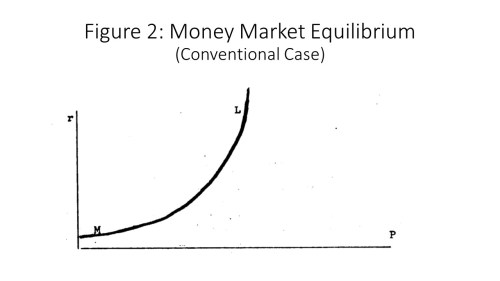
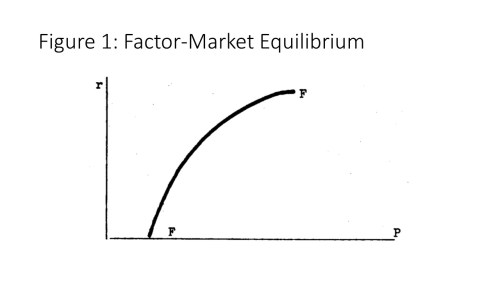
Because K* is assumed to be fully employed with a positive marginal product, a given value of P determines a unique corresponding equilibrium value of L, the supply of labor services being upward-sloping, but relatively elastic with respect to the nominal wage for given wage expectations by workers. That value of L in turn determines an equilibrium value of R for the given value of P. If we assume that inflation expectations are constant (i.e., that Pe varies in proportion to P), then a given value of P must correspond to a unique value of r. Because simultaneous equilibrium in the markets for capital services and labor services can be represented by unique combinations of P and r, a factor-market equilibrium condition can be represented by a locus of points labeled the FF curve in Figure 1 below.

Thompson_Figure1

The FF curve must be upward-sloping, because a linear homogenous production function of two scarce factors (i.e., doubling inputs always doubles output) displaying diminishing marginal products in both factors implies that the factors are complementary (i.e., adding more of one factor increases the marginal productivity of the other factor). Because an increase in P increases employment, the marginal product of capital increases, owing to complementarity between the factors, implying that R must increase by more than P. An increase in the price level, P, is therefore associated with an increase in the market interest rate r.

Beyond the positive slope of the FF curve, Thompson makes a further argument about the position of the FF curve, trying to establish that the FF curve must intersect the horizontal (P) axis at a positive price level as the nominal interest rate goes to 0. The point of establishing that the FF curve intersects the horizontal axis at a positive value of r is to set up a further argument about the stability of the model’s equilibrium. I find that argument problematic. But discussion of stability issues are better left for a future post.

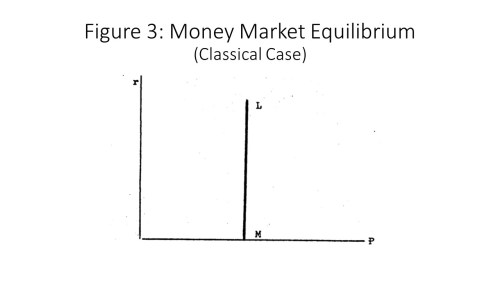
Corresponding to the FF curve, it is straightforward to derive another curve, closely analogous to the Keynesian LM curve, with which to complete a graphical solution of the model. The two LM curves are not the same, Thompson’s LM curve being constructed in terms of the nominal interest rate and the price level rather than in terms of nominal interest rate and nominal income, as is the Keynesian LM curve. The switch in axes allows Thompson to construct two versions of his LM curve. In the conventional case, a fixed nominal quantity of non-interest-bearing money being determined exogenously by the monetary authority, increasing price levels imply a corresponding increase in the nominal demand for money. Thus, with a fixed nominal quantity of money, as the price level rises the nominal interest rate must rise to reduce the quantity of money demanded to match the nominal quantity exogenously determined. This version of the LM curve is shown in Figure 2.

Thompson_Figure2

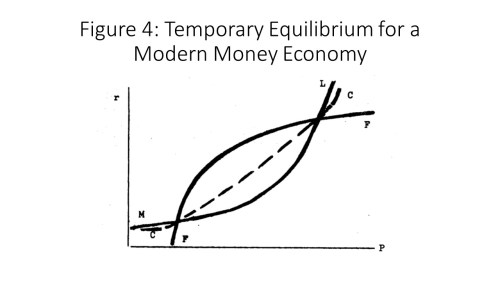
A second version of the LM curve can be constructed corresponding to Thompson’s characterization of the classical model of a competitively supplied interest-bearing money supply convertible into commodities at a fixed exchange rate (i.e., a gold standard except that with only one output money is convertible into output in general not one of many commodities). The quantity of money competitively supplied by the banking system would equal the quantity of money demanded at the price level determined by convertibility between money and output. Because money in the classical model pays competitive interest, changes in the nominal rate of interest do not affect the quantity of money demanded. Thus, the LM curve in the classical case is a vertical line corresponding to the price level determined by the convertibility of money into output. The classical LM curve is shown in Figure 3.

Thompson_Figure3

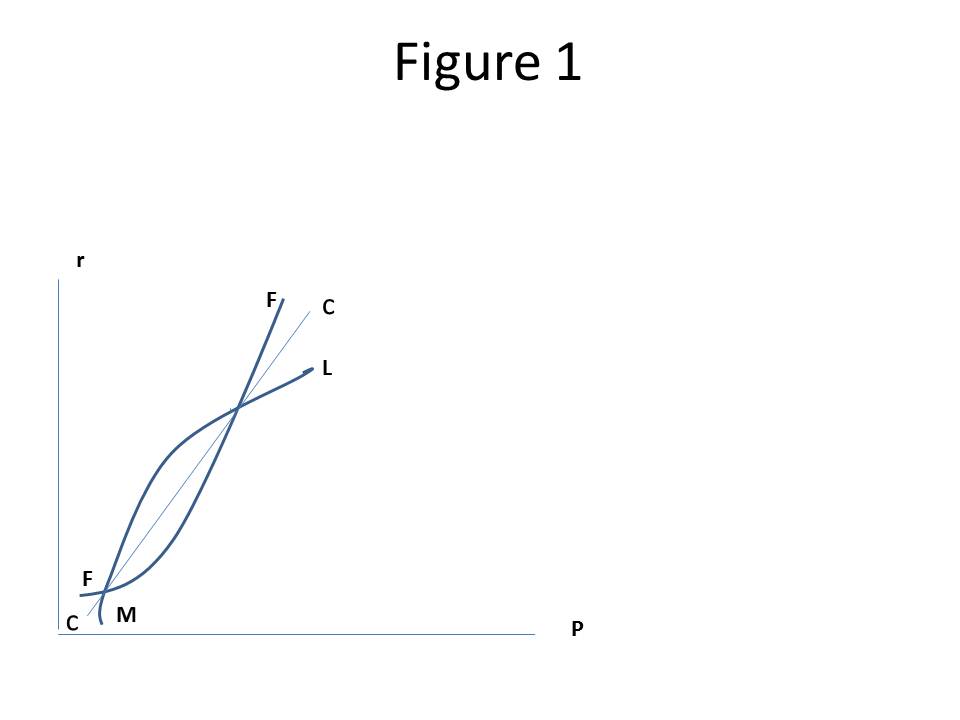
The full solution of the model (in the conventional case) is represented graphically by the intersection of the FF curve with the LM curve in Figure 4.

Thompson_Figure4

Note that by applying Walras’s Law, one could draw a CC curve representing equilibrium in the market for commodities (an analogue to the Keynesian IS curve) in the space between the FF and the LM curves and intersecting the two curves precisely at their point of intersection. Thus, Thompson’s reformulation supports Nick Rowe’s conjecture that the IS curve, contrary to the usual derivation, is really upward-sloping.

Thompson’s Reformulation of Macroeconomic Theory, Part II: Temporary Equilibrium

I explained in my first post on Earl Thompson’s reformulation of macroeconomics that Thompson posited a model consisting of a single output serving as both a consumption good and as a second factor of production cooperating with labor to produce the output. The single output is traded in two markets: a market for sale to be consumed and a market for hire as a factor of production. The ratio of the rental price to the purchase price determines a real interest rate, and adding the expected rate of change in the purchase price from period to period to the real interest rate determines the nominal interest rate. The money wage is determined in a labor market, and the absolute price level is determined in the money market. A market for bonds exists, but the nominal interest rate determined by the ratio of the rental price of the output to its purchase price plus the expected rate of change in the purchase price from period to period governs the interest rate on bonds, conveniently allowing the bond market to be excluded from the analysis.

The typical IS-LM modeling approach is to posit a sticky wage that prevents equilibrium at full employment from being achieved except via an increase in aggregate demand. Wage rigidity is thus introduced as an ad hoc assumption to explain how an unemployment “equilibrium” is possible. However, by extending the model to encompass a second period, Thompson was able to derive wage stickiness in the context of a temporary equilibrium construct that does not rely on an arbitrary assumption of wage stickiness, but derives wage stickiness as an implication of incorrect expectations, in particular from overly optimistic wage expectations by workers who, upon observing unexpectedly low wage offers, choose to remain unemployed, preferring instead to engage in job search, leisure, or non-market labor activity.  The model assumptions are basically those of Lucas, and Thompson provides some commentary on the rationale for his assumptions.

One might, however, reasonably doubt that government policy makers have systematically better information than private decision makers regarding future prices. Such doubting would be particularly strong for commodity markets, where, in the real world, market specialists normally arbitrage between present and future markets. . . . But laws prohibiting long-term labor contracts have effectively prevented human capital from coming under the control of market specialists. As a consequence, the typical laborer, who is not naturally an expert in the market for his kind of service, makes his own employment decisions despite relative ignorance about the market. (p. 6)

I will just note parenthetically that my own view is that the information problem is exacerbated in the real world by the existence of many products and many different  kinds of services. Shocks are transmitted from sector to sector via complicated and indirect interrelationships between markets and sectors. In the process of transmission, initial shocks are magnified, some sectors being affected more than others in unpredictable, or at least unpredicted, ways causing sector-specific shocks that, in turn, get transmitted to other sectors. These interactions are analogous to the Cantillon effects associated with sector-specific variations in the rate of additional spending caused by monetary expansion.  Austrian economists tend to wring their hands and shake their heads in despair about the terrible distortions associated with Cantillon effects caused by monetary expansion, but seem to regard the Cantillon effects associated with monetary contraction as benign and remedial.  Highly aggregated models don’t capture these interactions and thus leave out an important feature of business-cycle contractions.

Starting from a position of full equilibrium, an exogenous shift creates a temporary equilibrium with Keynesian unemployment when there is an overall excess supply of labor at the original wage rates and some laborers mistakenly believe that the resulting lower wage offers from their present employers may be a result of a shift which lowers the value of their products in their present firms relative to other firms who hire workers in their occupations. As a consequence, some of these laborers refuse the lower wage offers from their present employers and spend their present labor service inefficiently searching for higher-wage jobs in their present occupation or resting in wait for what they expect to be the higher future wages.

Since monetary shifts, which are apparently observed to induce inefficient adjustments in employment, also change the temporary equilibrium level of prices of current outputs, we must assume that some workers do not know of the present change in the price level. Otherwise, all workers, in responding to a monetary shift, would be able to observe the price level change which accompanied the change in their wage offers and would not make the mistake of assuming that wage offers elsewhere have not similarly changed. . . . (p. 7)

The price level of current outputs is only an expectation function for these laborers, as they cannot be assumed to know the actual price level in the current period. This is represented . . . by allowing labor’s perception of current non-labor prices to depend only on last period’s prices, which are parameters rather than variables to be determined, and on current wage offers. (p. 8)

Because workers may construe an overall shift in the demand for labor as a relative shift in demand for their own type of labor, it follows that future wage and price expectations are inelastic with respect to observed increases in wage offers. Thus, a change in observed wages does not cause a corresponding revision of expected future wages and prices, so the supply of labor does not shift significantly when observed wages are higher or lower than expected.  When wages change because of an overall reduction in the demand for labor destined to cause future wages and prices to fall, workers with slowly adjusting expectations inefficiently supply services to employers on the basis of incorrect expectations. The temporary equilibrium corresponds to the intersection of a demand curve and a supply curve.  This is a type of wage rigidity different from that associated with the conventional Keynesian model.  The labor market is in equilibrium in the sense that current plans are being executed. However, current plans are conditional on incorrect expectations. There is an inefficiency associated with incorrect expectations. But it is an inefficiency that countercyclical policy can overcome, and that is why there is potentially a multiplier effect associated with an increase in aggregate demand.

Thompson’s Reformulation of Macroeconomic Theory, Part I: Two Basic Problems with IS-LM

As promised in my previous post, I am going to begin providing a restatement or paraphrase of, plus some commentary on, Earl Thompson’s important, but unpublished, paper “A Reformulation of Macroeconomic Theory.” It will take a number of posts to cover the main points in the paper, and I will probably intersperse posts on Earl’s paper with some posts on other topics. The posts are not written yet, so it remains to be seen how long it takes to go through it together.

The paper begins by identifying “four basic difficulties in received [i.e., Keynesian] theory.” In this post, I will discuss only the first two of the four that are listed, the two that undermine the theoretical foundations of the IS-LM model. The other two problems involve what Earl considered to be inconsistencies between the implications of the IS-LM model and some basic stylized facts of macroeconomics and business cycles, which seem to me less fundamental and less compelling than the two flaws he identified in the conceptual foundations of IS-LM.G

The first difficulty is that the Keynesian model assumes both that the marginal product of labor declines as workers are added and that every worker receives a real wage equal to his marginal product. Those two assumptions logically entail the existence of a second scarce factor of production – call it capital – to absorb the residual between total output and total wages. But even though investment as a category of expenditure is a critical variable in the Keynesian model, the status of capital as a factor of production is unacknowledged, while the rate of interest is determined independently of the market for capital goods by a theory of liquidity preference and the equality between savings and investment. A market for bonds is implicitly acknowledged, but, inasmuch as Walras’s Law allows one market to be disregarded, the bond market is not modeled explicitly. The anomaly of an interest rate in a static, one-period model has been noted, but the inconsistency between the conventional Keynesian model IS-LM model with the basic neoclassical theory of production and factor pricing has been glossed over by the irrelevant observation that Walras’s Law allows the bond market to be excluded, as if the bond market were a proxy for a market for real capital services.

How can the inconsistency between the Keynesian model and the neoclassical theory of production and distribution be reconciled? The simplest way to do so is to treat the single output as both a consumption good and a factor of production. This amounts to treating the single output as a Knightian crusonia plant. If used as a consumption good, the plant is purchased and consumed; if used as a factor of production, it is hired (implicitly or explicitly) at a rental price equal to its marginal product. The ratio of the marginal product of a unit of capital to its price is the real interest rate, and that ratio plus the expected percentage appreciation of the money price of the capital good from the current period to the next is the nominal interest rate. This is a basic property of intertemporal equilibrium. The theory of liquidity preference cannot contradict, but must be in accord with, this condition, something that Keynes himself recognized in chapter 17 of the General Theory and again in his 1937 paper “The General Theory of Employment.”

It is worth quoting from the latter paper at length, as Duncan Foley and Miguel Sidrauski did in their important 1970 article “Portfolio Choice, Investment, and Growth,” cited by Thompson as an important precursor to his own paper. Here is Keynes:

The owner of wealth, who has been induced not to hold wealth in the shape of hoarded money, still has two alternatives between which to choose. He can lend his money at the current rate of money-interest or he can purchase some kind of capital asset. Clearly in equilibrium these two alternatives must offer an equal advantage to the marginal investor in each of them. This is brought about by shifts in the money prices of capital assets relative to money loans. The prices of capital assets move until, having regard to their prospective yield and account being taken of all those elements of doubt and uncertainty interested and disinterested advice, fashion, convention, and what else you will, which affect the mind of the investor who is wavering between one kind of investment and another. . . .

Capital assets are capable, in general, of being newly produced. The scale on which they are produced depends, of course, on the relation between their costs of production and the prices which they are expected to realize in the market. Thus if the level of the rate of interest taken in conjunction with opinions about their prospective yield raise the price of capital assets, the volume of current investment (meaning by this the value of the output of newly produced capital assets) will be increased; while if, on the other hand, these influences reduce the prices of capital assets, the volume of current investment will be diminished.

Thus, Keynes clearly recognized that the volume of investment could be analyzed as the solution of a stock-flow problem with a given cost of producing capital assets in relation to the current and expected future price of capital assets. The solution of such a problem involves an equilibrium in which the money rate of interest must equal the real rental rate of capital services plus the expected rate of appreciation of capital assets. But nothing in the IS-LM model constrains the rate of interest to satisfy this condition.

Earl sums up this discussion compressed into a single paragraph at the beginning of his paper as follows:

An inconsistency thus appears within the received [i.e., IS-LM] theory once we recognize the necessity of a market for the services of a non-labor input, a recognition which amounts to adding an independent equilibrium equation without adding a corresponding variable.

In other words, the IS-LM model implies one interest rate, and the neoclassical theory of production and distribution implies another, and there is no new variable defined that could account for the discrepancy. Earl goes on to elaborate in a long footnote.

Numerous authors have pointed out the inconsistency of Keynesian interest theory with neoclassical marginal productivity theory. But they have not seen the need for the extra equation describing equilibrium in the capital services market, and thus they have not regarded the inconsistency as a direct logical threat to Keynesian models. Rather, they have unfortunately been satisfied, at least since the classic paper of Lerner, with a conjecture that the difference in interest rates vanishes when there are increasing costs of producing capital relative to consumption goods. The error in this conjecture, an error first suggested by Stockfish and fully exposed very recently by Floyd and Hynes, is simply that increasing costs of producing investment goods will not generally permit the interest rate determined by marginal productivity theory to vary in a Keynesian fashion.

In other words, the negative-sloping IS curve will be replaced by a corresponding (FF) curve, representing equilibria in the labor and capital-services markets, that is upward-sloping in terms of interest rates and price levels. The footnote continues:

A legitimate way to account for the difference in interest rates would be to follow Patinkin in assuming the presence of “bonds” which receive the “rate of interest” referred to in the standard theory, a rate of interest which differs from the money rate of return on real capital because of positive transactions costs in the process of lending to owners of capital. But received macroeconomic theory would still be inconsistent with marginal productivity theory because of arbitrage between the two interest rates, where the transactions costs in the process of lending to owners of capital will determine the relationship between the rates. This arbitrage would provide a constraint on the behavior of the bond rate which . . . is generally not satisfied in standard formulations.

The point here is that the interest rate on bonds is not determined in a vacuum. The interest rate on bonds is an epiphenomenon reflecting the deeper forces that determine the rate of return on real capital. Without an underlying market for real capital, the rate of interest on bonds would be indeterminate. Once the real rate of return of capital is determined, the rate of return on bonds can vary only within the limits allowed by the transactions costs of lending and borrowing by financial intermediaries. The footnote concludes with this observation:

Finally, there would be no difference in interest rates, and no extra equation, if the implicit market excluded with Walras’ law in a Keynesian model were simply a capital services market. However, this interpretation of a Keynesian model is inconsistent with the rest of the model.

What Thompson means here is that suppose we had a complete theoretical description of an economy consistent with the neoclassical theory of production and distribution, and we also had a complete description of the Keynesian expenditure functions for consumption and investment. It would then be legitimate, in accordance with Walras’s Law, to exclude the market for capital services, rather than, as Thompson proposes to do, to exclude the expenditure functions. If so, what is all the fuss about? And Earl’s answer is that in order to render the Keynesian income-expenditure model consistent with the excluded market for capital services, we would have to modify the Keynesian income-expenditure model into a two-period framework with an explicit solution for the current and expected future price level of output, implying that the expected rate of inflation would become an equilibrating variable determined as part of the solution of model. Obviously that would not be the Keynesian IS-LM model with which we are all familiar.

I hope this post will serve as a helpful introduction to how Thompson approached macroeconomics.  The next post in this series (but not necessarily the next post on this blog) will discuss the concept of temporary equilibrium and Keynesian unemployment.

Earl Thompson

Sunday, July 29, will be the second anniversary of the sudden passing of Earl Thompson, one of the truly original and creative minds that the economics profession has ever produced. For some personal recollections of Earl, see the webpage devoted to him on the UCLA website, where a list of his publications and working papers, most of which are downloadable, is available. Some appreciations and recollections of Earl are available on the web (e.g, from Tyler Cowen, Scott Sumner, Josh Wright, and Thomas Lifson).  I attach a picture of Earl taken by a department secretary, Lorraine Grams, in 1974, when Earl was about 35 years old.

I first met Earl when I was an undergraduate at UCLA in the late 1960s, his reputation for brilliant, inconclastic, eccentricity already well established. My interactions with Earl as undergraduate were minimal, his other reputation as a disorganized and difficult-to-follow lecturer having deterred me, as a callow sophomore, from enrolling in his intermediate micro class. Subsequently as a first-year graduate student, I had the choice of taking either Axel Leijonhufvud’s macro-theory sequence or Earl’s. Having enjoyed Axel’s intermediate macro course, I never even considered not taking the graduate sequence from Axel, who had just achieved academic stardom with the publication of his wonderful book On Keynesian Economics and the Economics of Keynes. However, little by little over the years, I had started reading some of Earl’s papers on money, especially an early version of his paper “The Theory of Money and Income Consistent with Orthodox Value Theory,” which, containing an explicit model of a competitive supply of money, a notion that I had been exposed to when taking Ben Klein’s undergraduate money and banking course and his graduate monetary theory course, became enormously influential on my own thinking, providing the foundation for my paper, “A Reinterpretation of Classical Monetary Theory” and for much of my book Free Banking and Monetary Reform, and most of my subsequent work in monetary economics. So as a second-year grad student, I decided to attend Earl’s weekly 3-hour graduate macro theory lecture. Actually I think at least half of us in the class may have been there just to listen to Earl, not to take the class for credit. Despite his reputation as a disorganized and hard to follow lecturer, each lecture, which was just Earl at the blackboard with a piece of chalk drawing various supply and demand curves, and occasionally something more complicated, plus some math notation, but hardly ever any complicated math or formal proofs, and just explaining the basic economic intuition of whatever concept he was discussing. By this time he had already worked out just about all of the concepts, and he was not just making it up as he was going along, which he could also do when confronted with a question about something he hadn’t yet thought through. But by then, Earl had thought through the elements of his monetary theory so thoroughly and for so long, that everything just fit into place beautifully. And when you challenged him about some point, he almost always had already anticipated your objection and proceeded to explain why your objection wasn’t a problem or even supported his own position.

I didn’t take detailed notes of his lectures, preferring just to try to understand how Earl was thinking about the topics that he was discussing, so I don’t have a clear memory of the overall course outline.  However his paper “A Reformulation of Macroeconomic Theory,” of which he had just produced an early draft, provides the outline of what he was covering. He started with a discussion of general equilibrium and its meaning, using Hicksian temporary equilibrium as his theoretical framework.  Perhaps without realizing it, he developed many of the ideas in Hayek’s Economics and Knowledge paper, which may, in turn, have influenced Hicks, who was for a short time Hayek’s student and colleague at LSE — in particular the idea that intertemporal equilibrium means consistency of plans so that economic agents are able to execute their plans as intended and therefore do not regret their decisions ex post. From there I think he developed a search-theoretic explanation of involuntary unemployment in which mistaken worker expectations of wages, resulting from an inability to distinguish between sector-specific and economy-wide shocks, causes labor-supply curves to be highly elastic at the currently expected wage, implying large fluctuations in employment, in response to economy-wide shocks, rather than rapid adjustments in nominal wages . With this theoretical background, Earl constructed a simple aggregative model as an alternative to the Keynesian model, the difference being that Earl dispensed with the Keynesian expenditure functions and the savings equals investment equilibrium condition, replacing them with a capital-market equilibrium condition derived from neo-classical production theory — an inspired modeling choice.

Thus, in one fell swoop, Earl created a model fully consistent with individual optimizing behavior, market equilibrium and Keynesian unemployment. Doing so involved replacing the traditional downward-sloping IS curve with an upward-sloping, factor-market equilibrium curve. At this point, the model could be closed either with a traditional LM curve corresponding to an exogenously produced money supply or with a vertical LM curve associated with a competitively produced money supply. That discussion in turn led to a deep excursion into the foundations of monetary theory, the historical gold standard, fiat money, and a comparison of the static and dynamic efficiency of alternative monetary institutions, combined with a historical perspective on the Great Depression, and the evolution of modern monetary institutions. It was a terrific intellectual tour de force, and a highlight of my graduate training at UCLA.

Unfortunately, “A Reformulation of Macroeconomic Theory” has never been published, though a revised version of the paper (dated 1977) is available on Earl’s webpage. The paper is difficult to read, at least for me, because Earl was much too terse in his exposition – many propositions are just stated with insufficient motivation or explanation — with readers often left scratching their heads about the justification for what they have read or why they should care.  So over the next week or so, I am going to write a series of posts summarizing the main points of the paper, and discussing why I think the argument is important, problems I have with his argument or ways in which the argument needs further elaboration or what not. I hope the discussions will lead people to read the original paper, as well as Earl’s other papers.

Blinder Talks Sense to Bernanke: Stop Paying Interest on Reserves Now!

A number of us have been warning since 2008 that the Fed’s decision to pay interest on reserves in early October 2008 was a dangerously deflationary decision, the post-Lehman financial crisis reaching its most acute stage only after the Fed announced that it would begin paying interest on reserves. Earl Thompson, whose untimely passing on July 29, 2010 is still mourned by his friends and students, immediately identified that decision as deflationary and warned that thenceforth the size of the monetary base (aka the size of the Fed’s balance sheet) would be a useless and misleading metric for gauging the stance of monetary policy. When Scott Sumner began blogging a short time thereafter, the deflationary consequences of paying interest on reserves was one of his chief complaints about Fed policy. Indeed, opposition to the payment of interest on reserves is one of the common positions uniting those of us who fly under the banner of “Market Monetarism.”  But Market Monetarists are not the only ones who have identified and denounced the destructive effects of paying banks interest on reserves, perhaps the most notable critic being that arch-Keynesian Alan Blinder, Professor of Economics at Princeton, and a former Vice Chairman of the Federal Reserve Board.

Although Market Monetarists are all on record opposing the payment of interest on reserves, I don’t think that we have made a big enough deal about it, especially recently as NGDP level targeting has become the more lively policy issue.  But allowing the payment of interest on reserves to drop from the radar screen was a mistake.  Not only is it a bad policy in its own right, but even worse, it has fostered the dangerous illusion that monetary policy has been accommodative, when, in fact, paying interest on reserves has made monetary policy the opposite of accommodative, encouraging an unlimited demand to hoard reserves, thereby making monetary policy decidedly uneasy.

In a post earlier today I responded to Steve Horwitz’s argument that if a tripling of the Fed’s balance sheet had failed to provide an economic stimulus, there was no point in trying quantitative easing yet again. I pointed out that whether monetary policy has been simulative depends on whether the demand to hold the monetary base or the size of the monetary base has been increasing faster. I should have pointed out explicitly that the payment of interest on reserves has guaranteed that the demand to hold reserves would increase by at least as much as the quantity of reserves increased, thereby eliminating any possibility of monetary stimulus from the increase in bank reserves.

In Monday’s Wall Street Journal, Alan Blinder patiently explains why the most potent monetary tool in the Fed’s arsenal right now is to stop paying interest on reserves. The Fed apparently resists the idea, even though for almost a century it never paid interest on reserves, because not doing so would result in some inefficiencies in the operation of money market funds. Talk about tunnel vision.

Chairman Bernanke, listen to your former Princeton colleague Alan Blinder. He is older and wiser than you are, and knows what he is talking about; you should pay close attention to him.

If the FOMC does not stop its interest on reserves policy at its meeting next week, Chariman Bernanke should be asked explicitly to explain why he disagrees with Alan Blinder’s advice to stop paying interest on reserves. And he should be asked to justify that policy after every future meeting of the FOMC until the policy is finally reversed.

The payment of interest on reserves by the Fed must be stopped.

Money Wages and Money Illusion

A couple of weeks ago, in the first of three posts about Armen Alchian’s discussion of the microeconomic underpinnings for Keynesian involuntary unemployment, I quoted the following passage from a footnote in Alchian’s classic paper, “Information Costs, Pricing, and Resource Unemployment.”

[C]onsider the following question: Why would a cut in money wages provoke a different response than if the price level rose relative to wages – when both would amount to the same change in relative prices, but differ only in the money price level? Almost everyone thought Keynes presumed a money wage illusion. However, an answer more respectful of Keynes is available. The price level rise conveys different information: Money wages everywhere have fallen relative to prices. On the other hand, a cut in one’s own wage money wage does not imply options elsewhere have fallen. A cut only in one’s present job is revealed. The money versus real wage distinction is not the relevant comparison; the wage in the present job versus the wage in all other jobs is the relevant comparison. This rationalizes Keynes’ definition of involuntary unemployment in terms of price-level changes. If wages were cut everywhere else, and if employees knew it, they would not choose unemployment – but they would if they believed wages were cut just in their current job. When one employer cuts wages, this does not signify cuts elsewhere. His employees rightly think wages are not reduced elsewhere. On the other hand, with a rise in the price level, employees have less reason to think their current real wages are lower than they are elsewhere. So they do not immediately refuse a lower real wage induced by a higher price level, whereas they would refuse an equal money wage cut in their present job. It is the revelation of information about prospects elsewhere that makes the difference.

Saturos made the following comment on that post:

“The price level rise conveys different information: Money wages everywhere have fallen relative to prices. On the other hand, a cut in one’s own wage money wage does not imply options elsewhere have fallen.”

But that is money illusion. If my money wage rises by less than inflation, that says nothing about whether other money wages have risen by less than inflation. There is no explanation for a separate behavioral response to a cut in one’s observed real wage through nominal wages or prices – unless workers are observing their nominal wages instead of their real wages, i.e. money illusion.

I gave only a cursory response to Saturos’s comment, though I did come back to it in the third of my series of posts on Alchian’s discussion of Keynesian unemployment. But my focus was primarily on Alchian’s discussion of the validity of the inflation-induced-wage-lag hypothesis, a hypothesis disputed by Alchian and attributed by him to Keynes. I discussed my own reservations about Alchian’s position on the wage lag in that post, but here I want to go back and discuss Saturos’s objection directly. My claim is that there is a difference between the assumption that workers observe only nominal, not real, wages, in the process of making decisions about whether to accept or reject wage offers and the assumption of money illusion.

Here is how to think about the difference. In any period, some workers are searching for employment, and presumably they (or at least some of them) can search more efficiently (i.e., collect more wage offers) while unemployed than employed.  In obtaining wage offers, workers can only observe a nominal wage offer for their services; they can’t observe a real wage, because it is too costly and time-consuming for any individual to collect observations for all the goods and services that enter into a reasonably comprehensive price index, and then compute a price level from those price observations. However, based on experience and other sources of information, workers, like other economic agents, form expectations about what prices they will observe (i.e., the prices that will clear markets). In any period, workers’ wage expectations are determined, in part, by their expectations of movements in the general price level. The higher the expected rate of inflation, the higher the expected wage. The absence of money illusion means that workers change their expectations of wage offers (given expectations about changes in real wages) in line with their expectations of inflation. However, within any period, workers’ expectations are fixed. (Actually, the period can be defined as the length of time during which expectations are held fixed.) This is simply the temporary-equilibrium construct introduced by Hicks in Value and Capital and again in Capital and Growth.

With expectations fixed during a given period, workers, observing wage offers, either accept or reject those offers by comparing a given nominal nominal wage offer with the nominal reservation wage settled upon at the beginning of the period, a reservation wage conditional on the expectation of inflation for that period formed at the beginning of the period. Thus, the distinction made by Alchian between the information conveyed by a nominal-wage cut at a constant price level versus the information conveyed by a constant money wage at an unexpectedly high price level is perfectly valid, and entails no money illusion. The only assumption is that, over some finite period of time, inflation or price-level expectations are held constant instead of being revised continuously and instantaneously. Another way of saying this is that the actual rate of inflation does not always equal the expected rate of inflation. But to repeat, there is no assumption of money illusion. I am pretty sure that I heard Earl Thompson explain this in his graduate macrotheory class at UCLA around 1972-73, but I had to work through the argument again for myself before remembering that I had heard it all from Earl about 40 years earlier.


About Me

David Glasner
Washington, DC

I am an economist in the Washington DC area. My research and writing has been mostly on monetary economics and policy and the history of economics. In my book Free Banking and Monetary Reform, I argued for a non-Monetarist non-Keynesian approach to monetary policy, based on a theory of a competitive supply of money. Over the years, I have become increasingly impressed by the similarities between my approach and that of R. G. Hawtrey and hope to bring Hawtrey’s unduly neglected contributions to the attention of a wider audience.

My new book Studies in the History of Monetary Theory: Controversies and Clarifications has been published by Palgrave Macmillan

Follow me on Twitter @david_glasner

Archives

Enter your email address to follow this blog and receive notifications of new posts by email.

Join 665 other subscribers
Follow Uneasy Money on WordPress.com