Archive Page 55


Rising Inflation Expectations Work Their Magic

The S&P 500 rose by almost 2% today, closing at 1395.95, the highest level since June 2008, driven by an increase of 6 basis points in the breakeven TIPS spread on 10-year Treasuries, the spread rising to 2.34%. According to the Cleveland Federal Reserve Bank, which has developed a sophisticated method of extracting the implicit inflation expectations from the relationship between conventional Treasuries and TIPS, the breakeven TIPS spread overstates the expected inflation rate, so even at a 10-year time horizon, the market expectation of inflation is still well under 2%. The yield on 10-year Treasuries rose by 10 basis points, suggesting an increase of 4 basis points in the real 10-year interest rate.

Since the beginning of 2012, the S&P 500 has risen by almost 10%, while expected inflation, as measured by the TIPS spread on 10-year Treasuries, has risen by 33 basis points. The increase in inflation expectations was at first associated with falling real rates, the implied real rate on 10-year TIPS falling from -0.04% on January 3 to -0.32% on February 27. Real rates seem to have begun recovering slightly, rising to -0.20% today, suggesting that profit expectations are improving. The rise in real interest rates provides further evidence that the way to get out of the abnormally low interest-rate environment in which we have been stuck for over three years is through increased inflation expectations. Under current abnormal conditions, expectations of increasing prices and increasing demand would be self-fulfilling, causing both nominal and real interest rates to rise along with asset values. As I showed in this paper, there is no theoretical basis for a close empirical correlation between inflation expectations and stock prices under normal conditions. The empirical relationship emerged only in the spring of 2008 when the economy was already starting the downturn that culminated in the financial panic of September and October 2008. That the powerful relationship between inflation expectations and stock prices remains so strikingly evident suggests that further increases in expected inflation would help, not hurt, the economy.  Don’t stop now.

Raising Reserve Requirements

In Monday’s Wall Street Journal, Charles Calomiris advocated raising reserve requirements on banks as a pre-emptive strike against gathering inflationary forces inherent in the huge growth in bank reserves since 2008, forces expected by Calomiris to become increasingly powerful in coming months.

The end of credit crunches like the one we’ve just gone through can see dramatic and sudden increases in bank lending. After six years of zero loan growth in the banking system from 1933 to 1939, for example, a sudden shift in the economic climate produced a surge in lending by U.S. banks, and from December 1939 to December 1941 lending grew by roughly 20%.

That is precisely the risk the U.S. faces over the next several years. Given the huge amount of reserves held by banks in excess of their legal requirements—excess reserves today stand at roughly $1.5 trillion—there is the potential for an even more sudden increase in credit and money growth today, accelerating the inflation rate.

By increasing reserve requirements, in effect quarantining a big chunk of those reserves, the Fed, Calomiris believes, could help keep a lid on inflation while it drained reserves from the banking system over a longer time horizon than it might otherwise have.

However, this recommendation flies in the face of a half-century old consensus, dating at least to the Monetary History of the United States by Friedman and Schwartz, that a key factor in causing the 1937-38 downturn, a downturn shorter but almost as sharp as the 1929-33 downturn, was the doubling of reserve requirements in 1936-37. It was thought at the time that since the banking system was then holding very large amounts of excess reserves, raising reserve requirements would entail no tightening of monetary policy, instead just eliminating slack in the system, thereby making it easier to implement monetary policy. Calomiris acknowledges that his proposal resembles the proposal to increase reserve requirements in 1936-37, now viewed as a disastrous mistake, but maintains that the consensus that raising reserve requirements in 1936-37 led to the downturn of 1937-38 is itself mistaken.

In 1936-37 the Fed doubled reserve requirements as an insurance policy against inflation, and some monetary economists have argued that this contributed to the recession of 1937-38. But recent microeconomic analysis of bank reserve holdings by Joseph Mason, David Wheelock and me in a 2011 working paper available from the National Bureau of Economic Research showed that the higher reserve requirements were small relative to the banks’ pre-existing excess reserves and had no effect on interest rates or the availability of credit.

In their recent paper, Calomiris, Mason and Wheelock attribute the 1937-38 downturn mainly to a policy of sterilization of gold inflows undertaken by the Treasury starting in early 1937. Scott Sumner has similarly emphasized the sterilization policy as a key factor in causing the downturn by increasing the real value of gold, a deflationary shock in the quasi-gold standard monetary regime of the time, with gold convertibility suspended but with gold still playing a very important role in the international monetary system. Doug Irwin has also attributed the 1937-38 downturn to the gold sterilization policy in his recent paper on the subject, and even Friedman and Schwartz in the Monetary History ascribed about as much importance to gold sterilization as they did to the increase in reserve requirements. So Calomiris’s argument that doubling reserve requirements in 1936-37 was not the cause of the 1937-38 downturn is not quite as far out of the mainstream as it seems at first. Nevertheless, Scott Sumner is very critical of Calomiris’s historical argument about the 1937-38 downturn and about his current policy proposal for launching a pre-emptive strike against the gathering inflationary threat.

Now I must admit that I am not that well-informed about the 1937-38 downturn, more or less accepting at face value what I learned as an undergraduate, second-hand from Friedman and Schwartz, that it was the doubling of reserve requirements that caused the problems. While I have come to reject much of what Friedman and Schwartz had to say about 1929-33, until I read what Scott Sumner wrote in his unpublished work on the Great Depression about the role of gold in the 1937-38 downturn, it never occurred to me that there might be more to the 1937-38 episode than the doubling of reserve requirements.  I’m also now aware if Hawtrey wrote anything about the 1937-38 downturn, though it would actually be pretty surprising if he did not.  So, I now have something new to think about. How nice.

So here’s the first thing to cross my mind. Doubling reserve requirements increased the demand for reserves by the banking system. Calomiris et al. deny that increasing reserve requirements raised the demand for reserves, relying on regression estimates of the demand for reserves over 1934-35, which they use to simulate the demand for reserves in 1936-37, finding that there is little unexplained residual left to be attributed to the effect of increased reserve requirements. I still don’t understand the argument, so I can’t say that they are wrong. But it seems to me that if doubling reserve requirements did increase the demand for reserves, as I would expect to have happened, the consequence of the excess demand for reserves would be an influx of gold imports, which is just what happened. However, the policy of gold sterilization prevented the banks from increasing their holdings of reserves. The ongoing excess demand for reserves was translated into an ongoing increase in the demand for gold, causing an increase in its value and a drop in prices as long as the dollar price of gold remained stable. Thus, there was an underlying connection between the doubling of reserve requirements and the sterilization policy, a possibility that Calomiris seems to have overlooked.
There Are Microfoundations, and There Are Microfoundations; They’re Not the Same

Microfoundations are latest big thing on the econoblogosphere. Krugman, Wren-Lewis (and again), Waldmann, Smith (all two of them!) have weighed in on the subject. So let me take a shot.

The idea of reformulating macroeconomics was all the rage when I studied economics as an undergraduate and graduate student at UCLA in the late 1960s and early 1970s. The UCLA department had largely taken shape in the 1950s and early 1960s around its central figure, Armen Alchian, undoubtedly the greatest pure microeconomist of the second half of the twentieth century in the sense of understanding and applying microeconomics to bring the entire range of economic, financial, legal and social phenomena under its purview, and co-author of the greatest economics textbook ever written. There was simply no problem that he could not attack, using the simple tools one learns in intermediate microeconomics, with a piece of chalk and a blackboard. Alchian’s profound insight (though in this he was anticipated by Coase in his paper on the nature of the firm, and by Hayek’s criticisms of pure equilibrium theory) was that huge chunks of everyday economic activity, such as advertising, the holding of inventories, business firms, contracts, and labor unemployment, simply would not exist in the world characterized by perfect information and zero uncertainty assumed by general-equilibrium theory. For years, Alchian used to say, he could not make sense of Keynes’s General Theory and especially the Keynesian theory of involuntary unemployment, because it seemed to exclude the possibility of equilibration by way of price and wage adjustments, the fundamental mechanism of microeconomic equilibration. It was only when Axel Leijonhufvud arrived on the scene at UCLA, still finishing up his doctoral dissertation, published a few years after his arrival at UCLA as On Keynesian Economics and the Economics of Keynes that Alchian came to understand the deep connections between the Keynesian theory of involuntary unemployment and the kind of informational imperfections that Alchian had been working on for years at the micro-level.

So during my years at UCLA, providing microfoundations for macroeconomics was viewed as an intellectual challenge for gaining a better understanding of Keynesian involuntary unemployment, not as a means of proving that it doesn’t exist. Reformulating macroeconomic theory (I use this phrase in homage to the unpublished paper by the late Earl Thompson, one of Alchian’s very best students) based on microfoundations did not mean simply discarding Keynesian theory into the dustbin of history.  Unemployment was viewed as a search process in which workers choose unemployment because it would be irrational to accept the first offer of employment received regardless of the wage being offered. But a big increase in search activity by workers can have feedback effects on aggregate demand preventing a smooth transition to a new equilibrium after an interval of increased search. Alchian, an early member of the Mont Pelerin Society, was able to see the deep connection between Leijonhufvud’s microeconomic rationalization of Keynesian involuntary unemployment and the obscure work, The Theory of Idle Resources, of another member of the MPS, the admirable human being, and unjustly underrated, unfortunately now all but forgotten, economist, W. H. Hutt, who spent most of his professional life engaged in a battle against what he considered the fallacies of J. M. Keynes, especially Keynes’s theory of unemployment.

Unfortunately, this promising approach towards gaining a deeper and richer understanding of the interaction between imperfect information and uncertainty, on the one hand, and, on the other, a process of dynamic macroeconomic adjustment in which both prices and quantities are changing, so that deviations from equilibrium can be cumulative rather than, as conventional equilibrium models assume, self-correcting, has yet to fulfill its promise. Here the story gets complicated, and it would take a much longer explanation than I could possibly reduce to a blog post to tell it adequately. But my own view, in a nutshell, is that the rational-expectations revolution — especially the dogmatic view of how economics ought to be practiced espoused by Robert Lucas and his New Classical, Real Business Cycle and New Keynesian acolytes — has subverted the original aims of the microfoundations project. Rather than relax the informational assumptions underlying conventional equilibrium analysis to allow for a richer and more relevant analysis than is possible when using the tools of standard general-equilibrium theory, Lucas et al. developed sophisticated tools that enabled them to nominally relax the informational assumptions of equilibrium theory while using the tyrannical methodology of rational expectations combined with full market clearing to preserve the essential results of the general-equilibrium model. The combined effect of the faux axiomatic formalism and the narrow conception of microfoundations imposed by the editorial hierarchy of the premier economics journals has been to recreate the gap between the Keynesian theory of involuntary unemployment and rigorous microeconomic reasoning that Alchian, some forty years ago, thought he had found a way to bridge.

Update (1:16PM EST):  A commenter points out that the first sentence of my concluding paragraph was left unfinished.  That’s what happens when you try to get a post out at 2AM.  The sentence is now complete; I hope it’s not to disappointing.

Kuehn, Keynes and Hawtrey

Following up on Brad DeLong’s recent comment on his blog about my post from a while back in which I expounded on the superiority of Hawtrey and Cassel to Keynes and Hayek as explainers of the Great Depression, Daniel Kuehn had a comment on his blog cautioning against reading the General Theory either as an explanation of the Great Depression, which it certainly was not, or as a manual for how to recover from the Great Depression. Although Daniel is correct in characterizing the General Theory as primarily an exercise in monetary theory, I don’t think that it is wrong to say that the General Theory was meant to provide the theoretical basis from which one could provide an explanation of the Great Depression, or wrong to say that the General Theory was meant to provide a theoretical rationale for using fiscal policy as the instrument by which to achieve recovery. Certainly, it is hard to imagine that the General Theory would have been written if there had been no Great Depression. Why else would Keynes have been so intent on proving that an economy in which there was involuntary unemployment could nevertheless be in equilibrium, and on proving that money-wage cuts could not eliminate involuntary unemployment?

Daniel also maintains that Keynes actually was in agreement with Hawtrey on the disastrous effects of the monetary policy of the Bank of France, citing two letters that Keynes wrote on the subject of the Bank of France reprinted in his Essays in Persuasion. I don’t disagree with that, though I suspect that Keynes may have had a more complicated story in mind than Hawtrey did.   But it seems clear  that Hawtrey and Keynes, even though they were on opposite sides of the debate about restoring sterling to its prewar parity against the dollar, were actually very close in their views on monetary theory before 1931, Keynes, years later, calling Hawtrey his “grandparent in the paths of errancy.” They parted company, I think, mainly because Keynes in the General Theory argued, or at least was understood to argue, that monetary policy was ineffective in a liquidity trap, a position that Hawtrey, acknowledging the existence of what he called a credit deadlock, had some sympathy for, but did not accept categorically.  Hawtrey is often associated with the “Treasury view” that holds that fiscal policy is always ineffective, because it crowds out private spending, but I think that his main point was that fiscal policy requires an accommodative monetary policy to be effective. But not having studied Hawtrey’s views on fiscal policy in depth, I must admit that that opinion is just conjecture on my part.

So my praise for Hawtrey and dismissal of Keynes-Hayek hype was not intended to suggest that Keynes had nothing worthwhile to say. My point is simply to that to understand what caused the Great Depression, the place to start from is the writings of Hawtrey and Cassel. That doesn’t mean that there is not a lot to learn about how economies work (or don’t work) from Keynes, or from Hayek for that matter. The broader lesson is that we should be open to contributions from a diverse and eclectic range of sources. So despite superficial appearances, there really is not that much that Daniel and I are disagreeing about.

PS (8:58 AM EST):  I pressed a button by mistake and annihilated the original post.  This is my best (quick) attempt to recover the gist of what I originally posted last night.

PPS (11:07 AM EST):  Thanks to Daniel Kuehn for reminding me that Google Reader had protected my original post against annihilation.  I have now restored fully whatever it was that I wanted to restore.

Brad Delong Likes Bagehot and Minsky Better than Hawtrey and Cassel

It seems as if Brad DeLong can’t get enough of me, because he just quoted at length from my post about Keynes and Hayek even though he already quoted at length from the same post a month ago.  So, even though Brad and I don’t seem to be exactly on the same page, as you can tell from the somewhat snarky title of his most recent post, I take all this attention that he is lavishing on me as evidence that I must be doing something right.

After his long quote from my post, Brad makes the following comment:

As I have said before, IMHO Cassel and Hawtrey see a lot but also miss a lot. The Bagehot-Minsky and the Wicksell-Kahn traditions have a lot to add as well. And Friedman was a very effective popularizer of most of what you can get from Cassel and Hawtrey.

But, as I have said before, those of us who learned this stuff from Blanchard, Dornbusch, Eichengreen, and Kindleberger–who made us read Bagehot, Minsky, Wicksell, Metzler, and company–have a huge intellectual advantage over others.

I left a reply to Brad on his site, (which, as I write this, is still awaiting moderation so I can’t reproduce it here); the main point I made was that Hawtrey (who coined the term “inherent instability of credit”) was not outside the Bagehot-Minsky tradition, or, having invented the fiscal-multiplier analysis before Richard Kahn did (as documented by Robert Dimand), and having relied extensively on the concept of a natural rate of interest in most of his monetary writings, was he outside the Wicksell-Kahn tradition.  But, while acknowledged the importance of the two traditions that Brad mentions and Hawtrey’s affinity with those traditions, I maintain that those traditions are not all that relevant to an understanding of the Great Depression, which was not a typical cyclical depression of the kind that those two traditions are primarily concerned with.  The Great Depression, unlike “normal” cyclical depressions, was driven by powerful worldwide deflationary impulse associated with the dysfunctional attempt to restore the gold standard as an international system after World War I.  Hawtrey and Cassel understood the key role played by the demand for gold in causing the Great Depression.  That is why Brad’s reference to Friedman’s popularization “of most of what you can get from Cassel and Hawtrey” is really off the mark.  Friedman totally missed the role of the gold standard and the demand for gold in precipitating the Great Depression.  And Friedman’s failure — either from ignorance or lack of understanding — to cite the work of Hawtrey and Cassel in any of his writings on the Great Depression was an inexcusable lapse of scholarship.

Daniel Kuehne picks up on Brad’s post with one of his own, defending Keynes against my criticisms of the General Theory.  Daniel points out that Keynes was aware of and adopted many of the same criticisms of the policy of the Bank of France that Hawtrey had made.  That’s true, but the full picture is more complicated than either Daniel or I have indicated.  Perhaps I will try to elaborate on that in a future post.

When Ben Bernanke Talks, People Listen

Yesterday, the stock market (S&P 500) dropped sharply upon hearing Chairman Bernanke’s testimony before Congress in which he declined to promise that the Fed would engage in another round of quantitative easing as many observers were anticipating. The news sent the market tumbling, and the dollar rose 1% against the euro. Readers of a certain age will recall a well-known advertising slogan for a now defunct stock- brokerage house, E. F. Hutton: when E. F. Hutton talks, people listen. Ben Bernanke is not a stock trader, but when he talks, people do pay attention. By day’s end, however, the market recovered a bit of the ground that it lost immediately after Bernanke’s testimony was released, falling by just half a percent. What happened?

My guess is that the markets may have been factoring in two separate pieces of information. The first was the upward revision in real GDP growth in the fourth quarter of 2011 from 2.8% to 3%. Thus, the market was in positive territory before Bernanke’s testified. The news was reflected in rising real interest rates associated with improving expectations of real GDP growth. The improved expectations of future real GDP growth were countered by Bernanke’s testimony, which suggested that the anticipated easing might not be forthcoming. That sent inflation expectations south, and the market followed inflation expectations, as I have found that it usually has done ever since tight money sent the economy into steep decline in the spring of 2008 when the Fed was mistakenly focused on countering rising energy prices instead of supporting a faltering economy.

The combination of the two effects, the improvement in the real strength of the economy, a positive, was more than offset by the disappointment about the future course of monetary policy. The net effect was a slight fall in prices, but it is interesting to see an example of the two effects going in opposite directions on the same day.

Today the market more than recovered yesterday’s losses, the S&P 500 reaching a new post-crisis high. Real and nominal interest rates both rose, reflecting increasing optimism about economic recovery, and inflation expectations were unchanged. So there are some grounds for cautious optimism, but an oil-price shock could stall this fragile recovery yet again, especially if the inflation hawks on the FOMC have their way, yet again.

Hawtrey on Competitive Devaluation: Bring It On

In a comment on my previous post about Ralph Hawtrey’s discussion of the explosive, but short-lived, recovery triggered by FDR’s 1933 suspension of the gold standard and devaluation of the dollar, Greg Ransom queried me as follows:

Is this supposed to be a lesson in international monetary economics . . . or a lesson in closed economy macroeconomics?

To which I responded:

I don’t understand your question. The two are not mutually exclusive; it could be a lesson in either.

To which Greg replied:

I’m pushing you David to make a clearer and cleaner claim about what sort of monetary disequilibrium you are asserting existed in the 1929-1933 period, is this a domestic disequilibrium or an international disequilibrium — or are these temprary effects any nation could achieve via competitive devaluations of the currency, i.e. improving the terms of international trade via unsustainable temporary monetary policy.

Or are a ping pong of competitive devaluations among nations a pure free lunch?

And if so, why?

You can read my response to Greg in the comment section of my post, but I also mentioned that Hawtrey had addressed the issue of competitive devaluation in Trade Depression and the Way Out, hinting that another post discussing Hawtrey’s views on the subject might be in the offing. So let me turn the floor over to Mr. R. G. Hawtrey.

When Great Britain left the gold standard, deflationary measure were everywhere resorted to. Not only did the Bank of England raise its rate, but the tremendous withdrawals of gold from the United States involved an increase of rediscounts and a rise of rates there, and the gold that reached Europe was immobilized or hoarded. . . .

The consequence was that the fall in the price level continued. The British price level rose in the first few weeks after the suspension of the gold standard, but then accompanied the gold price level in its downward trend. This fall of prices calls for no other explanation than the deflationary measures which had been imposed. Indeed what does demand explanation is the moderation of the fall, which was on the whole not so steep after September 1931 as before.

Yet when the commercial and financial world saw that gold prices were falling rather than sterling prices rising, they evolved the purely empirical conclusion that a depreciation of the pound had no effect in raising the price level, but that it caused the price level in terms of gold and of those currencies in relation to which the pound depreciated to fall.

For any such conclusion there was no foundation. Whenever the gold price level tended to fall, the tendency would make itself felt in a fall in the pound concurrently with the fall in commodities. But it would be quite unwarrantable to infer that the fall in the pound was the cause of the fall in commodities.

On the other hand, there is no doubt that the depreciation of any currency, by reducing the cost of manufacture in the country concerned in terms of gold, tends to lower the gold prices of manufactured goods. . . .

But that is quite a different thing from lowering the price level. For the fall in manufacturing costs results in a greater demand for manufactured goods, and therefore the derivative demand for primary products is increased. While the prices of finished goods fall, the prices of primary products rise. Whether the price level as a whole would rise or fall it is not possible to say a priori, but the tendency is toward correcting the disparity between the price levels of finished products and primary products. That is a step towards equilibrium. And there is on the whole an increase of productive activity. The competition of the country which depreciates its currency will result in some reduction of output from the manufacturing industry of other countries. But this reduction will be less than the increase in the country’s output, for if there were no net increase in the world’s output there would be no fall of prices.

In consequence of the competitive advantage gained by a country’s manufacturers from a depreciation of its currency, any such depreciation is only too likely to meet with recriminations and even retaliation from its competitors. . . . Fears are even expressed that if one country starts depreciation, and others follow suit, there may result “a competitive depreciation” to which no end can be seen.

This competitive depreciation is an entirely imaginary danger. The benefit that a country derives from the depreciation of its currency is in the rise of its price level relative to its wage level, and does not depend on its competitive advantage. If other countries depreciate their currencies, its competitive advantage is destroyed, but the advantage of the price level remains both to it and to them. They in turn may carry the depreciation further, and gain a competitive advantage. But this race in depreciation reaches a natural limit when the fall in wages and in the prices of manufactured goods in terms of gold has gone so far in all the countries concerned as to regain the normal relation with the prices of primary products. When that occurs, the depression is over, and industry is everywhere remunerative and fully employed. Any countries that lag behind in the race will suffer from unemployment in their manufacturing industry. But the remedy lies in their own hands; all they have to do is to depreciate their currencies to the extent necessary to make the price level remunerative to their industry. Their tardiness does not benefit their competitors, once these latter are employed up to capacity. Indeed, if the countries that hang back are an important part of the world’s economic system, the result must be to leave the disparity of price levels partly uncorrected, with undesirable consequences to everybody. . . .

The picture of an endless competition in currency depreciation is completely misleading. The race of depreciation is towards a definite goal; it is a competitive return to equilibrium. The situation is like that of a fishing fleet threatened with a storm; no harm is done if their return to a harbor of refuge is “competitive.” Let them race; the sooner they get there the better. (pp. 154-57)

So yes, Greg, competitive devaluation is a free lunch. Bring it on.

More on Inflation and Recovery

David Pearson, a regular and very acute commenter on this blog, responded with the following comment to my recent post about the remarkable 1933 recovery triggered by FDR’s devaluation of the dollar a month after taking office.

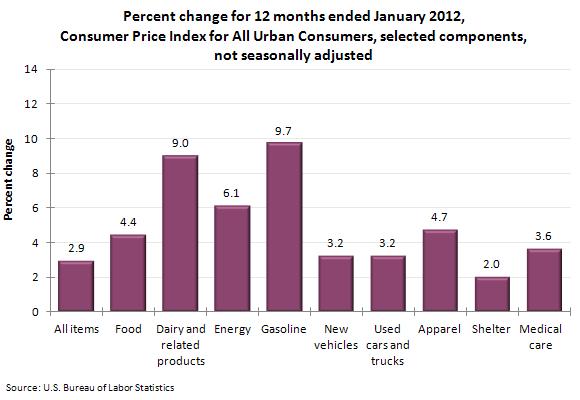
Here is a chart [reproduced below] showing the 12-mo. change in a broad range of CPI components. IMO, FDR would have been quite happy with this performance following 1933. The question is, if the Fed eased to produce 4-5% inflation, as MM’s recommend, what would each of these components look like, and how would that affect l.t. household real wage growth expectations? In turn, what impact would that have on current real household spending?

I inferred from David’s comment and the chart to which he provided a link that he believes that recent inflation has been distorting relative prices, and that he worries that increasing inflation would amplify the relative-price distortions. I thought that it would be useful to track the selected components in this chart more than one year back, so I created another chart showing the average rate of change in the CPI and in the selected components from January 2008 to January 2010 along side the changes from January 2011 to January 2012. There seems to be some inverse correlation between the rate of price increase in a component in the 2008-10 period and the price increase in 2011. Of the 6 components that increased by less than 1% per year in the 2008-10 period, four increased in 2011 by 4.7% or more in 2011, the remaining components increasing by 4.4% or less in 2011. So the rapid increases in some components in 2011 may simply reflect a reversion to a more normal pattern of relative prices.

I agree that inflation is not neutral. There are relative price effects; some prices adjust faster than others, but I don’t think we know enough about the process of price adjustment in the real world to be able to say that overall inflation in conditions of high unemployment amplifies relative distortions. What we do know is that even after a pickup in inflation in 2011, inflation expectations remain low (though somewhat higher than last summer) and real interest rates are negative or nearly negative at up to a 10-year time horizon. Negative real interest rates are an expectational phenomenon, reflecting the extremely pessimistic outlook of investors. Increasing future price-level expectations is one way – I think the best way — to improve the investment outlook for businesses. We are in an expectational trap, not a liquidity trap, and an increase in price-level expectations would generate a cycle of increased investment and output and income and entrepreneurial optimism that will be self-sustaining. Say’s Law in action; supply creates its own demand.

In a more recent comment on the same post, David Pearson worries that insofar as inflation would tend to reduce real wages, it will cause wage earners and households to cut back on consumption, thereby counteracting any stimulus to investment by business from expectations of rising prices. To the extent that expectations of future wage growth fall, workers may also revise downward their reservation wages, so, even if David is right, the effect on employment is not clear. But I doubt that short-term changes in the inflation rate cause significant changes in expectations of future wage and income growth which are dependent on a variety of micro factors peculiar to individual workers and their own particular circumstances. As usual David makes a good argument for his point of view, but I am not persuaded. But then I don’t suppose that I have persuaded him either.

Hawtrey on the Short but Sweet 1933 Recovery

Here’s another little gem (pp. 65-66) from Ralph Hawtrey’s Trade Depression and the Way Out. He discusses the amazing revival of business in the depth of the Great Depression triggered by FDR’s suspension of the gold standard in March 1933 immediately after taking office. Despite the suspension of the gold standard, there was period of uncertainty lasting over a month because it was not clear whether FDR would trigger a devaluation and the Treasury Department was issuing licenses to export gold preventing the dollar from depreciating in the foreign exchange markets. It was not until April 19 that the Secretary of the Treasury declined to issue any more licenses.

A license was a device for sustaining the value of the dollar. It was an instrument of torture designed to inflict further distress on a suffering nation. The pen refused to write the signature. No licenses were to be granted.

At once the dollar fell. The discount soon exceeded 10%. The suspension of the gold standard had become a reality.

The impulse given towards the revival of industry was instantaneous. It was like the magic change of spirit that seized the Allied line at Waterloo late in the afternoon, when there passed through the French ranks the terrible murmur “the Guard is giving way,” and the cohesion of their onset was at last loosened. . . . The eagles (258 grains, nine-tenths fine) were in full retreat.

Manufacturers pressed forward to fulfill a stream of orders such as they had not known for years. Wheat and corn, cotton, silk and wool, non-ferrous metals, rubber, almost every primary product found increased sales at higher prices. The steel industry, which at one time in March had been working at 15% of capacity rose in three months to 59%. The consumption of rubber in June exceeded the highest monthly totals of 1929. The index of manufacturing production, which relapsed from 66 in September 1932 to 57 in March 1933, advanced to 99 in July 1933, the highest since May 1930. The index of factory employment rose from 56.6 in March to 70.1 in July, and that of factory payrolls from 36.9 to 49.9. The Department of Labour Price Index rose from 59.8 in February 1933 to 69.7 on the 22nd July, the Farm Products group rising in the same period from 40.9 to 62.7.

This revival was a close parallel to that which occurred in Great Britain after the suspension of the gold standard in September 1931. On that occasion bank rate was put up to 6%, and renewed deflation and depression followed. In the United States, on the other hand, not only was cheap money continued (the 3% rediscount rate in New York being completely ineffective), but wide and unprecedented powers were conferred on the President with a view to a policy of inflation being carried out. . . .

For a month the depreciation of the dollar had no other source than in the minds of the market. The Administration quite clearly and certainly intended the dollar to fall, and every one dealing in the market was bound to take account of that intention. Towards the end of May the Federal Reserve Banks began to buy securities. By the end of June they had increased their holding of Government securities from $1,837,000,000 to $1,998,000,000, and the dollar was at a discount of more than 20%. The New York rediscount rate was reduced from 3% to 2.5% on the 26th May, and even the lower rate remained completely ineffective.

In July, however, the open market purchases slackened off. And other circumstances contributed to check the progress of depreciation. . . . Above all, on the 20th July, a plan for applying the minimum wages and maximum hours of the National Industrial Recovery Act throughout the whole range of American industry and trade without delay was put forward by the Administration. Profits were threatened.

The discount on the dollar had reached 30% on the 10th July, but, from the 20th July, it met with a rapid and serious reaction. There were fluctuations, but the discount did not again touch 30% till the middle of September. And the recovery of business was likewise interrupted.

There was some tendency to regard the policy of minimum wages and maximum hours as an alternative to monetary depreciation as a remedy for the depression.

It’s instructive to compare Hawtrey’s account of the effects of the devaluation of April 1933 with the treatment by Friedman and Schwartz in their Monetary History of the US (pp. 462-69) which treats the devaluation as a minor event. A subsequent discussion pp. 493-98 fails to draw attention to the remarkable recovery triggered over night by the devaluation of the dollar, and inexplicably singles out a second-order effect – increased production in anticipation of cost increases imposed by the anticipated enactment of the National Industrial Recovery Act – while ignoring the direct effect of enhanced profitability resulting from the depreciation of the dollar.

The revival was initially erratic and uneven. Reopening of the banks was followed by a rapid spurt in personal income and industrial production (see Chart 37). The spurt was intensified by production in anticipation of the codes to be established under the National Industrial Recovery Act (passed June 16, 1933), which were expected to raise wage rates and prices, and did. A relapse in the second half of 1933 was followed by another spurt in early 1934 and then a further relapse. A sustained and reasonably continuous rise in income and production did not get under way until late 1934.

This is an example of how Friedman’s obsession with the quantity theory, meaning that the quantity of money was always the relevant policy variable blinded him from recognizing that devaluation of the dollar in and of itself could raise the price level and provide the stimulus to profits and economic activity necessary to lift the economy from the depths of a depression.  The name Hawtrey appears only once in the Monetary History in a footnote on p. 99 citing Hawtrey’s A Century of Bank Rate in connection with the use of Bank rate by the Bank of England to manage its reserve position.  Cassel is not cited once.  To my knowledge, Friedman did not cite Hawtrey in any of his works on the Great Depression.

Hawtrey on the Interwar Gold Standard

I just got a copy of Ralph Hawtrey’s Trade Depression and the Way Out (1933 edition, an expanded version of the first, 1931, edition published three days before England left the gold standard). Just flipping through the pages, I found the following tidbit on p. 9.

The banking system of the world, as it was functioning in 1929, was regulated by the gold standard. Formerly the gold standard used to mean the use of money made of gold. Gold coin was used as a hand-to-hand medium of payment. Nowadays the gold standard means in most countries the use of money convertible into gold. The central bank is required to exchange paper money into gold and gold into paper money at a fixed rate. The currency of any gold-standard country is convertible into gold, and the gold is convertible into the currency of any other gold-standard country. Thus the currencies of any two gold-standard countries are convertible into one another at no greater cost than is involved in sending gold from one country to the other.

Thus, for Hawtrey, the key formal difference between the interwar and the prewar gold standards was that gold coins were did not circulate as hand-to-hand money in the interwar gold standard (hence the reference to gold exchange standard), gold coins having been withdrawn almost universally from circulation during World War I to enable the belligerent governments to control the monetary reserves they needed to obtain war supplies. A huge fraction of the demonetized gold coins wound up in the possession of the United States government or the Federal Reserve Bank of New York in payment for US exports, though an even greater amount of US exports were financed by loans to the allies. By war’s end, the US had accumulated a staggering 40% of the world’s monetary gold reserves. Many people casually distinguish between the prewar and the interwar gold standards without specifying what exactly accounts for the difference. There is no reason to think that the absence of gold coinage makes any significant difference in how the gold standard operated. David Ricardo, as committed a defender of the gold standard as ever lived, had proposed abolishing gold coinage (to be replaced entirely by convertible banknotes and token coins) in his 1816 Proposals for an Economical and Secure Currency. Thanks to the demonetization of gold coins during World War I, there was a huge increase in the world’s total stock of gold reserves in the hands of the central banks. Exactly how that affected the subsequent operation of the gold standard is never made clear. There may have been increased obstacles placed on the redemption of gold or the exchange of different currencies, but that is just conjecture on my part.

Back to Hawtrey:

Gold is a commodity with other uses than as money. But it would be a mistake to suppose that it therefore provides an independent standard of value. The industrial demand for gold throughout the world is insignificant in comparison with the demand for it as money. It is only a fraction of the annual output, and the annual output is only about 4% of the total stock held by the central banks and currency authorities of the world in their reserves. The market for gold consists of the purchases of the central banks from the mines and from one another. It is by their action that the value of gold in terms of other forms of wealth is determined.

The key point which bears repeating again and again is that under a gold standard, there is no assurance that the value of money will be stable in the absence of action taken by the monetary authorities to maintain its value. If a gold standard were to be restored, I have no idea how the demand for gold would be affected. The value of gold (in the short to intermediate run and perhaps even the long run) depends, more than anything, on the demand for gold. Gold is now a speculative asset; people hold gold now because they for some reason (unfathomable to me) believe that it will appreciate over time. If the value of gold were fixed in nominal terms by way of a gold standard, would people continue to demand gold in anticipation that its price would rise? Perhaps, but I don’t think so. And what do supporters of the gold standard believe that governments and monetary authorities, which now hold about almost 20% of existing gold stocks, ought to be done with those reserves?  Do they think that governments and public agencies ought to continue to hold gold simply to stabilize the value of gold? Is that how the free market is supposed to determine the value of money?


About Me

David Glasner
Washington, DC

I am an economist in the Washington DC area. My research and writing has been mostly on monetary economics and policy and the history of economics. In my book Free Banking and Monetary Reform, I argued for a non-Monetarist non-Keynesian approach to monetary policy, based on a theory of a competitive supply of money. Over the years, I have become increasingly impressed by the similarities between my approach and that of R. G. Hawtrey and hope to bring Hawtrey’s unduly neglected contributions to the attention of a wider audience.

My new book Studies in the History of Monetary Theory: Controversies and Clarifications has been published by Palgrave Macmillan

Follow me on Twitter @david_glasner

Archives

Enter your email address to follow this blog and receive notifications of new posts by email.

Join 665 other subscribers
Follow Uneasy Money on WordPress.com