The Wall Street Journal, building on its solid reputation for providing a platform for moderately to extremely well-known economists to embarrass themselves, featured an op-ed today by Arthur Laffer. Laffer certainly qualifies as a well-known economist, and he takes full advantage of the opportunity provided so generously by the Journal to embarrass himself.
Laffer’s op-ed is primarily a commentary on a table constructed by Laffer, which I reproduce herewith.
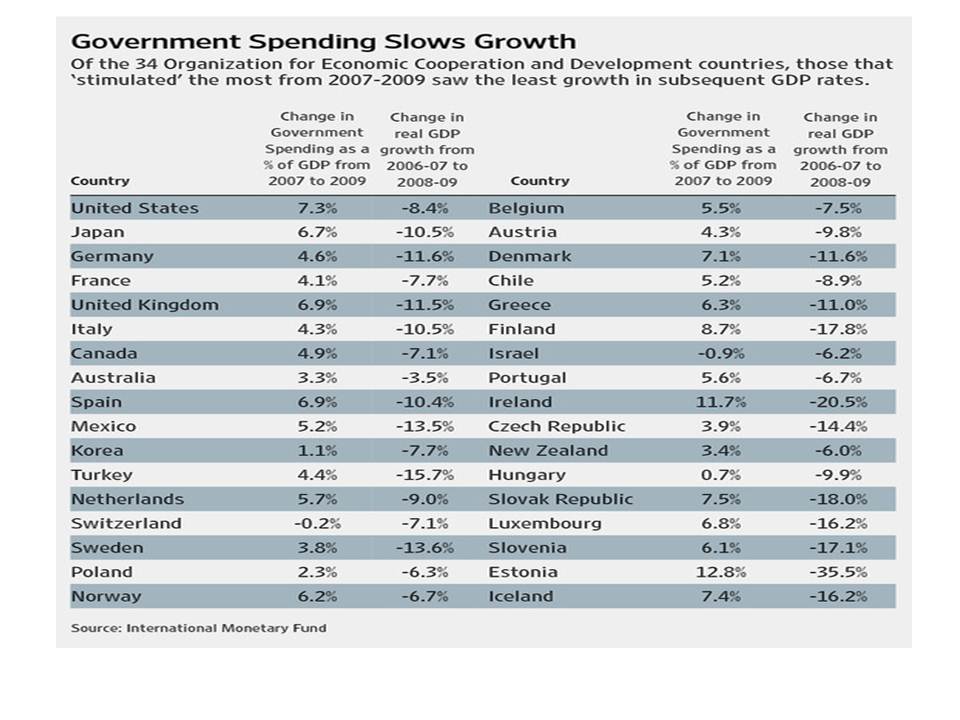
For each of the 34 OECD countries, the table provides two numbers. The first number has the following description: “change in government spending as a percentage of GDP from 2007 to 2009.” This number is treated by Laffer as a proxy for the amount of stimulus spending to counteract the 2008-09 recession. The second number has the following description: “change in real GDP growth from 2006-2007 to 2008-2009.” The second number is treated by Laffer as a proxy of the effectiveness of stimulus spending. Laffer thus regards the correlation between the two numbers as evidence on whether government spending actually helped to achieve a recovery from the 2008-09 recession.
Now, there are multiple problems with this starting with the following: Laffer’s description of the first number is ambiguous to the point of incomprehension. Does Laffer mean to say that he is subtracting the 2007 ratio of government spending to GDP in each country from the same ratio in 2009? Or, does he mean that he is subtracting total government spending in each country in 2007 from total government spending in 2009, and expressing that difference as a percentage of GDP in that country in 2007. Which calculation he is performing makes a big difference. Suppose Estonia — Laffer’s poster child for Keynesian stimulus — kept spending unchanged between 2007 and 2009, but GDP contracted by one-third. If Laffer is calculating his first number by the first method, he comes up with an increase in government spending as a percentage of GDP of 33%, even though government spending did not change. That is just perverse. So how did Laffer perform his calculation? He doesn’t say. All he does is cite the IMF as the source for his table. Thanks a lot, Art; that was really helpful, but unfortunately, not helpful enough to figure out what you are talking about.
But I didn’t just give up; I persisted. I thought to myself: “maybe I can calculate the number both ways for the US using readily available statistics on GDP and government spending and see which method allows me to reproduce his result of a 7.3% increase in US government spending as a percentage of US GDP between 2007 and 2009.” And that’s what I did. Just one problem, though. Adding state, local, and federal spending as a percentage of GDP in 2007, I came up with about 35%. Doing the same calculation for 2009, I came up with about 40%, implying a change of slightly over 5%, well under Laffer’s number of 7.3%. Inasmuch as nominal US GDP in 2009 was greater than nominal US GDP in 2007, the alternative method would have given me a number even smaller than I got using the first method. So I have no idea how Laffer got his 7.3% number for the US, and I seriously doubt that there was any valid way by which he could have arrived at an increase in government spending as a percentage of US GDP between 2007 and 2009 greater than 7%. So why should I even bother checking any of his other numbers?
As if this were not enough, Laffer offers an equally mysterious second number, the difference between the 2006-07 growth rate in each country and the 2008-09 growth rate. But wait, 2008-09 was when there was a recession, not a recovery. So how does Laffer know that his second number is measuring the strength the forces of recovery rather than the strength of the forces of contraction? Answer: He doesn’t. He doesn’t, because he can’t, there being no way to disentangle the two.
Finally – by which I mean, not that I am exhausting the criticisms that could be made of what Laffer has written, but that I am exhausting my own, and perhaps my readers’, patience – suppose that Laffer’s numbers had been accurately calculated, and second that his numbers actually mean something approximating what Laffer purports them to mean. Does the not-very-strong negative correlation that Laffer finds between increases in government spending and increases in the rate of growth of real GDP imply that government spending is useless in stimulating a recovery, as he claims it does? Not at all. As a former member of the University of Chicago faculty, Laffer should be aware of the concept of automatic fiscal stabilizers that none other than Milton Friedman often referred to in his writings on fiscal policy. Because almost all countries have some sort of social safety net, recessions automatically increase government spending through programs like unemployment insurance, food stamps, Medicaid and others that provide services and benefits to people who lose their jobs in recessions. The worse the recession, the greater the automatic increase in government spending. Thus, the negative correlation between government spending and economic growth that Laffer purports to uncover is easily explained by the existence of automatic stabilizers. The worse the recession, the greater the induced increase in government spending.
Moreover, suppose we knew with certainty that government spending stimulates a recovery, and suppose that governments, secure in that knowledge, increased their spending in recessions to achieve a recovery. If you went out and looked at the statistics on GDP and government spending, what would you find? You would find that governments increased spending when the economy was contracting and decreased spending when the economy was expanding. So what empirical correlation would you expect to observe between government spending and growth in real GDP? Exactly the one that Laffer finds and claims proves just the opposite of what we “know” to be true.
Art, heckuva job.
PS If Laffer had the sense to read Nick Rowe’s blog he might not have made such a ridiculous argument.
PPS Lars Christensen and Brad Delong are also exasperated with Laffer.

 Uneasy Money